JyotishaNovember 23, 2025
Vowel Divination for Kings: The Science of Victory
Five vowels — a, i, u, e, o — and the fate of kingdoms. That is the premise of the Narapatijayacaryā, a treatise on svarodaya, the science of vowel divinatio...

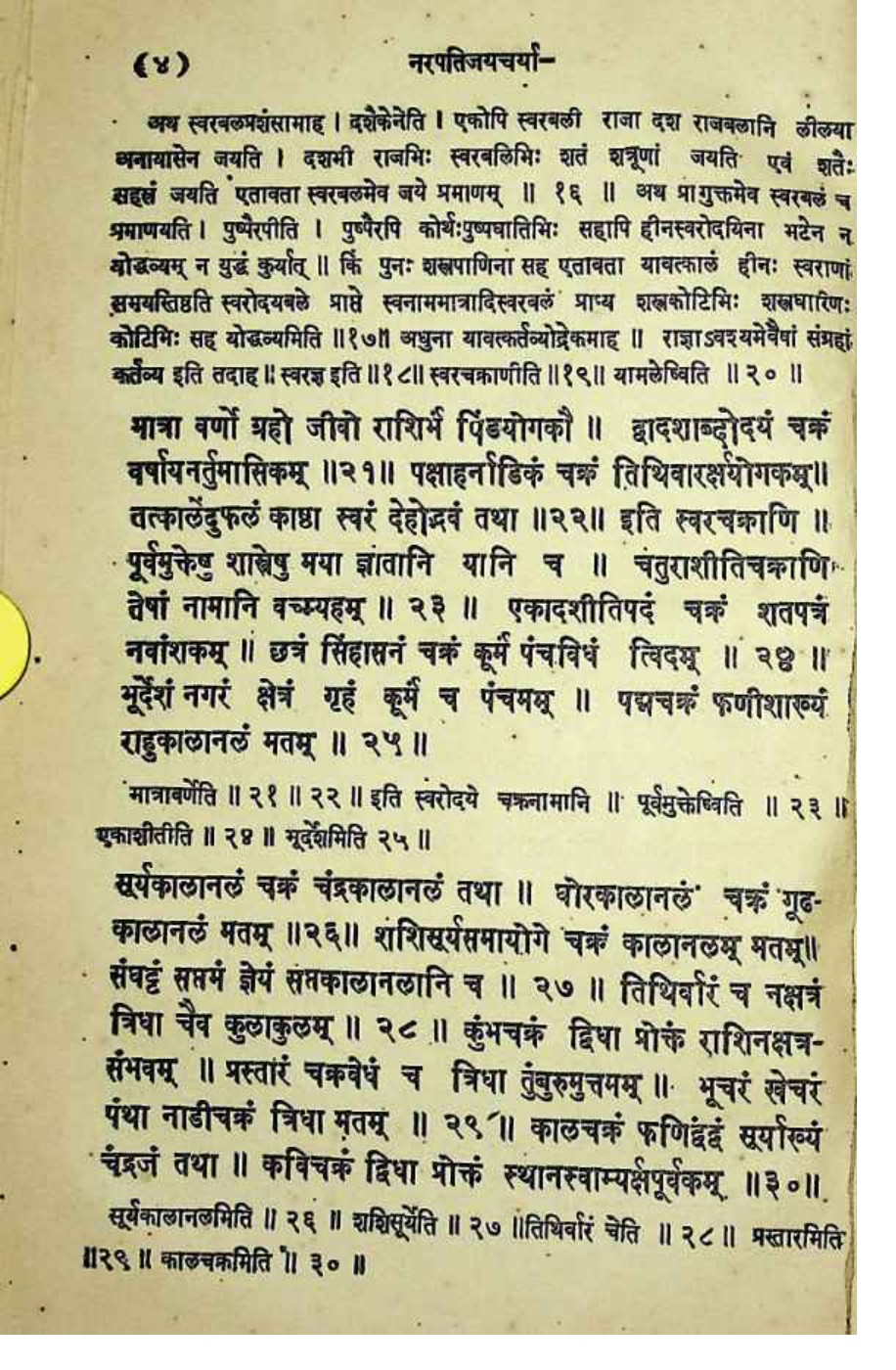
This manuscript presents the *Narpatijayacaryā* (also known as *Svarodaya*), a seminal Sanskrit treatise on divinatory astrology (*jyotiṣa*) composed by the poet Narpati, accompanied by the commentary *Jayalakṣmī* authored by Harivaṃśa Kavi. The prefatory material establishes the text's significance within the tradition of prognosticatory sciences, citing the canonical dictum that assigns the *Svarodaya* as the authoritative work for the Kali Yuga. The detailed table of contents reveals an encyclopedic scope, encompassing numerous *cakra* (cyclical diagrams) for divination—including *svara-cakra* (phonemic wheels), *graha-cakra* (planetary wheels), *nāḍī-cakra* (pulse/nadi wheels), and specialized configurations such as *kūrmacakra*, *siṃhāsanacakra*, and *rāhukālānalacakra*—alongside sections on *śakuna* (omens), *mantra-yantra-auṣadha* (incantations, devices, and medicaments), and practical queries regarding lost objects, stolen property, and medical diagnosis. This 1956 Bombay edition, published by the Śrīveṅkaṭeśvara Steam Press under Khemarāja Śrīkṛṣṇadāsa, represents a critical modern recension based on collation of multiple manuscripts, preserving a comprehensive system of applied astrology that integrates phonemic theory, temporal cycles, and spatial orientation for predictive purposes.