
Five vowels — a, i, u, e, o — and the fate of kingdoms. That is the premise of the Narapatijayacaryā, a treatise on svarodaya, the science of vowel divination, written by the poet Narapati and commented upon by Harivaṃśa Kavi. It is an astrology of the breath: which syllable is rising at the moment of a question, a birth, or a battle decides what happens next.
The vowel-knower every king needed
The text's claim about the svarodayī — the one who knows the science of vowels — is bold, and it frames everything that follows.
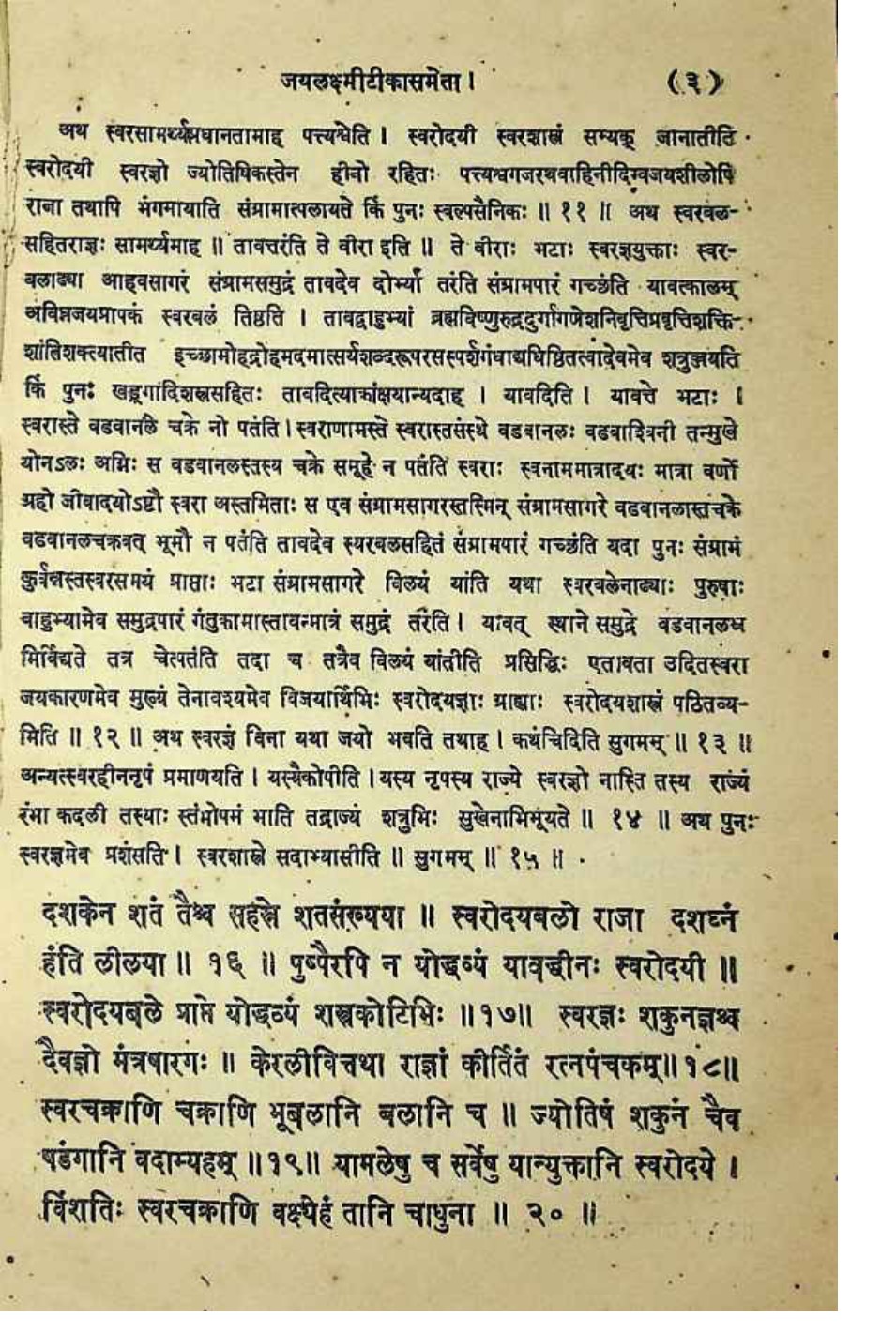
One who knows the science of vowels thoroughly is called svarodayī. A king devoid of such a vowel-knower, an astrologer, even if he has the habit of conquering the directions with infantry, cavalry, elephants, chariots and vehicles, still flees from battle — what then of one with a small army?
Knowledge of the vowels, the text insists, is not decoration — it is a military asset on the level of elephants and chariots, and a king who lacks it is at a disadvantage before the fighting even starts.
Breath as the measure of victory
The power of breath is quantified with the enthusiasm of a field manual.
Even one king powerful in breath conquers ten royal forces playfully, without effort. By ten kings powerful in breath, one hundred enemies are conquered; thus by hundreds, thousands are conquered. To this extent, power of breath alone is the measure in victory.
And the application is precise: the practitioner calculates the vowels of his own name, the enemy's name, and the moment, then compares them — a 'dead' vowel for the enemy and a 'young' vowel for oneself means the time is right to fight.
Every act has its syllable
The system extends beyond war into the whole calendar of action. The text assigns each kind of undertaking its own syllable, so that the practitioner knows when to do what.
Introduction Here, then, let the learned understand: Those who are adorned with the jewel-necklaces of the essence of the ocean of Vedic scriptures and Vedangas, which have been churned from the depths—those accomplished in all worldly and otherworldly means proclaimed by the Vedas and Agamas, whose sacrificial and other performances, without an auspicious beginning, do not fulfill their desires—perceiving this, the ancient great sages and astronomers composed many treatises in astrology adorned with excellent subjects. Among these, there are numerous divisions of subject matter. However, in this regard, there is a great saying: "In the Krita age, the Jayarnava; in the Treta, the Brahmayamala; in the Dvapara, the Vijaya is renowned; and in the Kali age, the Svarodaya." Since in the Kali age the Svarodaya gives abundant results, and since even among existing other treatises, due to being excessively complicated by various difficult methods, the principles are not easily grasped, this treatise named "Narapatijayacarya" was composed by the supremely compassionate poet adorned with the title 'Narapati,' desiring the welfare of others. It has subjects consisting of descriptions of various questions, battlefields, and so forth. Desiring to benefit others, the poet named 'Harivamsa' has adorned it with his own commentary named 'Jayalaksmi.' Though long desired to be printed, it has now been edited by scholars possessing three or four manuscripts and is splendidly published at my own "Sri Venkatesvara" press with clean, well-nourished paper and beautiful letters, eager to grant all desires.
Among these, there are numerous divisions of subject matter. However, in this regard, there is a great saying: "In the Krita age, the Jayarnava; in the Treta, the Brahmayamala; in the Dvapara, the Vijaya is renowned; and in the Kali age, the Svarodaya." Since in the Kali age the Svarodaya gives abundant results, and since even among existing other treatises, due to being excessively complicated by various difficult methods, the principles are not easily grasped, this treatise named "Narapatijayacarya" was composed by the supremely compassionate poet adorned with the title 'Narapati,' desiring the welfare of others. It has subjects consisting of descriptions of various questions, battlefields, and so forth. Desiring to benefit others, the poet named 'Harivamsa' has adorned it with his own commentary named 'Jayalaksmi.' Though long desired to be printed, it has now been edited by scholars possessing three or four manuscripts and is splendidly published at my own "Sri Venkatesvara" press with clean, well-nourished paper and beautiful letters, eager to grant all desires. Desiring the grace of the learned, Khemaraja Srikrishnadasa, President of the "Sri Venkatesvara" Steam Press, Bombay.
One should engage in dispute, battle, or killing when the fierce syllable rises. Bathing, drinking, and all such activities, as well as garments, ornaments, and decorations — the commencement of learning and marriage should be performed when the vital syllable rises. Royal consecration and initiation should be performed when the syllable of the sign rises.
What makes the Narapatijayacaryā remarkable is how systematic it is: twenty vowel-wheels, letter wheels, life-vowels, sign-vowels, and a whole vocabulary of child, youth, young adult, old, and dead vowels. It is a complete technology of timing, built on the smallest sounds of speech.