Sanskrit
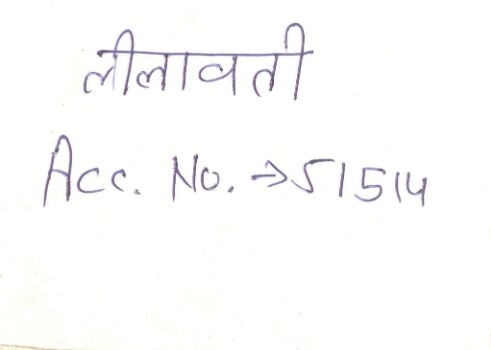
Līlāvatī4
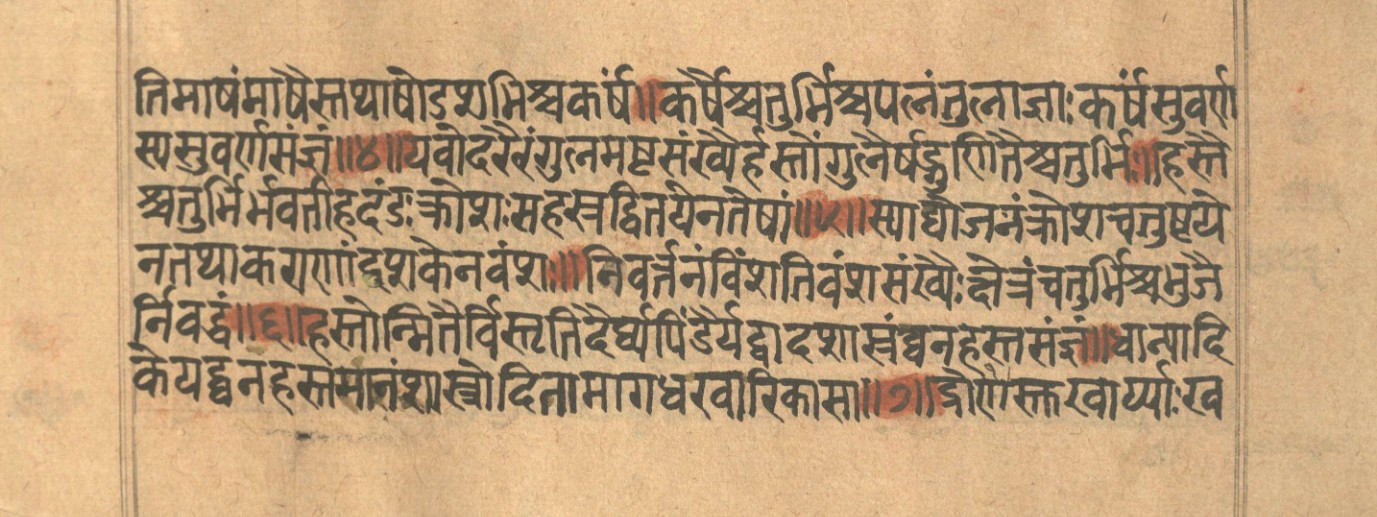
This Sanskrit manuscript preserves a portion of Bhāskara II's *Līlāvatī* (c. 1150 CE), the most celebrated mathematical treatise of medieval India, renowned for its elegant versification of arithmetic and algebraic problems. The folio exhibits characteristic features of Indian mathematical manuscripts, including metrical sūtras governing operations such as saṅkalita (addition), vyavakalita (subtraction), and guṇana (multiplication), alongside concrete word problems (*uddeśakas*) involving merchants, deer, and the eponymous Līlāvatī herself. Notable codicological elements include marginal annotations employing *bhūta-saṅkhyā* (poetic word-numerals) such as 'Rāma' for three, interlinear glosses clarifying technical terms like *aṅghri*, and scribal corrections—such as the insertion of the missing place-value *nikharva*—demonstrating active scholarly engagement with the text. The specimen reveals the sophisticated pedagogical apparatus of Sanskrit mathematical literature, where procedural rules, worked examples, and verification methods intertwine within strictly regulated āryā and śloka meters.