
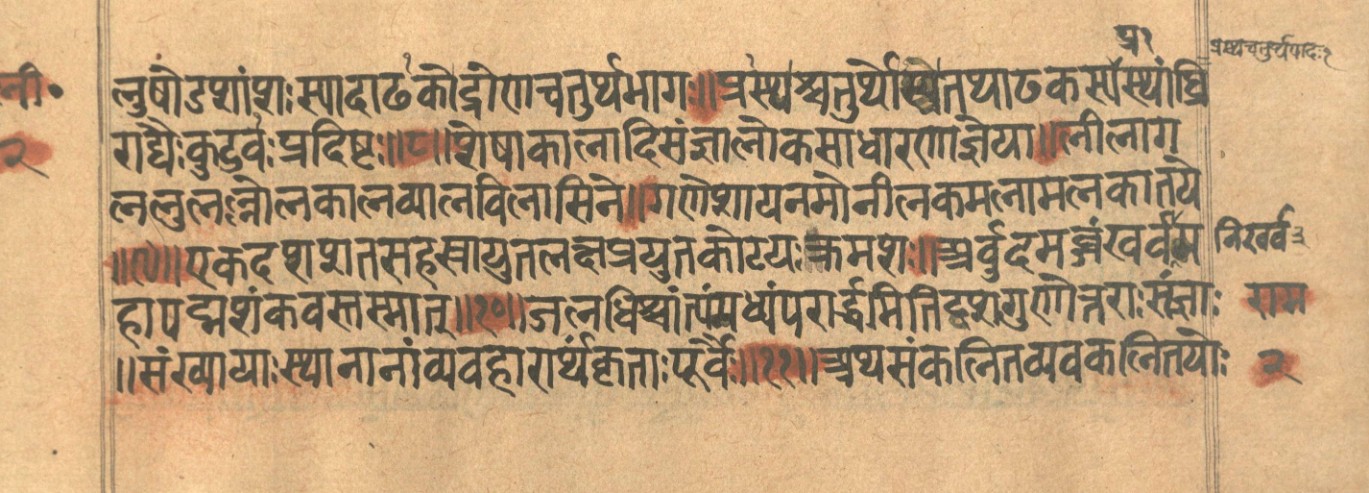
Arithmetic has to touch the ground somewhere. The Līlāvatī grounds it in measures — weights for the market, lengths for the map, and volumes for the grain — and this copy of Bhāskara's treatise works out the whole system, from a māṣa of gold to a yojana of road, before turning that same precision loose on fractions, algebra, and a run of word-problems built to be memorable rather than merely correct.
Weights and lengths
After its opening invocation to Gaṇeśa — praising the text itself as 'clear, concise, soft in syllables, pure in words, and playful with elegance' — the Līlāvatī begins with the units of weight and distance, each defined in terms of the last.
A timaṣa is sixteen māṣas, and a karṣa. Four karṣas make a pala, knowers of the balance; the gold-karṣa is known as suvarṇa. Eight barley-corns make an aṅgula, four hastas made up of six aṅgulas each, and four such hastas make a daṇḍa here; a krośa is two thousand of those. A yojana is four krośas, and a vaṃśa is ten karaṇas; a nivartana is a field bounded by twenty vaṃśas, with four sides.
The system runs from grain to distance without a break: barley-corns to aṅgulas, aṅgulas to hastas, hastas to daṇḍas, daṇḍas to krośas, krośas to yojanas — one continuous ladder from the seed to the horizon. Then come the measures of capacity that mattered at the granary — the droṇa divided down through āḍhaka, prastha, and kuḍava — and finally the place-value names for large numbers, climbing from ayuta and lakṣa up through mahāpadma and śaṅkha to parārdha, 'named tenfold' at each step.
The eightfold operations
With units settled, the text moves into what it calls the parikarmāṣṭaka — the eight basic operations: addition, subtraction, multiplication, division, squaring, square roots, cubing, and cube roots. Each rule is given first in verse, then worked through a numbered example, in a rhythm the manuscript repeats for every operation in turn.
The multiplicand's quality is purified by that by which it is obtained; or the multiplicand multiplied by the multiplier yields the result... 'O girl with playful eyes like a young deer, tell me: how many digits result when five times three plus one, etc., multiplied by the sun's rays?'
That address — 'O girl with playful eyes like a young deer' — is the Līlāvatī's signature move: the treatise is traditionally framed as arithmetic taught to a young woman, and nearly every worked problem is posed to her directly, wrapped in a scrap of imagery (a deer, a garland, a flock of swans) that has nothing to do with the mathematics and everything to do with making the number stick.
Fractions, zero, and the algebra of the unknown
A long middle section works through fractions with the same eightfold structure — addition, multiplication, division, squaring — before arriving at a short but pointed passage on zero.
In addition, zero is equal to the additive; in square, etc., zero; a quantity divided by zero; zero-divisor should be... When the multiplier becomes zero, and if the divisor is zero again, then the quantity is to be known as unchanged.
The text then turns to inverse operations — solving backward from a result to an unknown starting quantity — under the heading viloma-vidhi, and from there into the rule of three, five, seven, and nine (trairāśika, pañcarāśika, saptarāśika, navarāśika), the proportional reasoning that Indian arithmetic used for everything from currency exchange to interest calculations. Each expansion adds more terms to the proportion, and each is illustrated, true to form, with a merchant pricing cloth or a trader converting niṣkas to varāṭakas.
Swans, arrows, and bees: arithmetic as riddle
The word-problems are where the manuscript is most alive, and where the shorter draft of this article said the least. A flock of swans, half of them as lotus roots on the bank, the rest quarreling in the water — how many in the flock? Arjuna, angry at Karṇa in battle, spends half his arrows repelling an opposing volley, four on the horses, six on the charioteer, three each on umbrella, banner and bow, and one final arrow to cut off the enemy's head — how many arrows did he fix in total?
Pārtha, angry in battle, fixed a number of arrows against Karṇa. Repelling that group of arrows with half of them, and with four roots [the horses], with six arrows the charioteer, with three the umbrella, banner, and bow, and cutting off his head with one arrow—how many did Arjuna fix?
The answer, worked out through the rule of the assumed quantity, comes to exactly one hundred. A companion problem asks after a swarm of black bees settled on a lotus at night, one-fifth here, one-third there, a final pair caught buzzing in the middle — each riddle a fully specified equation dressed as a scene from courtly or epic life, precise enough to solve and vivid enough to remember, which was rather the point.
Arithmetic with a world attached
What makes the Līlāvatī enduring is that its mathematics is never pure — every rule is tied to a measure, every measure to a use, every operation eventually dressed in an image sharp enough to outlast the number itself. This copy, one of several in the collection, is a reminder that Bhāskara taught arithmetic as the science of the real and the memorable at once: gold weighed, fields bounded, grain measured, roads paced, and somewhere in the middle of it all, a girl with a deer's eyes being asked to count arrows, swans, and bees.