Kūṭamudgara
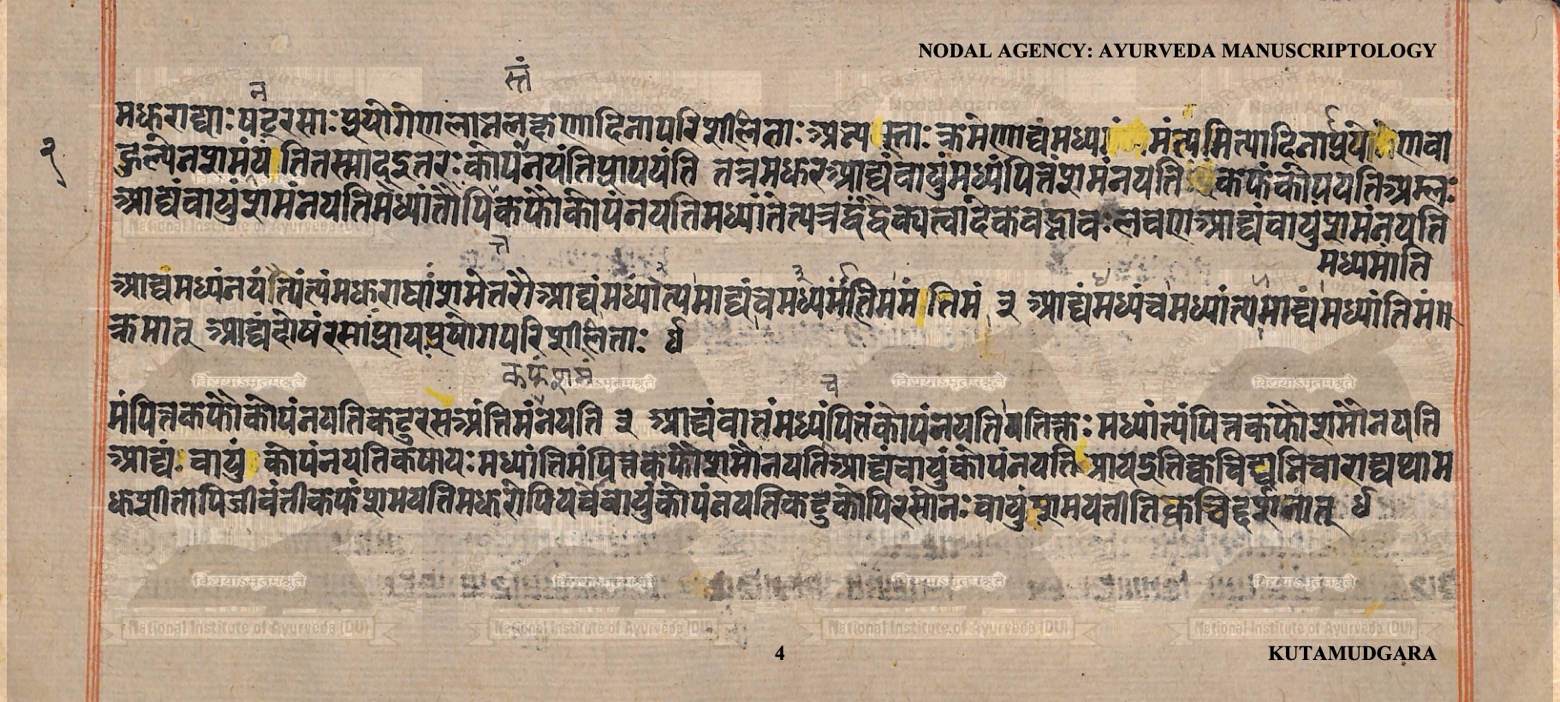
This Sanskrit manuscript presents a foundational Ayurvedic treatise on the six tastes (ṣaḍrasa) and their therapeutic effects on the three doṣas—vāta, pitta, and kapha. The text systematically analyzes how sweet (madhura), sour (amla), and salty (lavaṇa) tastes increase kapha while pacifying vāta, whereas pungent (kaṭu), bitter (tikta), and astringent (kaṣāya) tastes produce the opposite effects, with particular attention to sequential combinations (trika) and their applications in disease management. Notable features include detailed discussions of temporal (ahorātra) and physiological (deha) distributions of doṣic disturbances, marginal annotations indicating scholastic commentary traditions, and the presence of modern institutional watermarking from the National Institute of Ayurveda, indicating its preservation within a contemporary manuscriptological framework. The fragmentary nature of the text, with visible ink bleed-through and yellow highlighting, suggests active scholarly engagement with this important contribution to classical Indian medical theory.