
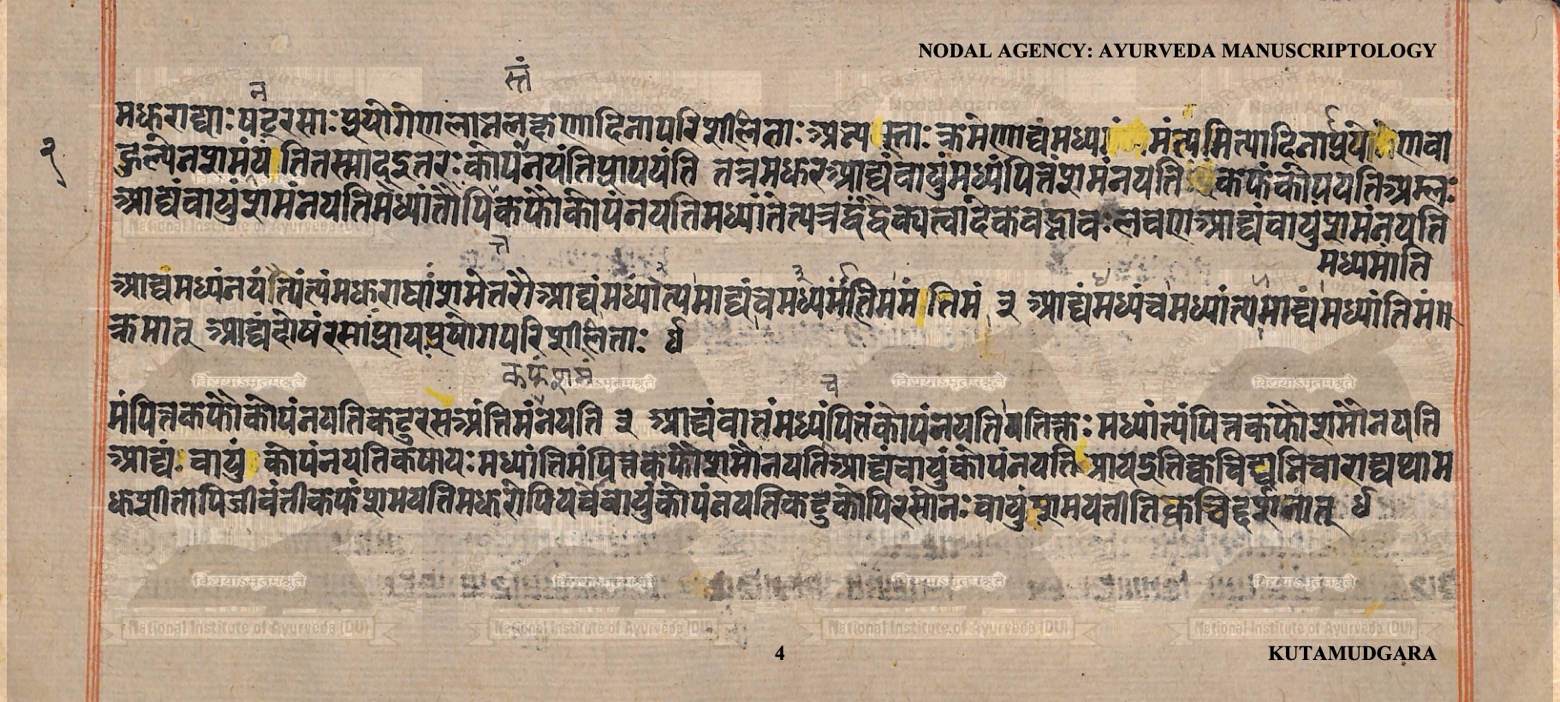
The Kūṭamudgara—literally the 'wooden hammer' that strikes at delusion—is a verse treatise on the six tastes (ṣaḍrasa) and their ceaseless negotiation with the three doṣas. Two copies survive in the National Institute of Ayurveda's collection, both opening with the same compact doctrine: sweet, sour, and salty tastes increase kapha while pacifying vāta; pungent, bitter, and astringent do the reverse. For pitta, sweet, bitter, and astringent bring pacification. This is the grammar of taste, and it governs every meal.
Taste in Stages of Digestion
The most distinctive passages analyze taste across the temporal stages of food digestion. Sweet pacifies vāta first and pitta in the middle but aggravates kapha; sour pacifies vāta first but aggravates pitta and kapha in the middle and last; pungent aggravates vāta first and pitta in the middle. The text is careful to note exceptions—substances like jīvantī, barley, and garlic behave differently from what their taste would predict. This is diagnosis through taste, recognition that no food is simple in its effects and that time changes everything.
There, sweet taste pacifies vata first, pitta in the middle, and aggravates kapha.
The Body as Map of Doṣa
The manuscript maps the three doṣas onto the body itself. Kapha occupies the upper body from head to navel, pitta the middle, and vāyu the lower; kapha rules the morning, pitta midday, vāyu the afternoon; kapha dominates childhood, pitta youth, and vāyu old age. The junctions—the chest between upper and middle body, the pakvāśaya between middle and lower, dawn between night and day—are where the doṣas gather, and where disease tends to arise. These are the hinges of the body, the places where one principle gives way to another.
The Metabolism of Taste
The text explains how each rasa moves through the body. Sweet initiates by pacifying vāta, but as digestion proceeds and the sweet taste moves deeper, it shifts toward kapha aggravation. Sour similarly pacifies vāta initially but reveals its heating nature later in the process, aggravating pitta. This dynamic quality—the idea that a taste has a trajectory through the body, beginning one way and ending another—is central to Ayurvedic diagnosis. The timing of a meal matters; the sequence of tastes matters; the individual's current digestive state matters. Food is not a static substance ingested into a static body but a dynamic event unfolding in time.
Sweet, sour, and salty tastes increase kapha while pacifying vāta; pungent, bitter, and astringent tastes do the reverse.
Philosophy Disguised as Medicine
The text pairs its medical content with invocations to Śrī Rāma and closes with a philosophical reflection: hearing alone, like the hollow sound of a wooden mace, can delude the intellect. In the Kūṭamudgara, therapeutics and epistemology are two faces of the same discipline. Both teach the reader to distinguish what pacifies from what provokes, to see beneath the obvious to the underlying mechanism. A sweet taste seems harmless, comforting even, yet in excess or at the wrong time in digestion, it produces disease. Truth requires seeing past appearance. The "hammer" (kūṭa) strikes (mudgara) not at the body but at illusion—the illusion that food is simple, that taste is what it seems, that a physician can heal without understanding the deep grammar of transformation that the six tastes embody.