MathematicsJune 20, 2026
Avyakta: The Unmanifest Seed of Indian Algebra
An ancient Sanskrit algebra treatise grounds the unknown in Sāṃkhya philosophy, treating invisible quantities as seeds from which all calculation grows.

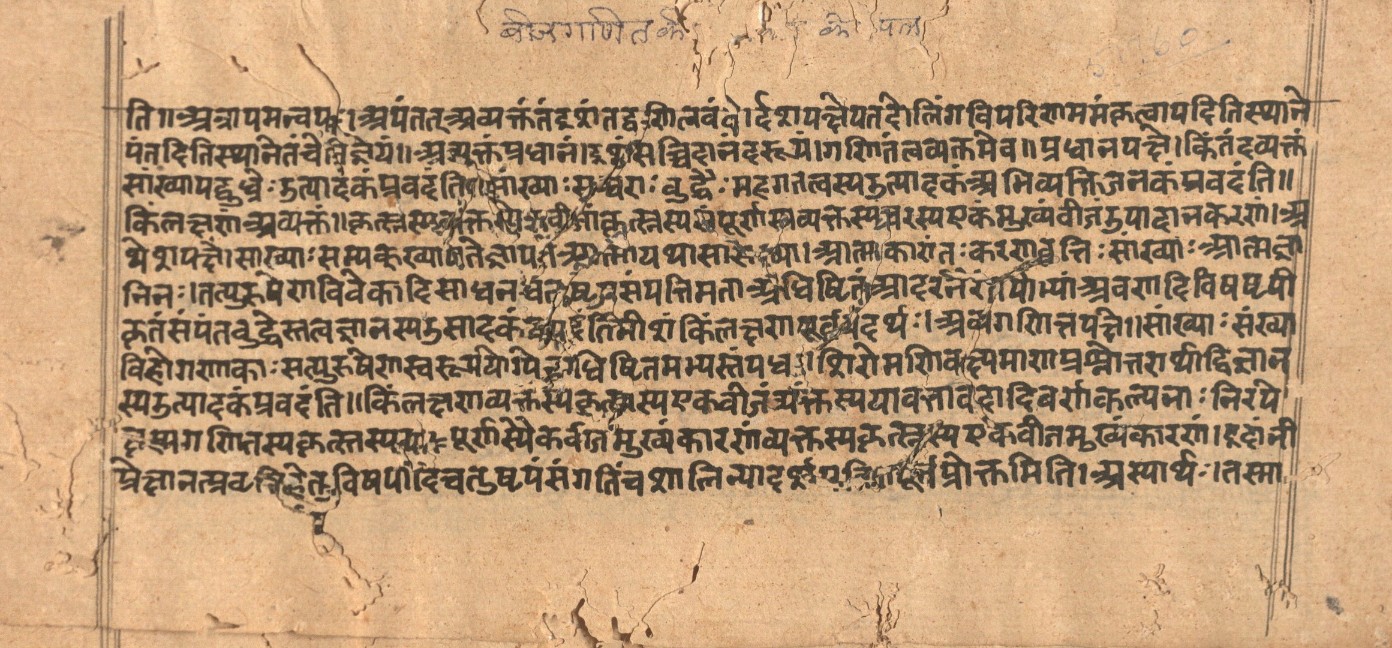
This Sanskrit manuscript presents a sophisticated treatise on *bījagaṇita* (algebra), specifically addressing the foundational concept of *avyakta* (the unknown/invisible) as the generative principle of mathematical knowledge. The text uniquely synthesizes Sāṃkhya philosophical terminology—where *avyakta* denotes primordial matter—with algebraic methodology, establishing the unknown quantity as the "single seed" (*eka-bīja*) from which all manifest mathematical operations proceed. The excerpt demonstrates the systematic exposition of algebraic operations including addition and subtraction of positive (*dhana*) and negative (*ṛṇa*) quantities, multiplication, division, squaring, and root extraction, with worked examples (*udāharaṇa*) illustrating the rules for sign manipulation. The manuscript's interlinear and marginal notations, including a later Hindi identification of the text as belonging to the *Bījagaṇita*, attest to its sustained scholarly engagement across centuries.