
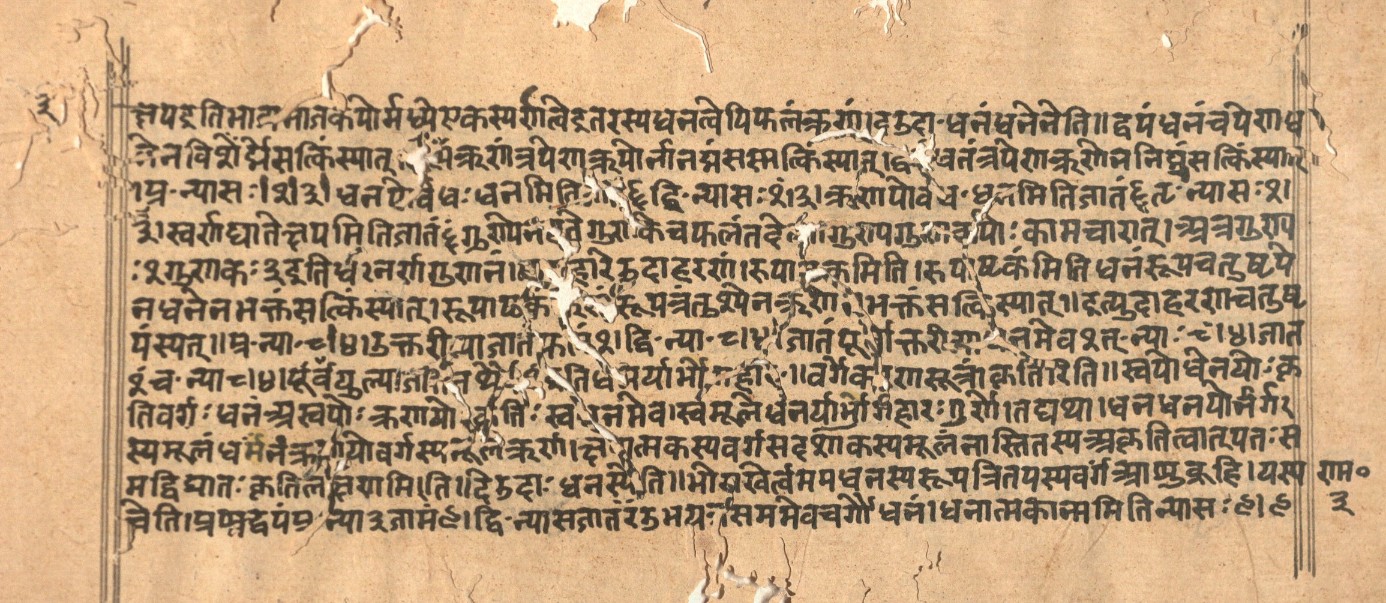
Every algebra student meets the unknown — the x to be solved for. A Sanskrit commentary on the Bījagaṇita gives that unknown a philosophical pedigree: it calls it avyakta, the unmanifest, and treats it as the seed of all calculation.
The unknown as primordial matter
The commentary reads the opening verse through Sāṃkhya metaphysics, where the unmanifest, prakṛti, is the source of everything that appears.
The unmanifest is the Pradhāna (primordial matter). The power of consciousness and bliss belonging to the Puruṣa—that is the unmanifest itself. What is that unmanifest which the Sāṃkhyas declare to be the producer of intellect?
The equation is striking: as the world is to prakṛti, so every answer is to the unknown — the seed from which arithmetic grows.
Therefore from what [cause], from that [cause] from the unmanifest... from which unmanifest seed. Unmanifest seed calculation whose root-seed that.
Wealth, debt, and the rules of the sign
From philosophy the commentary descends to the sign rules, demonstrated with worked placements — set down 3 and 4, add, subtract, and watch the sums come out. The tradition calls positive numbers dhana (wealth) and negative numbers ṛṇa (debt), so that the rules themselves tell a story: when wealth multiplies wealth, the result is wealth; when debt multiplies debt, the result is wealth; but when wealth multiplies debt, the result is debt.
Between a positive and a negative, if one is positive and the other negative, the product is negative. Example: Wealth by wealth. What is the product of two positive quantities multiplied by three positive quantities? 2 times 3 equals 6.
The proof is by example — nyāsa, "setting down," the ancient equivalent of showing your work.
The algebra of zero
Zero receives its own careful treatment: adding zero changes nothing, and subtracting zero from zero leaves wealth and debt as they were.
In zero-addition: one's own addition with zero, or zero's addition with zero, or subtraction of zero from zero—wealth and debt remain as they are.
Naming the unknown in colors
When one unknown is not enough, the tradition drafts colors into service: yāvattāvat (the as-much-as), kālaka (the black), nīlaka (the blue), pītaka (the yellow). Each color stands for an unknown quantity, and operations among them follow rules. This is symbolic algebra without symbols — the mind doing what algebra notation would later do on paper.
"Yāvattāvat"—time, black, another color, yellow, red... by the best teachers, for the enumeration of unknown quantities, unmanifested, unknown numbers, for knowing, for proving the enumeration of those unknown quantities.
Multiplication and the production of new forms
As unknowns multiply with other unknowns, the algebra produces new forms: squaring (varga), cubing (ghana), and beyond. These are not mere notational conveniences but genuine products, like seeds that grow into whole numbers.
The product of two homogeneous [quantities] is called 'square' in multiplication; so too its name. In triple product, it is 'cube'; of four, 'square-square'. In product of five, the product of square and cube. In product of six, 'square-cube' or 'cube-square'. In product of eight, 'square-square-square'. In product of nine, 'cube-cube'.
Long before Descartes, Indian algebra had variables, sign rules, and a symbol for the unknown — and grounded them in a philosophy that made calculation a mirror of creation.