
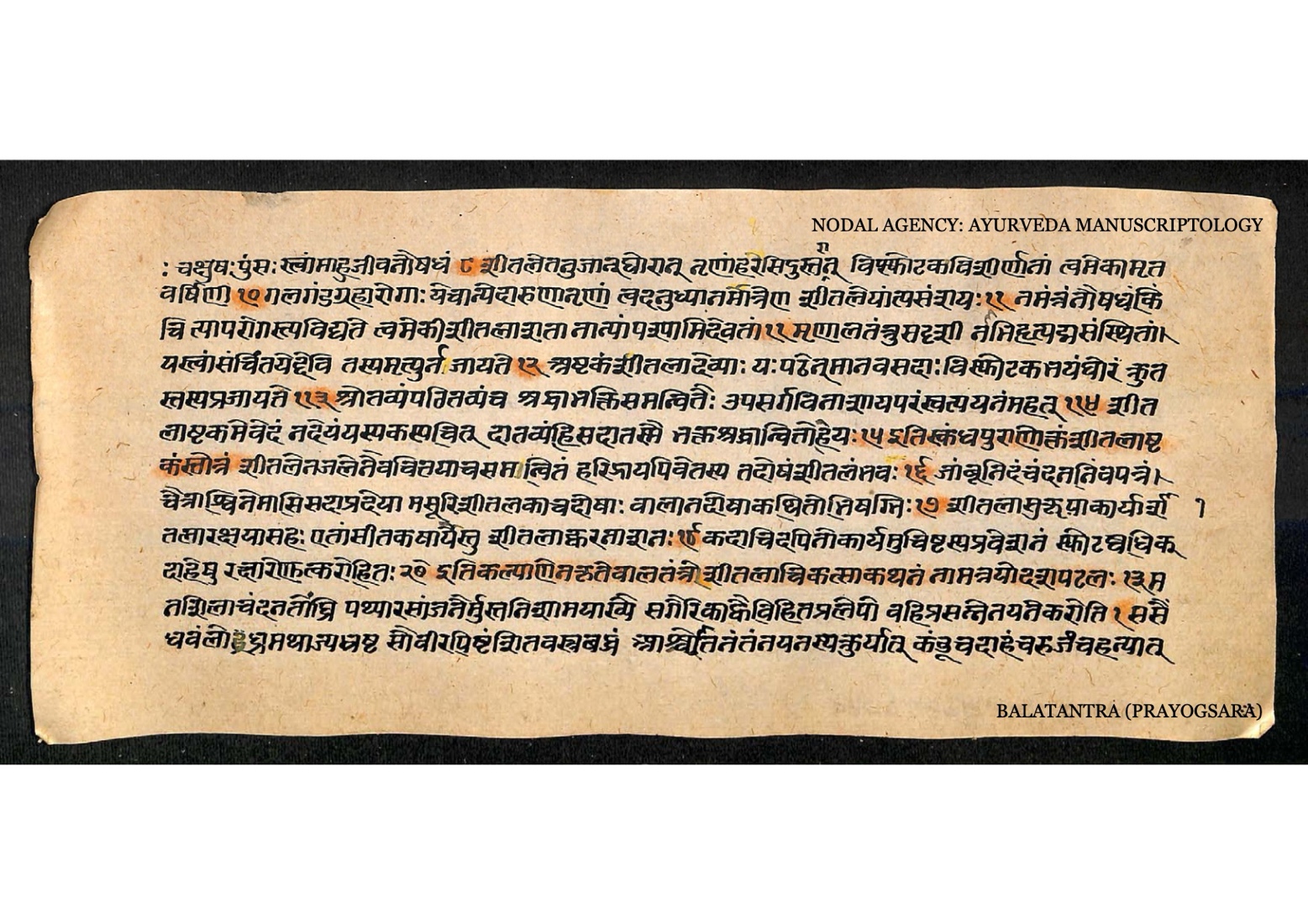
The thirteenth chapter of Kalyāṇa's Bālatantra — the pediatric wing of his compendium Prayogasāra, the 'essence of therapeutic applications' — turns from herbs to a goddess. Entitled 'The Account of Śītalā's Treatment,' it pairs the Śītalā Aṣṭakam, a hymn in praise of the deity who cools eruptive fevers, with a set of distinctly practical cooling remedies. But the chapter is only the visible surface of a far larger work: this complete manuscript, written in Devanagari on aged paper, is a systematic compendium of child-rearing medicine in which pharmacy, ritual, and maternal care are braided together.
The Cool One and her promise
Śītalā, 'the Cool One,' is invoked as the one who alleviates severe fevers, quenches insatiable thirst, and heals eruptions and sores. The hymn promises that whoever recites the eight verses with faith remains free from the fear of terrible eruptions, and that merely meditating on her overcomes all fevers.
The eyes of men call you the elixir of life. You alleviate severe fevers with coolness and quench insatiable thirst. You alone are the nectar for those afflicted with eruptions and sores. You are the bestower of rain, the destroyer of dreadful throat diseases, goiters, and other fierce ailments of the body. Merely by meditating on you, one undoubtedly overcomes all fevers.
The hymn is followed by the same practical turn the whole chapter takes: offerings of jambu, neem, and kadamba leaves with lentils are prescribed for the months of Chaitra and Āśvina, and the text warns against entering places with remnants of food during eruptions. The devotional and the dietary sit on the same page.
The hidden world of the balagrahas
The compendium's other great theme is the balagrahas — the child-seizing spirits that, in the tradition's nosology, were the cause of much infant distress. The Bālatantra catalogs them by month and year, from the demon Krasha who seizes the newborn in the first month to the spirits of the seventh to eleventh years, each with its own symptom profile and its own ritual remedy.
First Month: The infant seized by the demon Krasha exhibits high fever, restlessness in limbs, exhaustion, loss of appetite, emaciation, vomiting, fainting, and tremors. The eyes become sunken, and the voice weak. I shall now describe the remedy by which Putana is expelled. One should perform the rite of reviving the child with a ritual bath. First, prepare a paste of white mustard, white sandalwood, fragrant substances, and white flowers. Then, arrange five lamps, a swastika symbol, and five offerings facing the eastern direction.
The remedies are a careful blend: protective pastes of white mustard and sandalwood, fumigations of neem and mustard seeds, offerings of rice, fish, meat, and wine at crossroads, amulets written on birch bark and tied to the arm. Whatever one makes of the demonology, the pattern is medical — a symptom list followed by a treatment protocol — and the tradition clearly treated these spirits as one more diagnosable cause of childhood illness.
Secrets for the birthing chamber
The manuscript also preserves what it calls 'the highly secret methods to be employed for the ease of women' — the midwife's craft, passed in closed pages.
At the time of delivery, a cow's horn transformed into a vessel should be placed atop the birthing chamber and struck. A leaf from the karanja tree, ground with goat's milk, should be mixed with oil and applied to the vagina to facilitate an easy delivery. Then, the mantra: 'On the northern slope of Himavat, there is a yakshini named Shambari. By the sound of her anklet, may the pregnant woman be freed from pain. Svaha!'
Here again the two registers are inseparable: mechanical aids and herbal applications sit beside an incantation to the yakṣiṇī Śambarī, and all of it is introduced as secret knowledge for the birthing room.
The wet nurse and the quality of milk
Beyond emergencies, the compendium devotes serious attention to the ordinary work of infant feeding — above all, the examination of the wet nurse, whose milk the text treats as a vector of health or disease.
A person proficient in the knowledge of lactation should examine a wet nurse who is of medium build, dark-complexioned, particularly robust, of good lineage, with well-formed and firm breasts, pure-minded, obedient, free from bodily defects, with a strong waist, affectionate, free from planetary afflictions, and whose milk is of good quality. Only pure milk leads to health, while impure milk causes disease.
The same chapter explains how contaminated milk passes harm along: when a wet nurse is fed improper foods, her doṣas are aggravated, and the child who drinks that milk falls ill — vāta-vitiated milk brings hoarseness, dry body, and retention of stool and urine; pitta-vitiated milk brings jaundice and loose stools. The disease model is a chain running from the elder's feeding choices through the nurse's body into the infant, and the text's answer is careful selection, purification, and diet.
One medical world
The Bālatantra is a window into how classical Ayurveda held empirical and devotional therapeutics together. The same manuscript that measures pediatric doses in guñjā and māṣaka and catalogs spirits by the month here invokes a goddess for diseases — like smallpox — that outran the physician's pharmacopeia. Both responses, the herbal and the ritual, belong to a single medical world, and the Bālatantra makes no effort to separate them: the goddess of cooling fevers sits at the center of a text devoted to the health of children, and the hymn and the decoction are simply two instruments of the same art.