
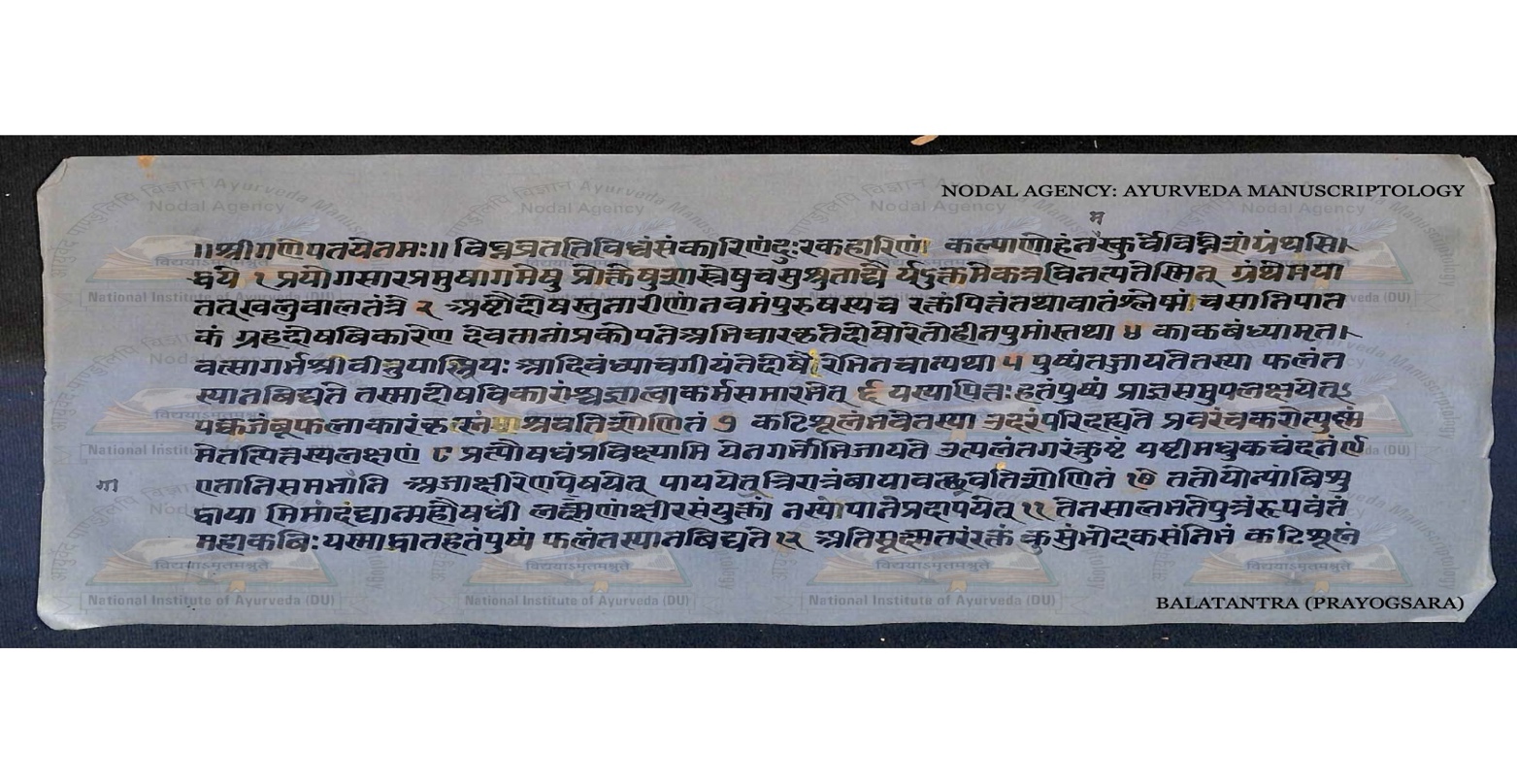
Among the Ayurvedic compendia that survive in manuscript, few are as complete and practical as the Prayogasāra, a treatise on applied therapeutics whose pediatric focus earned it the subtitle Bālatantra. Compiled by the physician Kalyāṇa, the text runs to thirty-two folios covering the full arc of family medicine — from fertility and pregnancy to the diseases of newborns and children.
The opening verses set the tone. After saluting Gaṇeśa, Kalyāṇa explains that he has drawn together what is scattered across treatises like the Suśruta and distilled it into a single manual of practices. The text is organized not by theory but by use: what to prescribe, when to prescribe it, and for whom.
Diseases Unique to Children
After closing its chapters on conception, pregnancy, and protective ritual, the manuscript turns explicitly to childhood disease — and is careful to distinguish the ordinary from the pediatric-only.
All diseases such as squinting, vomiting, colic, fever, and others that affect adults also occur in children due to similar dosha imbalances. However, certain diseases are unique to children and do not affect adults, such as talukantaka (uvular swelling)... First, talukantaka: when kapha is aggravated, it affects the uvula and flesh, causing swelling in the uvular region. This leads to a depression in the palate and an aversion to breastfeeding, difficulty in drinking, and loose stools.
The same page names kukunaka, an infantile eye condition caused by defects in the breast milk itself — intense itching, constant discharge, and a swelling that makes the child rub its eyes and shy from sunlight — and kuṇḍigudapāka, an inflammation of the rectum brought on by aggravated vāta and pitta. A page later, the text adds ahīpūtanā, a cold, stiffening skin eruption, and jagallikā, a painless mung-bean-sized nodule under the skin.
Jagallī is described: smooth, of oily color, thick, painless, resembling a mung bean, arising from phlegm and wind — this is known as Jagallikā in children, with nodules like caves and resembling mung beans in shape.
The same page identifies teething as a systemic event in its own right — 'even without fever, tooth eruption leads to all forms of half-body pain, shoulder pain, excessive salivation' — and lays down the manuscript's central caution: purgatives, emetics, and caustic procedures, freely used on adults, are to be withheld from children except as strictly prescribed, because the margin for error in a small body is thin.
Dosage for Small Bodies
Pediatric dosing is a recurring concern, and the manuscript is unusually exact about how a dose should grow with the child.
In the second month, the child should be given medicinal pellets and electuaries prepared with honey, milk, sugar, and ghee, increasing by one each time until a year is completed. Thereafter, the monthly increment should continue until the age of ten... In all conditions, the child should be nourished only with breast milk. The wet nurse should regulate the child's feeding by moderating her own milk supply.
The unit of measure is the guñjā seed, and Kalyāṇa cites Suśruta directly for the rule that when no specific pediatric remedy exists for a condition, the physician should simply dose the mother and let the medicine reach the infant through her milk. The formulation caturbhadra — built from musta, ativiṣā, and śṛṅgī — appears again and again here for fever, diarrhea, cough, and vomiting, always adjusted to the child's strength.
The Wet Nurse and the Quality of Milk
A remarkable chapter addresses the selection of a wet nurse (dhātrī) with the same rigor the text brings to a herbal formula.
A person proficient in the knowledge of lactation should examine a wet nurse who is of medium build, dark-complexioned, particularly robust, of good lineage, with well-formed and firm breasts, pure-minded, obedient, free from bodily defects... Only pure milk leads to health, while impure milk causes disease. One should discard milk that is cold, impure, cut (curdled), or resembling conch-shell water.
When the milk has already gone wrong, the manuscript does not simply forbid it — it prescribes a cure. Decoctions of amṛtā and saptaparṇa, or of pāṭhā, mustā, and rohita, are given to purify vitiated milk; a paste of pañcakola, madhuka, and bilva root, applied directly to the breast, is offered as a faster remedy. The nurse herself is protected too — the text insists she 'should never be made to experience mental distress,' treating her wellbeing as inseparable from the infant's.
The Umbilicus, the Mouth, and the Anus
The manuscript's most granular chapter walks through the newborn body site by site, prescribing exact treatments for the places most likely to suppurate or inflame.
An umbilicus swollen and painful due to wind should be pacified with wind-relieving remedies, unctions, sudation, and poultices. The umbilicus should be fomented with auspicious clay balls made from milk-tree wood, or with castor leaves wrapped around it, or with fire-heated or burnt cow dung... For oral and anal suppuration in newborns, a powder of rasāñjana and water should be applied.
Even a crying infant is read diagnostically here — the text advises watching where the child touches itself, how it cries, and whether it keeps its eyes closed, using behavior as the only diagnostic instrument available before the child can speak. A baby that cries loudly at night from flatulence gets a specific remedy: a paste of rock salt mixed with the wet nurse's own milk, applied to relieve the discomfort.
A Coherent System of Care
Read together, these chapters present a coherent system: pediatric care in the Bālatantra begins before conception and continues through weaning, with the physician, the mother, and the wet nurse all held accountable for the child's health. What makes the text distinctive is its insistence on precision at every scale — a dose measured in guñjā seeds, a nurse's temperament assessed alongside her milk, a swelling on the palate distinguished by name from a nodule under the skin — the same disciplined attention Kalyāṇa brought to compiling the whole work out of what earlier physicians had left scattered.