
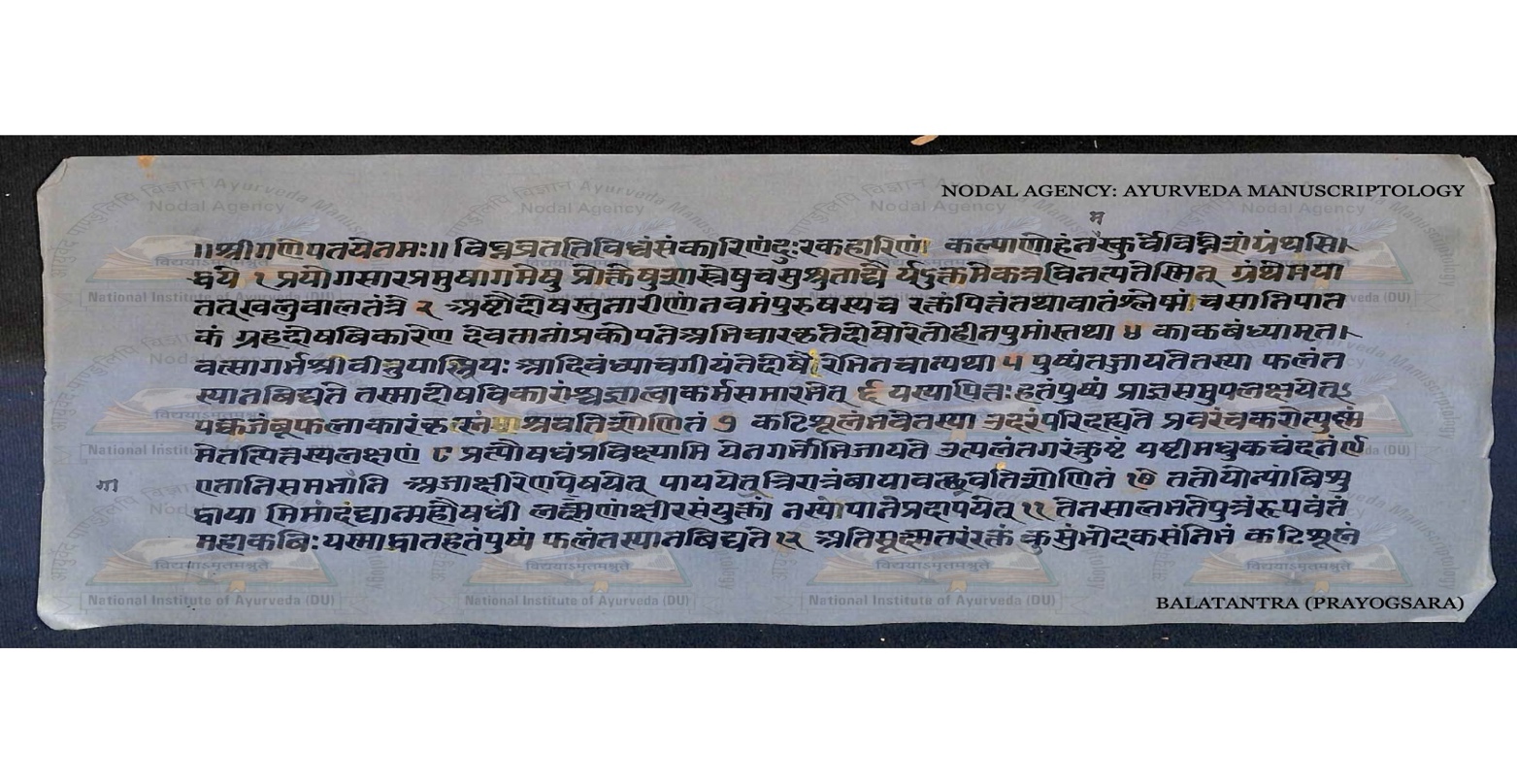
The Bālatantra of Kalyāṇa begins where life begins. Before a single remedy for a childhood illness, the manuscript opens its therapeutic section with fertility: the causes of barrenness, the signs of defective menstrual blood, and the formulations meant to bring about conception.
The author frames the problem in humoral terms. Defects in women arise from blood, bile, wind, phlegm, their combination (sannipāta), planetary afflictions, and divine wrath; in men, from deficiency of semen. Women are classified by their capacity to bear children — those who are like a crow's bondage, those who miscarry, those who give birth to nectar-like children — and the physician is told to identify the cause before beginning treatment.
Reading the Signs
Diagnosis is detailed. If menstrual blood is carried away by bile, it flows hot and clear, resembling a ripe bimba fruit; if afflicted by wind, it is dry, red, black, or like ink, and accompanied by pain in the waist and bladder. Such observations determine which formulation follows. For conception, the text prescribes a paste of utpala, tagara, kuṣṭha, yaṣṭimadhu, and candana ground in goat's milk, administered for three nights. Then comes the celebrated Lakṣmaṇā preparation, taken with milk, which the manuscript promises will yield a handsome and mighty son.
In such women, the flower (menstrual blood) is known, but the fruit (conception) does not occur. Therefore, having understood the cause of the defect, one should commence the treatment.
Ritual and Timing
Herbs are paired with timing. Conception remedies are to be taken during auspicious lunar phases such as Puṣya or Śatabhiṣā, and rituals — worship of family deities, recitation of the Durgā mantra, offerings on the eighth or fourteenth day — accompany the medicines. The text also classifies types of barren women, including kākabandhyā, mṛtvatsā, and trimukhī, each with its own symptoms and prognosis.
On the eighth or fourteenth day, having performed rituals, one should offer (oblations) accordingly. Having worshipped the family deity and revered Durgā, one should then chant the mantra. Having worshipped Gārgī's words, she will certainly obtain a son.
A System, Not a Scrapbook
What stands out is the coherence of the approach. Humoral diagnosis, botanical pharmacy, astrological timing, and ritual are presented as one system in which the physician moves from cause to remedy in a fixed sequence. The Bālatantra's fertility chapters are a striking record of how premodern Ayurveda integrated empirical observation with a broader cosmology of health.
For women whose fertility is lost, for men weakened and aged, for those whose intellect is dull and whose learning fades, in all types of urinary disorders, poor digestion, urinary stones, dysuria, jaundice, and anemia, for those whose food is not digested and whose heart and other organs are afflicted, for the barren woman and the one who miscarries repeatedly, for those who do not conceive at all, for those with epilepsy, scrofula, vāta-rakta, boils, all malignant conditions, leprosy, and eczema, this destroys all fevers, whether caused by vāta or pitta.
Kalyāṇa's genius lay in gathering recipes, remedies, and rituals into a single navigable text. The Bālatantra is not a catalog of ailments but a physician's manual, where each remedy is grounded in cause and matched to its season, its patient type, and its expected outcome.