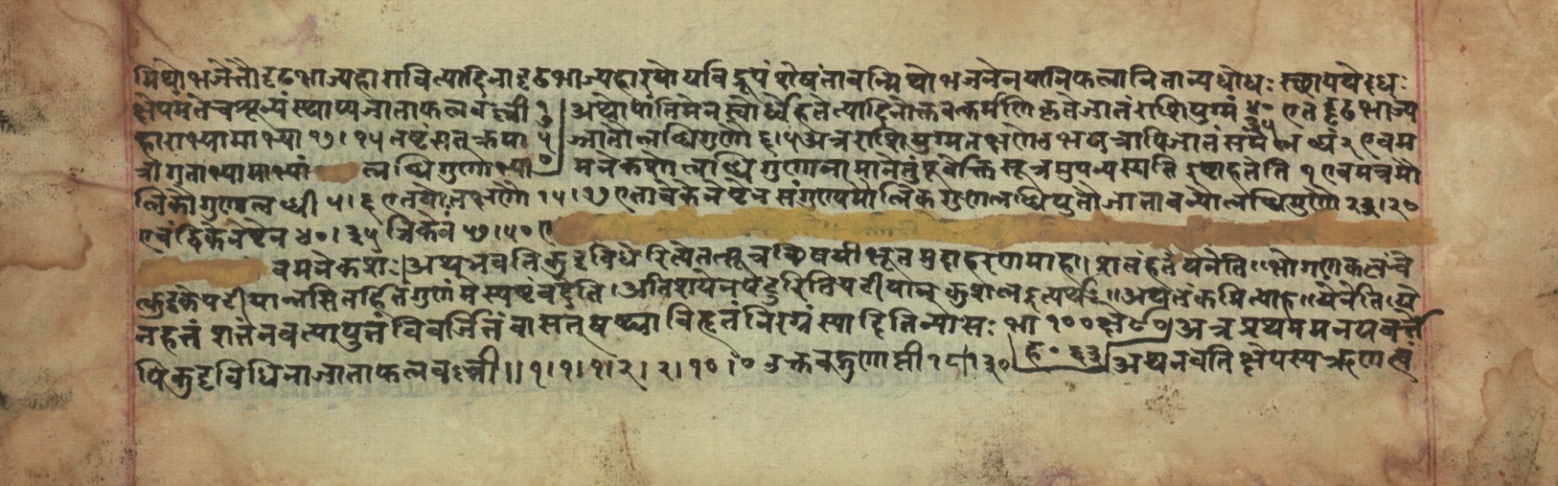
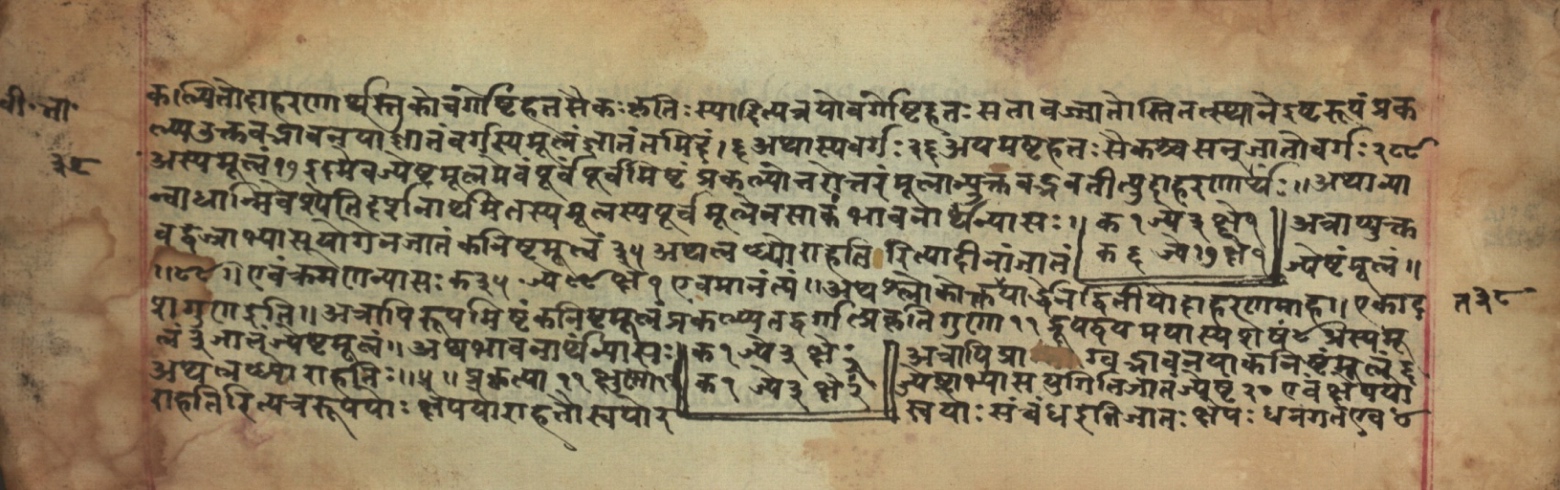
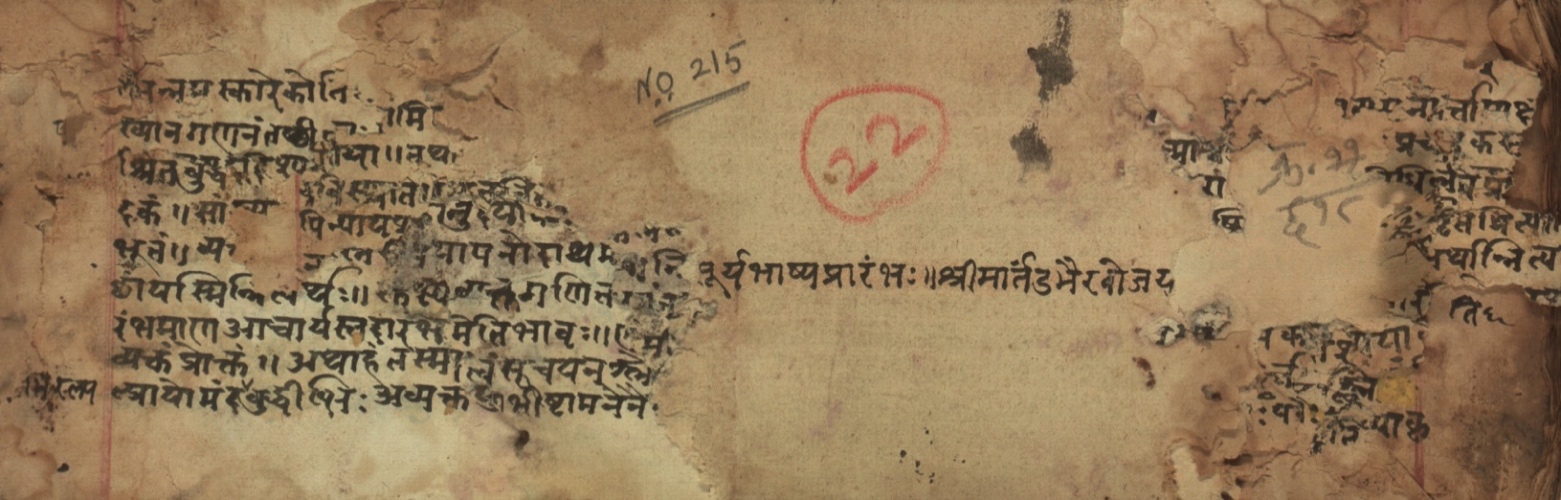
This damaged manuscript page contains fragments of Sanskrit commentary text with modern archival markings including Nº 215 and red circle notation 22. The visible content includes references to vyakhya (commentary), ashritabuddhi (dependent intellect), shishya (disciple), nyaya (logic), shruti (revealed scripture), and ganita (mathematics). The page marks the beginning of Suryabhashya with an invocation to Shri Martanda Bhairava, and mentions an acharya (teacher) beginning instruction for students of slow intellect (manda-buddhi). The text discusses proper method of teaching and interpretation of eternal meaning (nityartha).
Sanskrit

Sūryabhāṣya

This Sanskrit manuscript fragment constitutes a commentary (vyākhyāna) on mathematical astronomy, specifically treating the *Sūryasiddhānta* and the associated *Bījagaṇita* (algebraic mathematics). The text preserves a sophisticated discussion of *avyakta-gaṇita* (mathematics of unknown quantities), invoking philosophical concepts of causation (*kārya-kāraṇa*) and the unmanifest (*avyakta*) as foundational to algebraic reasoning. Notable features include metrical invocations to deities such as Śrīmārtaṇḍabhairava and Jñānarāja, alongside technical terminology for algebraic operations and demonstrations (*pramāṇa-darśana*). The manuscript exhibits significant material damage with lacunae, yet retains critical evidence of the pedagogical transmission of mathematical sciences (*gaṇita-śāstra*) in early modern South Asia, including references to student-teacher lineages (*śiṣya-ācārya*).

The fruit-chain of quotients 2 | 2 | 1 | 1 | 2 set down for the pulverizer
MathematicsJune 16, 2026

The Pulverizer: India's Ancient Equation Machine

The kuṭṭaka (pulverizer) algorithm solves linear indeterminate equations by mutual division, essential for reconciling calendars and planetary periods. It is the Extended Euclidean Algorithm, expressed in classical Sanskrit verse.

The example of a square multiplied by eight and increased by one yielding the square 289
MathematicsJune 14, 2026

Cakravāla: The Cyclic Method for Impossible Equations

The cyclic method (cakravāla) solves Pell-like equations through iterated composition, reducing and recomposing solutions until reaching the minimal pair. Indian mathematicians solved this 1000 years before Lagrange.