
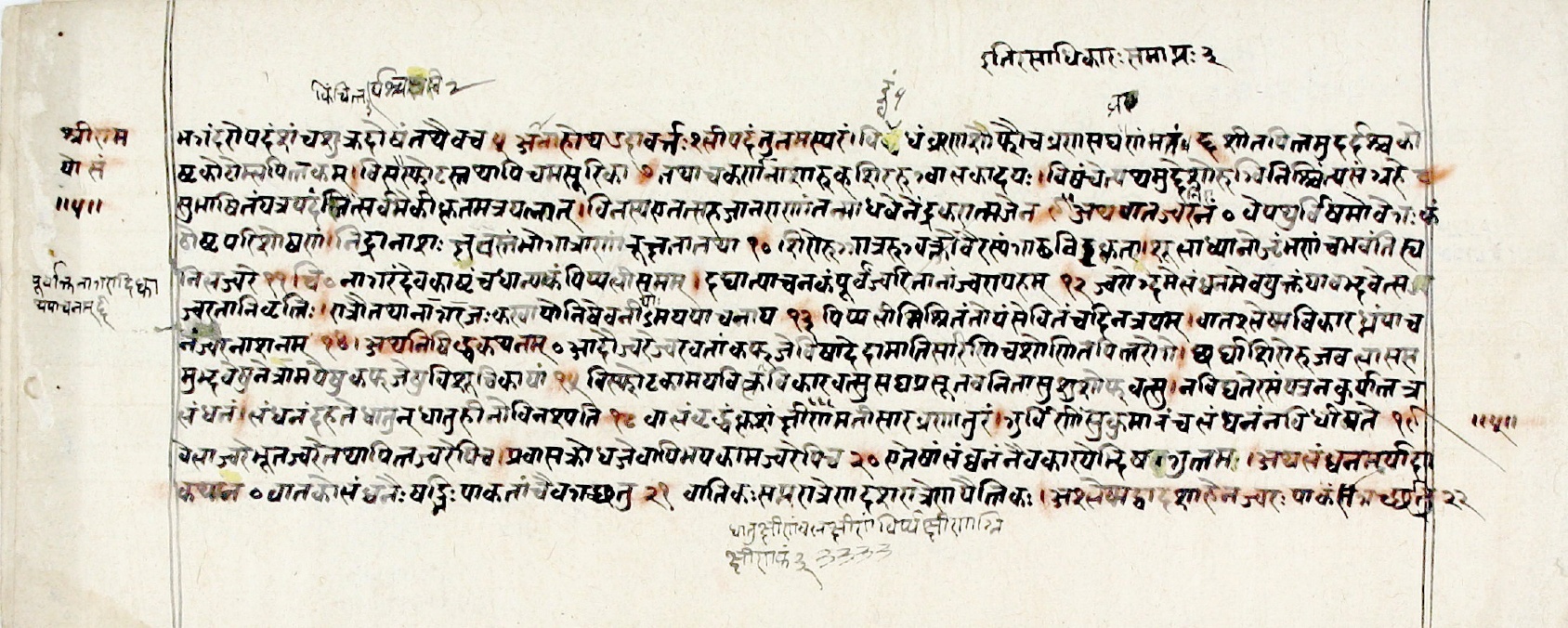
The title says war — 'the festival of victory' — but the contents range far wider. Yuddhajayotsava is a working compendium that moves from the omens of messengers to the formulas of the dispensary, treating victory in battle and victory over disease as the same kind of problem. Its hundred pages preserve a practitioner's handbook of war and healing — and much of it is alchemy.
The medicines of victory
Much of the text is pharmaceutical — the classical compound formulas that anchor Ayurveda, given with their ingredients and their powers.
Now, Trikaṭu: Pippalī, Marica, and Śuṇṭhī — these three mixed together. With Bibhītaka, Āmalaka, and Harītaka fruits — this triad of fruits is thus spoken of by physicians. For those with kuṣṭha, it destroys gulma and prameha. Nāgara, Tiviṣā, and Mustā — these three are Tribhadraka. That which is united with Guḍūcī is called Caturbhadra.
The triads and tetrads of the pharmacopoeia — three peppers, three myrobalans, three gingers — are the grammar of the Indian dispensary, and the text recites them like a drill.
The alchemist's fire
Beneath the herbal pharmacy lies the rasashastra layer — the alchemical processing of metals and minerals that the tradition used to make heavy remedies. The manuscript describes the puta, the enclosed heating by which minerals were calcined into ash.
One should cook (pacet) the powders of orpiment, realgar, and copper sulfate in a puta (enclosed heating) on iron. One kola (weight measure) of each, prepared in this manner, with one kola of triphala and water, heated in a puta — after 100 putas it becomes pure.
A hundred firings — the numbers of the alchemist are patient ones. The same page carries on to copper calcination, mercury 'mixed with masūcada leaf, with a little salt and milk,' and the striking instruction that 'the physician should cook them in a human skull, indeed' — the skull-vessel of the rasaśāstra tradition, part of the secret apparatus of the art.
Fever and the arsenal of rasa
The fever section is where the alchemical pharmacy meets the sickbed. The text works through the classical fevers — quotidian, chronic, irregular — and then prescribes the rasa formulations, the mercury-and-mineral pills that were the heavy artillery of medieval Indian medicine.
One who eats in the morning in ekāhika [quotidian], in chronic, in irregular [quartan] fever — completely removes all fever. Now Śītāri Jvarāṅkuśa rasa: Mercury, borax, equal to mercury [certainly] equal to poison [equal]... One guñjā-measure mixed with sugar [drunk] or with cumin. One, two, three, four [doses] alleviating cold... Therefore called Śītāṅkuśa. Now Jvarāṅkuśa rasa: Mercury, sulphur, equal poison.
The names are weapons: Jvarāṅkuśa, 'the goad of fever,' Śītāri, 'the enemy of cold' — the formulas named as instruments of conquest, in keeping with the manuscript's martial title. The doses are minute — a guñjā measure, a fraction of a gram — because the ingredients include mercury and the 'poisons' that the tradition had learned to tame through processing.
From omens to formulas
The same manuscript opens with the science of the messenger — how to read the syllable of a messenger's name for good or ill — and closes with disease.
With loosened hair, anointed with abundant oil, with fallen matted locks — by these heads there is no accomplishment. The messenger's syllable tripled — who would subtract how many syllables? With four parts to Hari, the remainder is the messenger's characteristic.
The divination is arithmetic: count the messenger's name-syllable, triple it, divide by four with Hari, and read the remainder as the messenger's nature — a procedure as rule-bound as any decoction recipe. The manuscript's margins, full of 'Śrī Rāma' invocations and working notes, show a text actually used.
The decoction's seven powers
The compendium also pauses to teach theory, as when it classifies the seven kinds of decoction and what each one does.
A decoction is said to be of seven kinds: digestive, pacifying, kindling, moistening, purgative, nourishing, and purifying. The digestive ripens the doṣas; the kindling kindles the fire; the purifying is for impurity purification; the pacifying pacifies fevers. The nourishing nourishes the dhātus; the moistening is moistening.
Seven kinds of decoction, each with a distinct action on the body — the systematic pharmacology that underlay the practice, and that a working physician would need at his fingertips.
Two fronts, one discipline
Yuddhajayotsava treats war and medicine as one campaign: the army needs remedies as much as omens, and the physician's formulas are as strategic as the astrologer's readings. Its pages braid together messenger-divination, herbal compounds, mercury alchemy, and fever pills — the whole arsenal of a medical tradition that named its remedies for conquest. It is a handbook for a world where the festival of victory was won on both fronts — the battlefield and the sickbed.