
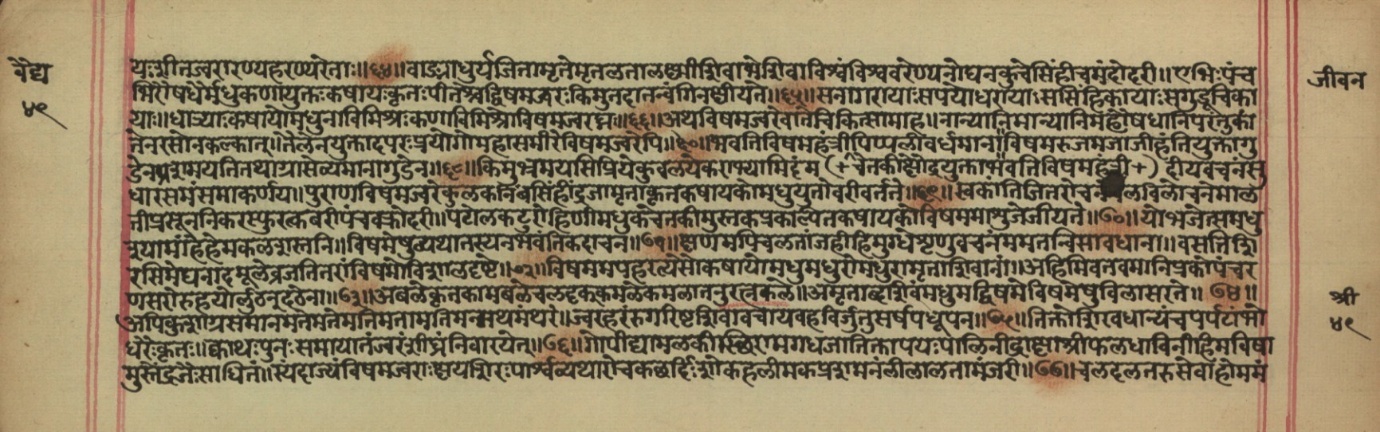
Vaidyajīvana — "the physician's livelihood" — is a fever manual that refuses to be only a manual. Between its decoctions are verses of love poetry, and behind it stands a lineage of physicians who wrote in verse. Composed by Rudra of Kānyakubja, son of Divākara, the work opens with invocations and philosophical verses before turning to fever as the most urgent of diseases.
Fast first, then the decoction
The text is emphatic about the first move in fever: not the strongest drug but the right restraint — laṅghana, therapeutic fasting. The author sets up the principle with verse after verse: fever is among all diseases the most powerful, and therefore its remedy is spoken first.
Now hear the excellent fasting which is highly praised as the first [treatment] for those suffering from fever.
When the time comes for medicine, the first decoction is a classic: devadāru, viśvā, and bṛhatī among its ingredients.
The decoction of devadāru (Cedrus deodara), ghanā (a type of preparation), viśvā (a herb), bṛhatī (Solanum indicum), and the two pañcāna (five-fold preparations) should be drunk first in fever.
Chronic fever: milk and pañcāṅga
The manual then moves down the disease's timeline to jīrṇa-jvara, the stubborn chronic fever that has outlasted the acute attack — and prescribes gentleness. The ancient physician recognizes that a fever that persists for months requires a different approach than a fresh attack.
A person freed from chronic fever, with ribs, bones, and nose bent from breathing difficulty, should drink milk cooked with five-fingered (Panchnaga) medicine.
Irregular fever's five herbs and the rhythm of relapse
For viṣama-jvara — the irregular, relapsing fever that disappears and returns — the remedy is five herbs taken with honey, and the verse teasingly hides the formula behind a riddle of names. The text recognizes that not all fevers follow the same calendar; some strike daily, others in patterns of two or three days.
With these five medicinal herbs combined with honey, if a decoction is made and drunk, what then of irregular fever? It is quickly subdued by its potency.
The spectrum of fever and complicated cases
Beyond the simple acute fever lies a cascade of varieties: fever accompanied by diarrhea, fever with cough and asthma, fever mixed with the phlegm disorders that cloud the lungs. Each requires its own careful decoction, and Rudra's manual does not shy away from the difficult cases.
Fever with diarrhea, vomiting, and cough, asthma, and colic: Pañcādhivṛkṣa, Bṛhat seed, Sārivā, Tikta, Amṛtā, Viśva, Bilva—this decoction pacifies fevers, diarrheas, phlegm, wind, phlegmatic coughs, and colics.
For the most intractable fevers—those that linger and return—the text prescribes combinations drawn from roots and powders, each layered with careful observation of what the body reveals.
In chronic irregular fever, a decoction made of kulaka, nimba, simhi, dru, and amrita, combined with honey, is excellent. A decoction prepared with patola, katurohini, madhuka, chetaki, and mustaka is quickly destructive to irregular fever.
The physicians behind the verses
The manuscript is proudly personal: it names Koṇera Bhaṭṭa, "the best of physicians," as the father of its author, Rudra of Kānyakubja. The text shows how fever, the commonest of diseases, produced an enormous literature in India — and how that literature was also art, mixing therapy, pharmacology, and poetry on a single folio. A physician's life, after all, was made of this: diagnosis by method, the determination of curability, and the daily mix of botanical knowledge and human observation.
The Vaidyajīvana stands as testimony to that tradition: named for the physician's livelihood, yet written as a work of verse, it shows that medicine in the classical Indian world was never purely technical. It was also a matter of poetry, lineage, and the particular voice of each healer who took up the work.