
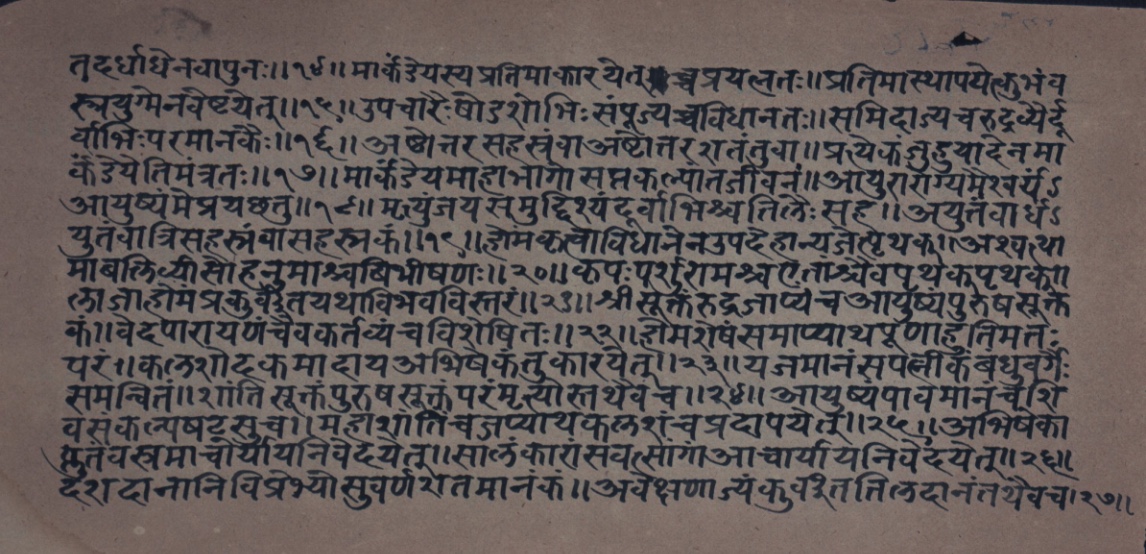
The Ugrarathaśānti — 'the pacification of the fierce chariot [year]' — is a ritual for the most dreaded birthday in the Hindu astrological calendar: the sixtieth. Attributed to the sage Śaunaka, the text lists the calamities that threaten a person who completes sixty years, and prescribes an elaborate liturgy to outlive them — centered on Mārkaṇḍeya, the sage who famously conquered death itself.
What the sixtieth year threatens
The diagnosis is blunt and comprehensive. "If one reaches sixty years, then death is certain. Bad dreams occur, and then the death of mother and father. Separation from wife and son, fear of disease and fire, affliction of the house, fear of the king, various diseases in the body." The text continues the catalog: "Dental disease, weakness of vision, distorted shadows. Stars are not seen, the pole star and others do not shine clearly. Ghosts, spirits, piśācas and others are seen in various places." The sixtieth year is not merely a milestone; it is a battlefield. The planetary conjunction that turns sixty is read as a cosmic death sentence. But the text adds a crucial note: "One who, out of greed or disrespect, does not perform the pacification rite, in that year death will occur, this is true, there is no doubt." The ritual, then, is not optional — it is the difference between life and death.
If one reaches sixty years, then death is certain. Bad dreams occur, and then the death of mother and father. Separation from wife and son, fear of disease and fire, affliction of the house, fear of the king.
Preparing the ritual space
The ritual begins with preparation. "Having completed daily duties and having invoked the Brahmins, one should first select an Ācārya who is proficient in the Vedas and Vedāṅgas. One who is of good conduct, knower of dharma, skilled in pacification rites, free from lust and anger, devoid of attachment and aversion." The choice of priest is not casual. The ritual requires someone who embodies the qualities being invoked. Then come the material preparations: "Having brought all medicinal herbs, five barks, five sprouts, five jewels, five cow-products, five ambrosias, then having brought the jar, preceded by the planets. Having worshipped the nine planets, with Mārkaṇḍeya as the chief."
The rite of Mārkaṇḍeya
The remedy is a full ritual sequence centered on the image of Mārkaṇḍeya, the boy-saint who defeated death itself. "One should have an image of Markaṇḍeya made with effort. One should install the image in a pot and wrap it with a pair of cloths." Then comes the worship: "Having worshipped it with sixteen upacāras (services) according to the prescribed method, and with sacrificial sticks, ghee, cooked rice, substances, dūrvā grass, and excellent rice dishes." The number of oblations is given in options for different means: "One should offer oblations eight thousand one hundred times, or eight hundred one hundred times, with the mantra 'To Markaṇḍeya' for each one."
The mantras themselves appeal directly to the exemplar: "'O Markaṇḍeya, most fortunate, living through seven kalpa-endings, grant me long life, health, and prosperity, longevity.'" The text then prescribes fire rituals for specific deities — mantras offered to the cosmic heroes who conquered death: Aśvatthāman, Bali, Vyāsa, Hanumān, and Vibhīṣaṇa. These are beings from mythology who, by their spiritual power or devotion, escaped or transcended death. The ritual makes the person at risk a participant in their power.
One should have an image of Markaṇḍeya made with effort. One should install the image in a pot and wrap it with a pair of cloths. Having worshipped it with sixteen upacāras, with sacrificial sticks, ghee, cooked rice, and excellent rice dishes.
Gifts, Brahmins, and a hundred years
The rite ends in the social world. "One should accept the blessings of Brahmins and wear new clothes. One should honor women and bow down to the deities. One should feed Brahmins afterwards — by the thousands or by the hundreds. One should eat together with relatives and thus obtain long life." And the promise is explicit: "One who performs this properly according to the pacification rites for the planets — for him, life extending to a hundred years is certain." The ritual is not merely personal mysticism; it is deeply social. The Brahmins' blessings carry weight. The community's gathering and feasting carry power. Women are honored, relatives are fed, the deities are bowed to.
Reading it, one is struck by the honesty of the transaction: an astrological danger, a mythological exemplar who beat death, and a ritual that asks the whole community — Brahmins fed, relatives gathered, women honored — to stand between one person and the fear of the sixtieth year. It is a reminder that in the Hindu tradition, even death is not faced alone, but with the cosmos as witness and the community as co-performer.