
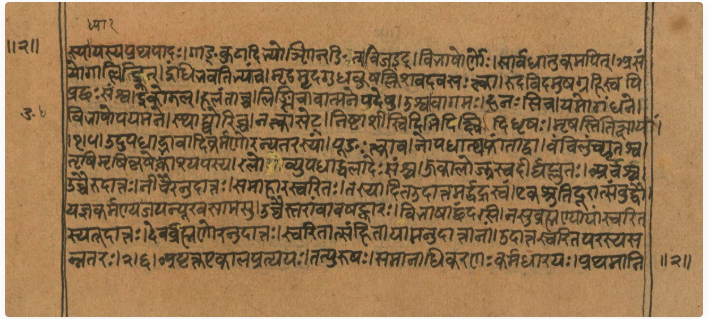
The Aṣṭādhyāyī was usually studied with a commentary. But there was another way to copy it — bare. The Sūtrapāṭha is Pāṇini's grammar stripped to its skeleton: nothing but the sūtras themselves, in order, without explanation. This copy comes from the Rajasthan Oriental Research Institute in Jodhpur, dated 1744, thirty-five folios of grammar with no gloss to lean on.
The grammar in its pure form
The text opens as the Aṣṭādhyāyī always does — with homage to Pāṇini and then, immediately, the fourteen Māheśvara Sūtras: the sound-inventory Śiva is said to have sounded on his drum, which every subsequent rule of the grammar presupposes.
By whom the entire grammar was proclaimed, having received the alphabet-series from Maheśvara; to that Pāṇini, salutation. a i u ṇ. ṛ ḷ k. e o ṅ. ai au c. ha ya va ra ṭ... Vṛddhi is ā, ai, au. Guṇa is a, e, o.
From there the rules run on unbroken, in their canonical order — a text meant to be recited and held in memory rather than puzzled over on a page. Technical terms are defined in the same breath as they're first used: saṃyoga for a run of consonants, savarṇa for sounds articulated at the same place with the same effort, pragṛhya for vowels that resist the usual sandhi contractions. There is no room to pause; each definition is immediately put to work in the rule that follows it.
A machine for building words
By the second chapter the manuscript moves into the grammar's real machinery — the rules governing verbal roots, their augments, and which of the two voices (parasmaipada or ātmanepada) a given root takes under which conditions.
The suffix ktvā after mṛḍ, mṛd, gudh, kuṣ, kliś, vad, and vas. The augment saṃ after rud, vid, muṣ, grah, svap, and prach. Of ik before jhal. The suffix sic after han.
Rules like these are Pāṇini's method in miniature: a short list of roots, a single grammatical operation, no explanation of why. The genius of the system — and the difficulty of reading it bare — is that each sūtra depends on the ones before it for context that is never restated. A reader without a teacher or commentary has to hold the entire chain in mind at once, which is precisely what memorization was for.
Compounds, case, and the architecture of a sentence
Later sections turn to samāsa — compound formation — laying out, sūtra by sūtra, the distinctions between avyayībhāva, tatpuruṣa, dvigu, bahuvrīhi, and dvandva compounds, and which case relationship licenses each.
Tatpuruṣa. And dvigu. The second case with śrita, atīta, patita, gata... The third case with that which is the means of the action, with a quality-word... The fourth case with words meaning purpose, artha, bali, hita, sukha, rakṣita.
This is the part of the grammar a working reader of Sanskrit poetry or śāstra actually leans on daily — how to unpack a five-word compound into the sentence it's standing in for. The bare sūtras give the rule but never the worked example; a student reciting this text would need to already know, or be told separately, what a compound like rāja-danta actually means before the rule about compound-final accent placement makes any sense.
The logic of case, laid bare
A long stretch of the manuscript is devoted to kāraka — the theory of case relations, how a noun's ending signals its role in the action of a sentence. It is arguably the most quietly radical part of the whole grammar: an attempt to describe, exhaustively, every semantic relationship a nominal can have to a verb, and to assign each one a formal case marker.
Dhruvamapāye'pādānaṃ — That which is fixed at the point of departure is apādāna (the ablative sense). Bhītrārthānāṃ bhayahetuḥ — For verbs of fearing, the cause of fear [is in the ablative]. Karmaṇā yamabhipraiti sa saṃpradānaṃ — That whom one intends by the action is the recipient (dative).
These few lines are the seed of a semantic theory that Sanskrit grammar never really abandoned — case as meaning, not just as inflection. Later Indian philosophy of language spent centuries arguing with exactly this passage.
The value of the skeleton
Why copy the grammar without commentary? Because the sūtras were meant to be memorized — the bare text was the version a student carried in the head, the commentary the version read at the desk beside it. This Jodhpur manuscript preserves the grammar in its hardest, purest form: the rules alone, one after another for thirty-five folios, a machine with no instructions, trusted by a scribe in 1744 — and by the tradition behind him — to generate the entire language on its own.