
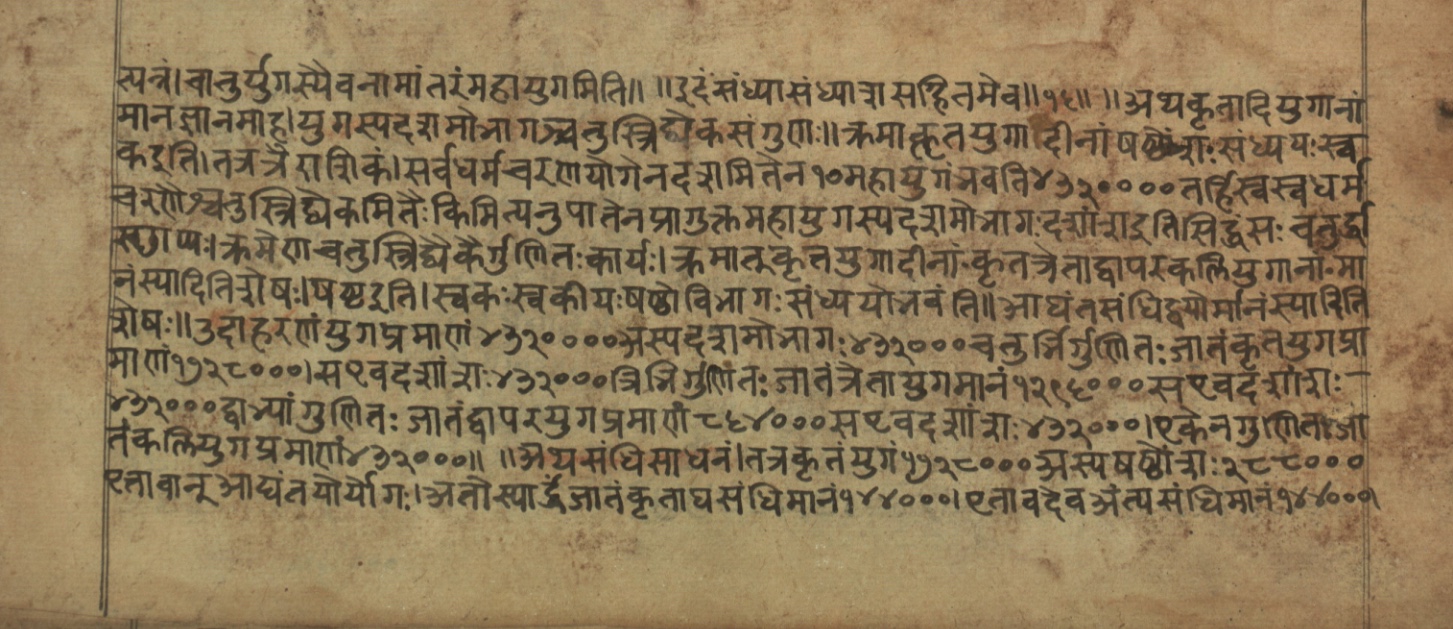
Start with a breath, and keep multiplying: six breaths make a pala, sixty palas a ghaṭikā, sixty ghaṭikās a sidereal day and night, thirty days a month, twelve months a year — and keep going and you reach a kalpa, a day of Brahma, at 4.32 billion solar years. That continuous ladder of time, from the body to the cosmos, is the subject of this commentary on the Sūryasiddhānta.
The ladder of small time
The commentary begins with the smallest practical units, anchored to something everyone has: breathing. This is not a metaphorical choice. In classical Indian thought, the breath (prāṇa) is the first measurable unit because it's the first thing the body does that can be counted. Six breaths fill the time it takes for one drop of water to form—the pala, a unit of time. Then the climbing begins: sixty palas make a ghaṭikā (24 minutes), sixty ghaṭikās make a day and night.
By six prāṇas or breaths, one pala of water is produced. By sixty palas, a ghaṭikā is stated by those who know the truth of time. By sixty nāḍīs, a sidereal day and night is proclaimed.
It is a beautiful move: the unit of time is defined by the breath, the day by the stars, and the two are joined in a single chain of multiplication. From the smallest pulse of the body, you can climb to cosmic epochs. This is how classical Indian mathematics thought about scale: not as a hierarchy, but as ratios all the way up and down. One breath leads to the breath of Brahma, which lasts 4.32 billion years.
The four yugas, calculated
Beyond the day, the text scales up to cosmic time. The great cycle contains four ages (yugas) of decreasing duration and virtue. A mahāyuga — the complete great age — is 4,320,000 solar years. But each component yuga is calculated by a simple rule: take one-tenth of the total, and multiply by four, three, two, and one for the Kṛta, Tretā, Dvāpara, and Kali yugas respectively.
A tenth part of the yuga, multiplied by four, three, two, and one respectively, gives the measures of Kṛta-yuga and others. By the rule of three: by the sum of all dharma-quarters, measured as ten, the mahāyuga becomes 4,320,000.
So Kṛta is 1,728,000 years, Tretā 1,296,000, Dvāpara 864,000, and Kali 432,000 — each with its twilight (sandhyā) periods added on, and the arithmetic is worked out line by line in the margin, the same way a student today would show their working. This manuscript is a teacher's copy: working out examples for students to follow.
One system, no breaks
What makes the Sūryasiddhānta tradition remarkable is that the scale never changes units arbitrarily — a breath, a day, a year, a yuga, a kalpa are all the same system of measurement, and any of them can be converted into any other using the same rules of proportion. The system is coherent from the microscopic to the cosmic. This is not metaphor or poetry; it is the rigor of mathematical astronomy applied to the shape of time itself.
This manuscript is a record of that consistency, preserved in the working examples of a scholar trained in a lineage that went back centuries. Every number in the text carries the weight of observation and calculation—refined by generations of astronomers who watched the sky, predicted eclipses, and tested their mathematics against the actual motion of the heavens. The ladder of time, from breath to cosmos, is not invented; it is measured.