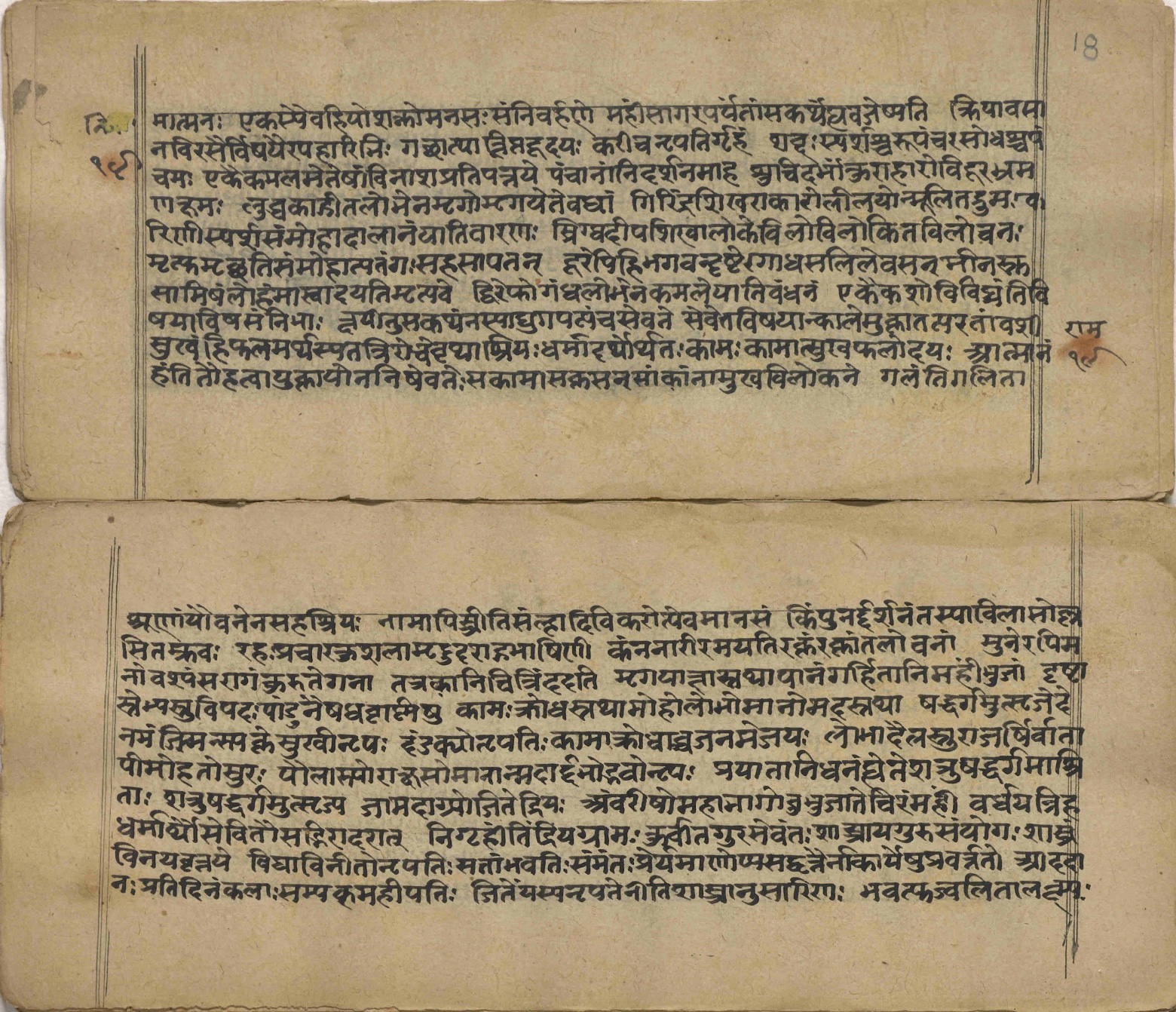
What makes a kingdom a kingdom? For Nīlakaṇṭha's Nītimayūkha, dated 1793 in the Vikrama era and drawing on the political philosophy of Siṃhasena, the answer is a precise inventory: the sovereign, the minister, the ally, the treasury, the territory, the fort, and the army. A kingdom is those seven limbs, and it stands or falls on how they are held together.
Seven Limbs, One Body
The manuscript sets out the doctrine plainly, then quotes Kāmandaka to the same effect — the seven-limbed state was a settled idea in Indian political thought, and this text is its practical application.
Having been consecrated, he should rule the kingdom, which consists of seven limbs: the sovereign, minister, ally, treasury, territory, fort, and army. Among these, the sovereign is the king.
The king, it adds, is no ordinary man: the text says the essences of Indra, Wind, Sun, Fire, Varuna, Moon, and the Lord of Wealth are present in him, which is why he surpasses all beings in radiance. If there were no king, the people would be destroyed like a ship without a helmsman. But with that power comes a warning.
Consecration: The Ritual Foundation
Before a king can truly reign, he must be consecrated through an elaborate ceremony that appears throughout the manuscript in meticulous detail. The manuscript prescribes the proper time (certain nakshatras and lunar phases), the sacred bathing with water from multiple sources, and the recitation of mantras to invoke blessings from every level of the cosmos. Brahmins, Kshatriyas, Vaishyas, and Shudras participate in order; priests and ministers conduct the ritual; and the king is anointed with waters mixed with all herbs, all essences, all seeds — a distillation of the kingdom's fertility.
When a king is first anointed after the death of the previous king, then the annual priest and he, by that bathing procedure, with sesame and mustard seeds, with cow's products and so forth, having bathed the king, should seat him on the throne and show him to the ministers and city people.
The manuscript names auspicious nakshatras, describes the eight-hundred qualities to be embroidered on the royal canopy, lists the directional elephants that protect the king, and recites consecration verses invoking Brahma, Vishnu, Shiva, all Adityas, the Maruts, the Gandharvas, the ancestors (Pitris), the Yakshas, the Rakshasas, the Daityas, the Apsaras — a cascade of divine blessings. Even the great sages of old — Vedavyasa, Valmiki, Vishvamitra, Bharadvaja, Agastya — are invoked to consecrate the earthly king.
The Trap of the Senses
With that power comes a profound warning. The Nītimayūkha devotes remarkable space to how rulers lose themselves — not to enemies, but to sound, touch, form, taste, and smell, each one capable of destroying even the wise.
Sound, touch, form, taste, and smell as the fifth — each one of these is capable of causing destruction. The deer, allured by song, goes to its death; the elephant goes to the pit, deluded by the touch of the female; the moth falls into the flame; the fish, greedy for bait, goes to death on the hook; the bee, through greed for fragrance, goes to bondage in the lotus.
This is not mere moralizing. The manuscript is saying that a kingdom's strength is only as solid as its ruler's self-mastery. A king who becomes enslaved to his senses abandons the discernment required to rule. His ministers will sense the lapse, his allies will read the weakness, and the fragile order of the realm will unravel.
The Art of Statecraft
The Nītimayūkha is a whole education for a ruler: the consecration ceremonies that legitimate power, the seven limbs that define the state, the sacred geography and cosmic invocations that remind the king of his cosmic role, and the self-discipline that keeps a king from being undone by his own senses. It is statecraft as both ritual and psychology — a beam (mayūkha) of light on how to rule, and how not to be ruled by yourself. The text treats the kingdom not as a machine but as a living body whose health flows from the head downward, from the sovereign's clarity and restraint through every limb of the realm.