
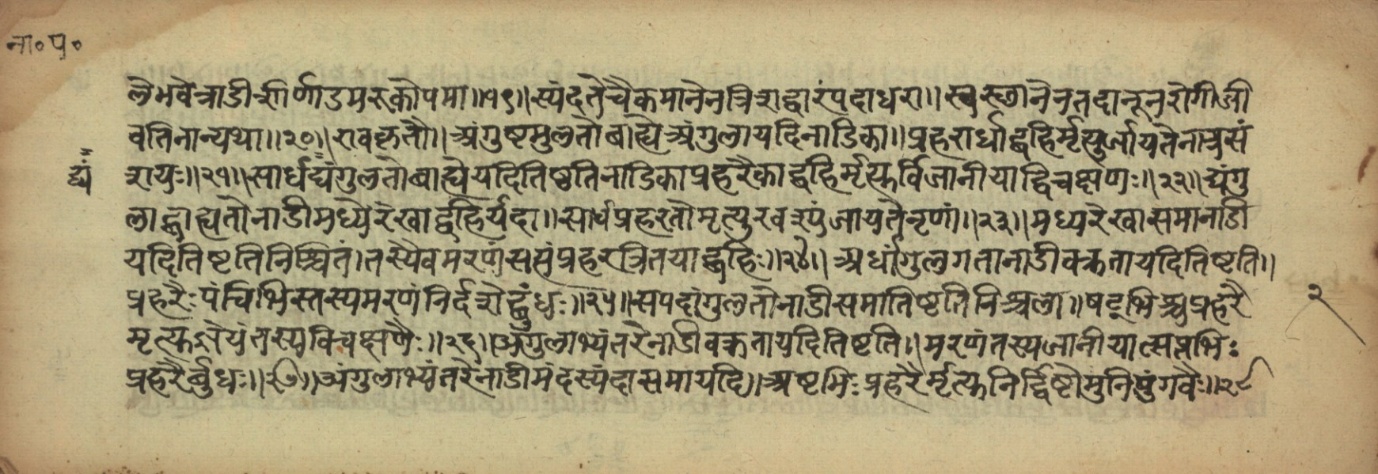
Before the stethoscope, there was the wrist. Nāḍīparīkṣā — pulse examination — was one of the eight ways a classical physician assessed a patient, and this short manual from the Bhandarkar collection is a complete lesson in the art: where to find the pulse, what it feels like under each finger, and what each quality foretells.
A lamp that reveals the doṣas
The text opens by framing the whole diagnostic method, then names the pulse as its centerpiece. One should examine eight sites on a diseased body: pulse, urine, feces, tongue, sound, touch, and natural appearance. The pulse itself — the life-artery, or jīva-nāḍī — is the most eloquent of these. As the text says:
The life-artery (jīva-nāḍī) reveals to the wise physician the nature of the doṣas—whether scattered, balanced, or combined—just as a lamp reveals objects.
The anatomy follows: the life-artery sits at the root of the thumb, and the physician finds it one finger-width below — 'obtained only through practice,' as the text honestly adds. Before examining it, the physician must wait: one must not take the pulse of someone who has just bathed, eaten, bathed in oil, or suffered hunger, thirst, or sleep. The body speaks differently under these conditions.
Three fingers, three doṣas
The diagnostic scheme is beautifully physical. Each finger reads a different humor: vāta at the index, pitta at the middle, kapha at the ring. The quality of the pulse under each finger — its movement, temperature, and steadiness — tells the physician which doṣa is disturbed and how badly.
When vāta is predominant, the pulse appears at the tip of the index finger. When pitta, it appears at the middle finger; when kapha, at the third finger. Between the index and middle fingers, when vāta and pitta are predominant, it is distinct. Between the middle and ring fingers, when pitta and kapha are predominant, it is distinct. In all three fingers, it appears clearly in saṃnipāta [tridoṣic condition].
Pulse as prognosis
The most striking passages are prognostic. The manual, quoting Rāvaṇa, reads the exact position and character of the pulse to count down the hours of life. Each measurement — in finger-widths from the wrist — matches a specific time of death. It is diagnosis as precision.
As spoken by Rāvaṇa: If the nāḍī [pulse] at one aṅgula [finger-width] from the root [wrist] externally remains for half a prahara [3 hours], death occurs on that very day—there is no doubt. If the nāḍī remains at one and a half aṅgulas externally, death occurs in one prahara [6 hours]—let the wise know this. When the nāḍī is at two aṅgulas in the middle with two lines, death occurs in one and a half praharas [9 hours] for men. If the nāḍī remains equal to the middle line, his death is certain in three praharas [18 hours] from that time.
Whether or not one accepts these specifics, the method is striking: a physician who could feel the pulse and count finger-widths could assign a prognosis in hours. That is diagnosis as a precise, teachable skill — and it is exactly what this manuscript preserves.