
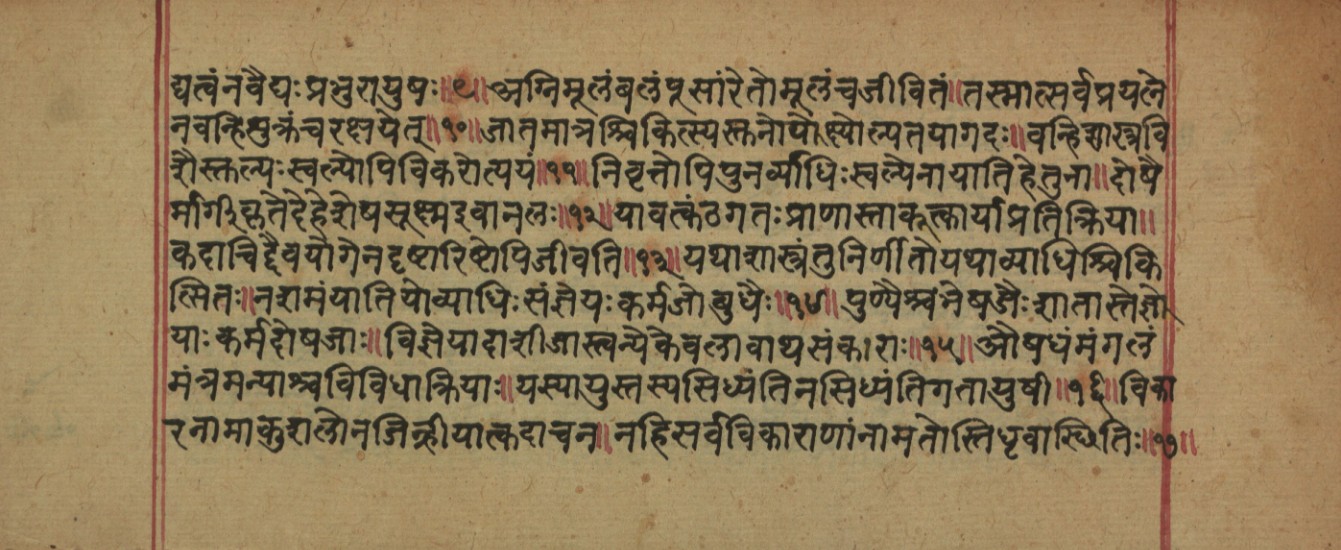
A physician examines the body the way a musician tunes a lute — the Nāḍīparīkṣādi Aṣṭaparīkṣā, a manual of the eightfold examination, makes the comparison itself. It teaches the eight places a physician must look: pulse, urine, stool, tongue, sound, touch, sight, and form — and it begins not with technique but with the physician's own conduct and the ethics of the profession.
The physician's own discipline
Before any examination technique, the manual insists on principles that govern the practitioner. It opens by ranking the physician among society's most honored figures, then immediately warns against practicing without real knowledge.
The food-giver, the water-giver, and the physician of the sick — these three go to heaven without sacrifice, O Bharata. Whoever rescues a man drowning in the ocean of disease and suffering — what duty has he not performed, what worship is he not worthy of?
Fire is the root of strength in men, and semen is the root of life. Therefore, with all possible effort, one should protect the digestive fire and the semen. A disease should be treated immediately upon its manifestation and should not be neglected even if it is minor.
The text is equally direct about who a physician should refuse to treat with strong intervention — naming fools, thieves, and those of low or violent character as patients where the shamana procedure should be withheld, on the reasoning that saving such a life makes the physician complicit in what follows.
The lute and its strings
The text's image for the pulse is one of the finest in the diagnostic literature, and it sets up the eightfold method that gives the manuscript its name.
One should observe the eight places of the patient — nāḍī (pulse), urine, feces, tongue, sound, touch, sight, and form... Just as the strings of a lute, when touched, reveal all sounds, so the nāḍī held in the hand reveals all diseases.
The manual is precise about technique: the physician touches with three fingers, feels the pulse below the root of the thumb for a full prahara in the morning, and assigns the vāta, pitta, and kapha pulses to Brahmā, Śaṅkara, and Viṣṇu respectively — each recognized by its own animal gait, from the snake and leech of vāta to the royal swan and peacock of kapha.
Reading the signs of death
What the shorter draft of this article omitted almost entirely is the manuscript's long, exacting catalogue of prognostic signs — the physical details by which an ancient clinician judged how many nights a patient had left.
If the swift nadi is not perceived, or if it appears cold, death on the second day — so speak the knowers of nadi science. If the nadi flows intensely in happiness, or sometimes flows cold, and sticky sweat comes, he does not live seven nights.
The same logic extends to urine: a physician dropped oil onto a sample and read the shape it took as it spread — a bhadra-pīṭha, a mirror, an elephant, a lotus meant a curable case; a shape that sank, spread flat, or hung suspended meant the opposite.
If oil, when dropped into urine, assumes the shape of a bhadra-pīṭa, mirror, umbrella, conch, bull, or chowrie, it is curable... If the oil spreads out, that will not be curable.
Omens and the right hand
The manual also includes the practical and the superstitious side by side: which hand to use for male and female patients, the omens of a favorable or unfavorable messenger sent to summon the physician, and a numerical rule — multiply by three, divide by eight — for reading the outcome from the day of inquiry itself.
An excellent messenger is one who is well-bathed, wears white garments, has wealth in his hands, is a Kshatriya or Brahmin, has betel in his mouth, is of good character, and speaks auspicious words.
A complete picture of the ancient clinician's world
Between the physician's own conduct, the eightfold examination itself, and the exhaustive signs of curability and death, the Nāḍīparīkṣādi Aṣṭaparīkṣā is a complete picture of the ancient clinician's world — where observation, discipline, and timing all mattered, and where the pulse, held in the hand like a lute string under the fingers, was the instrument through which the body spoke first.