
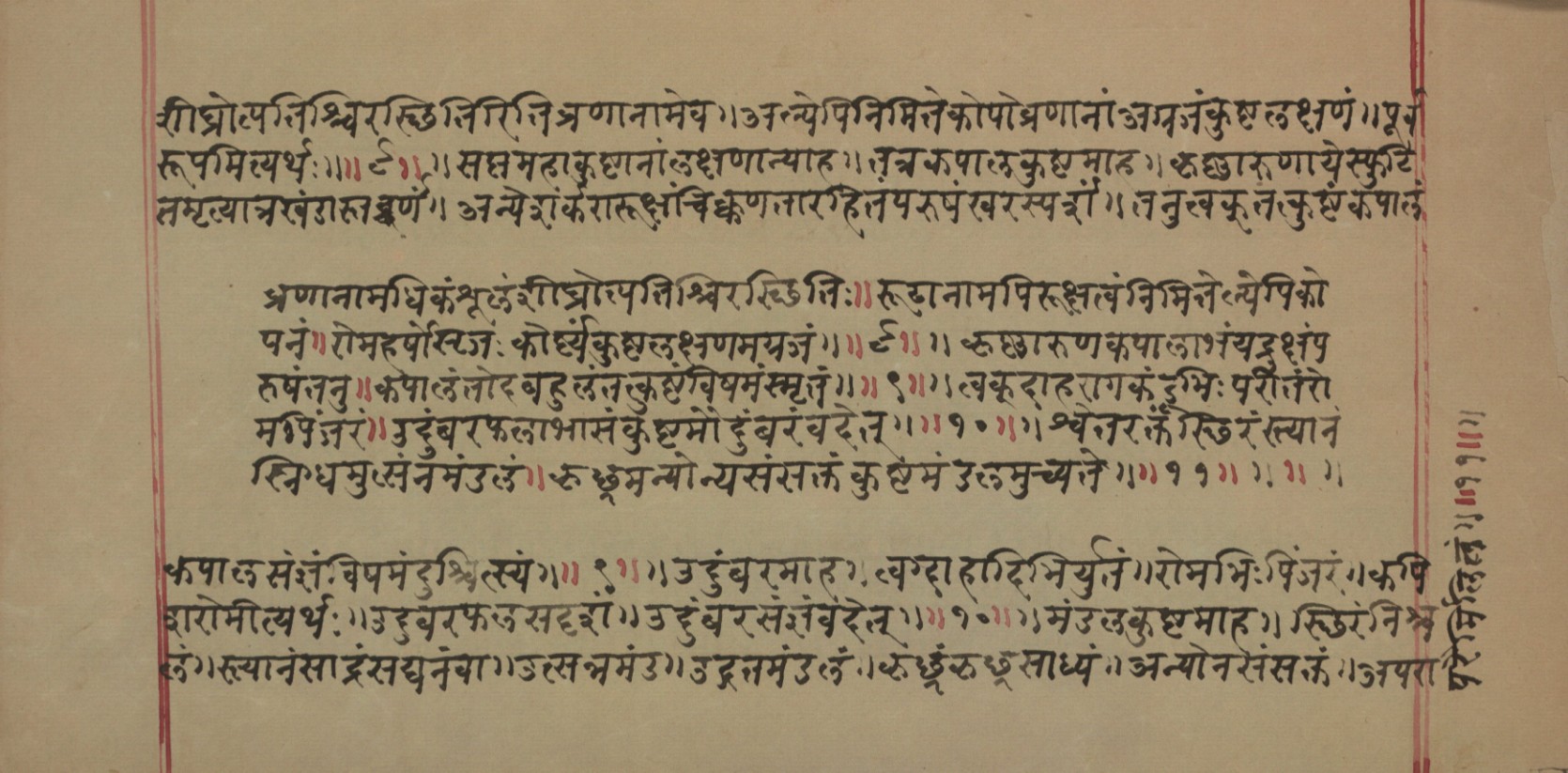
The same Mādhavanidāna manuscript that dissects grahaṇī also carries one of the boldest chapters in classical Indian medicine: the nidāna of kuṣṭha, the great skin disease. It classifies eighteen varieties, describes each with a poet's eye, and — most striking of all — names the mechanism of transmission: "through the association of leprosy by contact." This is contagion theory written centuries before germ theory.
Eighteen diseases, seven great and eleven minor
The classification is numerical and precise. "Seven and eleven: by the reading with number-division, he indicates that seven are mahākuṣṭha and eleven are kṣudrakuṣṭha." The seven great ones come from the doṣas — three single, three paired, one from all three combined — while the eleven minor ones fill out the catalog. The text is careful to add that every kuṣṭha is really tridoṣaja; the naming by a single doṣa is "designation according to predominance."
Seven and eleven: by the reading with number-division, he indicates that seven are mahākuṣṭha and eleven are kṣudrakuṣṭha. Though kuṣṭhas are tridoṣaja, by the defect of designation, he states their sevenfold nature.
Skin described in similes
The descriptions are unforgettable because they are visual. Kapāla-kuṣṭha is "rough, reddish, fissured, broken, with scattered, rough patches," like a cracked pot-shard. Ṛkṣajihva "has the shape of a bear's tongue" — the text even glosses the bear as "a blue deer, gavaya, called roha in common speech." Puṇḍarīka "extends from white to red, resembling a lotus petal, elevated and reddish." The same clinical tradition that counts tendons counts skin patches, and it remembers them the way a painter would.
Contagion, stated plainly
The chapter's most remarkable passage is its theory of transmission. "Through the association of leprosy by contact, indeed diseases arising from contact [occur]. Association means sexual intercourse. Or alternatively, association means continuous contact... Leprosy, fever, consumption, and indeed eye-discharges, and contagious diseases transmit from person to person." The list — leprosy, fever, consumption, eye-discharge — is a genuine, if early, epidemiology of infectious disease.
Leprosy, fever, consumption, and indeed eye-discharges, and contagious diseases transmit from person to person.
Even inheritance is in the text
The manuscript goes further, into vertical transmission. A page on śukragata kuṣṭha — leprosy located in semen — says plainly: "Due to the abundance of leprosy in both husband and wife, male and female, there is vitiation of semen and menstrual blood. Leprosy located in semen produces offspring with leprosy." And a passage on śvitra (leucoderma) grades curability by signs: curable when the hairs are not white, the patches not thick, not conjoined, not born of fire-burn — and "to be rejected otherwise."
Pungent, undigested, burning, alkaline, etc., making pitta excessive. Flooding, killing the fire, like hot water [fire].
Flooding, killing the fire, like hot water [fire]. Undigested, alkaline, etc.
Undigested, alkaline, etc. Thus, that substance with alkaline.
He describes that: 'prasahya'—forcibly; 'dravaṃ ghanaṃ sitaṃ snigdhaṃ sakaṭīvedanaṃ śakṛt'—liquid, solid, white, unctuous stool with pain like a cart [passing]. 'āmaṃ bahu sapicchilyaṃ saśabdaṃ maṃdavedanaṃ'—undigested, abundant, with mucus, with sound, mild pain; 'pakṣānmāsāddaśāhādvā nityaṃ vā'pi vimuñcati'—releases after a fortnight, a month, ten days, or daily; 'aṃtrakūjanamālasya daurbalyaṃ sadanaṃ bhavet'—there is intestinal gurgling, lethargy, weakness, depression.
'āmaṃ bahu sapicchilyaṃ saśabdaṃ maṃdavedanaṃ'—undigested, abundant, with mucus, with sound, mild pain; 'pakṣānmāsāddaśāhādvā nityaṃ vā'pi vimuñcati'—releases after a fortnight, a month, ten days, or daily; 'aṃtrakūjanamālasya daurbalyaṃ sadanaṃ bhavet'—there is intestinal gurgling, lethargy, weakness, depression. 'divā prakopo bhavati rātrau śāntiṃ ca gacchati'—there is aggravation by day and it subsides at night; 'durvijñeyā durnivārā cirakālānubaṃdhanī'—difficult to diagnose, difficult to cure, of long duration.
'divā prakopo bhavati rātrau śāntiṃ ca gacchati'—there is aggravation by day and it subsides at night; 'durvijñeyā durnivārā cirakālānubaṃdhanī'—difficult to diagnose, difficult to cure, of long duration. 'sā bhavet āma-vātena saṅgraha-grahaṇī matā'—that is considered saṅgrahaṇī grahaṇī due to āma-vāta; 'prasuptiḥ pārśvayoḥ śūlaṃ tathā jalaghaṭīdhvaniḥ'—excessive sleeping, pain in the sides, and sound like a water-pot; 'taṃ vadet ghaṭīyaṃtram asādhyagrahaṇīgadaṃ'—that should be called ghaṭīyantra, an incurable grahaṇī disease.
The alkaline substance from bamboo manna, etc., is mentioned; the alkaline water prepared from chaff-flower, etc. Mixed as a condiment, in Kamrup, etc., thus alkaline.
Mixed as a condiment, in Kamrup, etc., thus alkaline. After a long time, painfully, liquid, dry, thin, small, with froth.
After a long time, painfully, liquid, dry, thin, small, with froth. Repeatedly releasing feces, afflicted by cough, asthma, and pain from wind.
When the causes and signs separately indicated by vāta and others come together, one should diagnose the tridoṣa [grahaṇī]; I shall now describe their treatment. He describes the characteristics of saṅnipāta grahaṇī: 'pṛthag' etc. In conditions endowed with separate vāta etc., with combined etiological characteristics, one should diagnose the tridoṣa grahaṇī disease. 'Physician' is the remainder [of the verse]. The complete syllables of the verse: 'I shall describe their characteristics' is written.
After a long time, sometimes liquid, sometimes dry, thin, small. With froth, accompanied by froth. From wind, or here [?] feces. Again, repeatedly, afflicted by cough and asthma, one should release, meaning one should let go. Who should release?
With froth, accompanied by froth. From wind, or here [?] feces. Again, repeatedly, afflicted by cough and asthma, one should release, meaning one should let go. Who should release? The person—the remainder.
From wind, or here [?] feces. Again, repeatedly, afflicted by cough and asthma, one should release, meaning one should let go. Who should release? The person—the remainder. Now, having mentioned the etiology, he describes the symptoms of pittagrahani: causing burning, producing burning.
What makes this chapter feel modern is not the remedies but the structure: a classification, a description, a mode of transmission, and a prognosis. It is the skeleton of a dermatology textbook, written in similes and Sanskrit verse.