
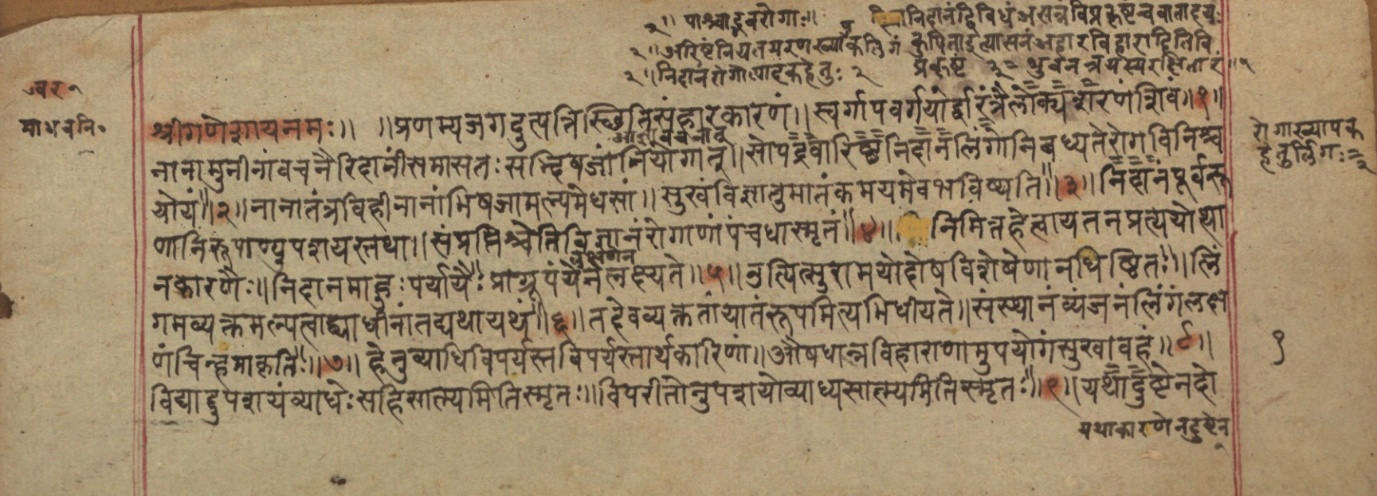
The Mādhavanidāna, composed by Mādhava in the seventh century, is the work that organized Ayurvedic diagnosis into a teachable system. This manuscript copy, preserved in the Poona University Collection at the Bhandarkar Oriental Research Institute, opens with a compact statement of the whole method — and a revealing promise about who it was written for.
A diagnosis before a remedy
Mādhava begins not with remedies but with a framework for knowing disease. The text declares that physicians of little intelligence, devoid of vast treatises, can understand disease through five knowledges.
Nidana (etiology), Purvarupa (prodromal symptoms), Rupa (symptoms), Upashaya (therapeutic test), and Samprapti (pathogenesis) — these fivefold knowledges of diseases are remembered. For physicians of little intelligence who are devoid of various treatises, this alone will become easy to understand.
Each term is defined in turn — nidāna by its synonyms nimitta, hetu, and āyatana; rūpa as the sign once it has become manifest; upaśaya as the employment of remedies contrary to the cause that brings happiness, and its opposite, anupaśaya, as that which aggravates. The method is emphatic: physicians must examine the disease before prescribing medicine or procedure, and the text presents the fivefold framework as the foundation of the physician's fame and prosperity.
The meaning of etiology
Mādhava then shows how the framework handles the first of the five, etiology — and how a single disease branches into many.
Due to predominance of number and variation, strength, time, and specific conditions, it is divided — just as here itself the eight fevers will be described. The variation of combined doshas is the conception of parts and sub-parts; the predominance of disease should be indicated by independence and dependence. The distinction of strength and weakness by the entirety or parts of causes, etc.; the appropriateness of disease occurrence by night, day, season, and food intake.
The passage is dense, but the method is clear: a single cause-branch can split according to number, strength, time, and circumstance — which is exactly why the fever chapter that follows describes not one fever but eight.
Fever's mythic origin
The fever chapter itself opens with a striking double frame: a mythological portrait of fever as a divine being, followed by the humoral mechanics of its causes.
The nature of fever is described in the Harivaṃśa: 'Fever has three feet, three heads, six arms, and nine eyes. Embodied, terrible, fierce, the destroyer of sinners.' Untimely, excessive, incompatible, and spoiled food; irregular eating and what is called false diet — these are termed unwholesome regimen.
Both frames operate at once. Fever is a divine punishment — 'born from the curse of Dakṣa, from Rudra's anger, from his breath' — and simultaneously a mechanical consequence of 'false diet and conduct' that vitiates the doṣas. The same page moves without embarrassment between the two.
Reading the body's signs
The manuscript shows the framework in action. Fevers are located in tissues through which they travel.
Trembling of the fat and bone, loss of consciousness, vomiting, and purgation — one should know these as signs of fever located in the bone. Darkness entering [the eyes], hiccups, cough, coldness, and vomiting likewise; internal burning, great dyspnea, and cutting pain in the vital points — one attains death there from fever located in the marrow.
Prognosis follows the same logic: a fever in the flesh is curable, while one that has reached the marrow is a sign of death. Even the seasons are folded into the diagnosis, with fevers arising from vāta in the rainy season, pitta in autumn, and kapha in spring.
When not to treat
The framework reaches its most practical point in its warning about āma — the undigested residue that blocks therapy. Here the fivefold method dictates restraint.
One should not give medicine there where the signs of āma-fever are present, for medicine increases the fever of āma-doṣa. Purgation and palliative measures make irregular fever. Thirst exceeding the fever-impulse, delirium, difficult breathing, dizziness, discharge of waste products, and nausea are the signs of digesting [fever].
The physician is taught to read whether the fever is still digesting (āma) or already clear (nirāma) — hunger, emaciation, lightness, and softness of the limbs mark the nirāma state — and to time treatment accordingly. Diagnosis is not just classification; it is a decision procedure for when to act and when to wait.
A system built to be taught
What makes the Mādhavanidāna foundational is not any single insight but the whole architecture: five categories, each defined, each demonstrated, each feeding into prognosis and treatment. The manuscript's opening — a catalog entry, an invocation to Gaṇeśa, a dedication to Nṛsiṃha — frames the work as both scholarship and devotion. And its stated audience — 'physicians of little intelligence who are devoid of various treatises' — is the key to its success. Mādhava built a diagnostic system compact enough to carry in the head and complete enough to govern practice, and the Poona copy preserves it for us still.