
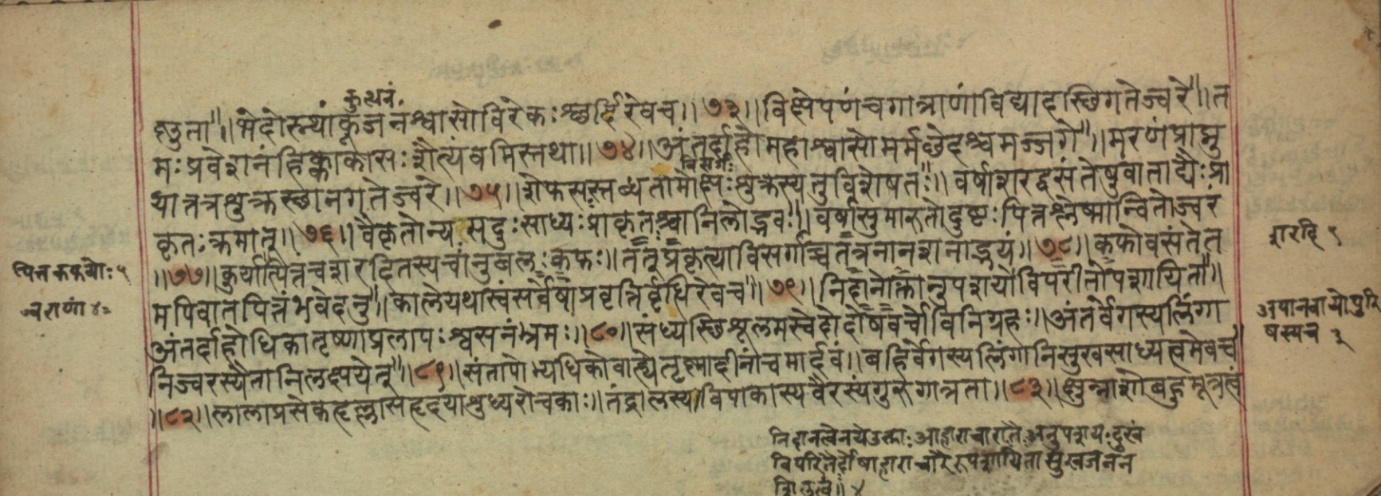
No disease receives more attention in the Mādhavanidāna than jvara, fever. The manuscript classifies fevers eight ways by doṣa — vātaja, pittaja, kaphaja, and their dual and triple combinations — and adds a mythological etiology: fever as the progeny of Rudra's wrath. Both frames, divine and humoral, operate at once, and the text's fever chapter is a masterclass in how the fivefold diagnostic framework actually organizes a single disease into a branching family.
Eight fevers from one cause
The chapter opens by deriving the eightfold division from the mechanics of the doṣas.
Born from the curse of Dakṣa, from Rudra's anger, from his breath: fever is of eight kinds — separate, dual, combined, and external origin. By false diet and conduct, doṣas [are vitiated].
Three separate (vāta, pitta, kapha), three dual (dvandva), one triple (sannipāta), and one of external origin — the arithmetic of the doṣas yields the eight. The mythology supplies the gravity, the humoral theory the structure.
Irregular fever and its five forms
The chapter then branches into vishama-jvara, the irregular fever — and here the classification multiplies again, this time by periodicity and by the tissue in which the fever is lodged.
A fever arising from slight faults or again from the discharge of a fever, reaching one of the dhātus, produces irregular fever. Continuous, constant, quotidian, tertian, and quartan. In continuous [fever], located in rasa and rakta; that quotidian [fever] is situated in flesh. Located in fat is the tertian indeed; located in bone and marrow again, it would produce the terrible quartan, the deadly one, the mixture of diseases.
The periodic fevers are mapped onto the body's tissues in a strict sequence: rasa and rakta for the continuous, flesh for the quotidian, fat for the tertian, bone and marrow for the quartan — and the deeper the tissue, the deadlier the fever. It is a neat example of the tradition's habit of correlating time, tissue, and prognosis.
Location and prognosis
Fever is located in the tissues through which it travels. In the flesh, it brings tremor; in the bone, loss of consciousness and purgation; in the marrow, hiccup, internal burning, and cutting pain in the vital points — a stage the text marks as fatal.
Trembling of the fat and bone, loss of consciousness, vomiting, and purgation — one should know these as signs of fever located in the bone. Darkness entering [the eyes], hiccups, cough, coldness, and vomiting likewise; internal burning, great dyspnea, and cutting pain in the vital points — one attains death there from fever located in the marrow.
External manifestation, by contrast, is a good sign: excessive external heat with soft thirst marks a fever that is easy to cure. The direction of the fever's movement — inward or outward — is itself a diagnostic sign.
The signs of internal manifestation
The text is equally careful about the fever that hides rather than shows itself.
Pain in the joints at the junctures of day and night, absence of sweating, and suppression of doṣas and feces — these are declared as signs of internal manifestation of fever.
A fever that should be external but is not — no sweating, suppressed waste, joint pain at the turning of day and night — is a fever turned inward, and the physician is taught to recognize it before it deepens.
Season as diagnosis
Time of year is built into the diagnosis. In the rainy season, corrupted wind accompanied by pitta and kapha causes fever; in autumn, pitta dominates with kapha secondary; in spring, kapha leads while vāta and pitta may be present. Prognosis follows suit — wind-fever is described as natural and generally safe, while the unnatural fevers are always difficult to cure.
Beneath all this classification runs the framework's deeper point: the Mādhavanidāna offers a fever nosology at once humoral, seasonal, and prognostic, a system that gave the practicing physician a structured path from first sign to final verdict. The eight fevers are not a static list but a decision tree — branching by doṣa, by period, by tissue, by season — and every branch ends in a judgment: curable, difficult, or fatal.