
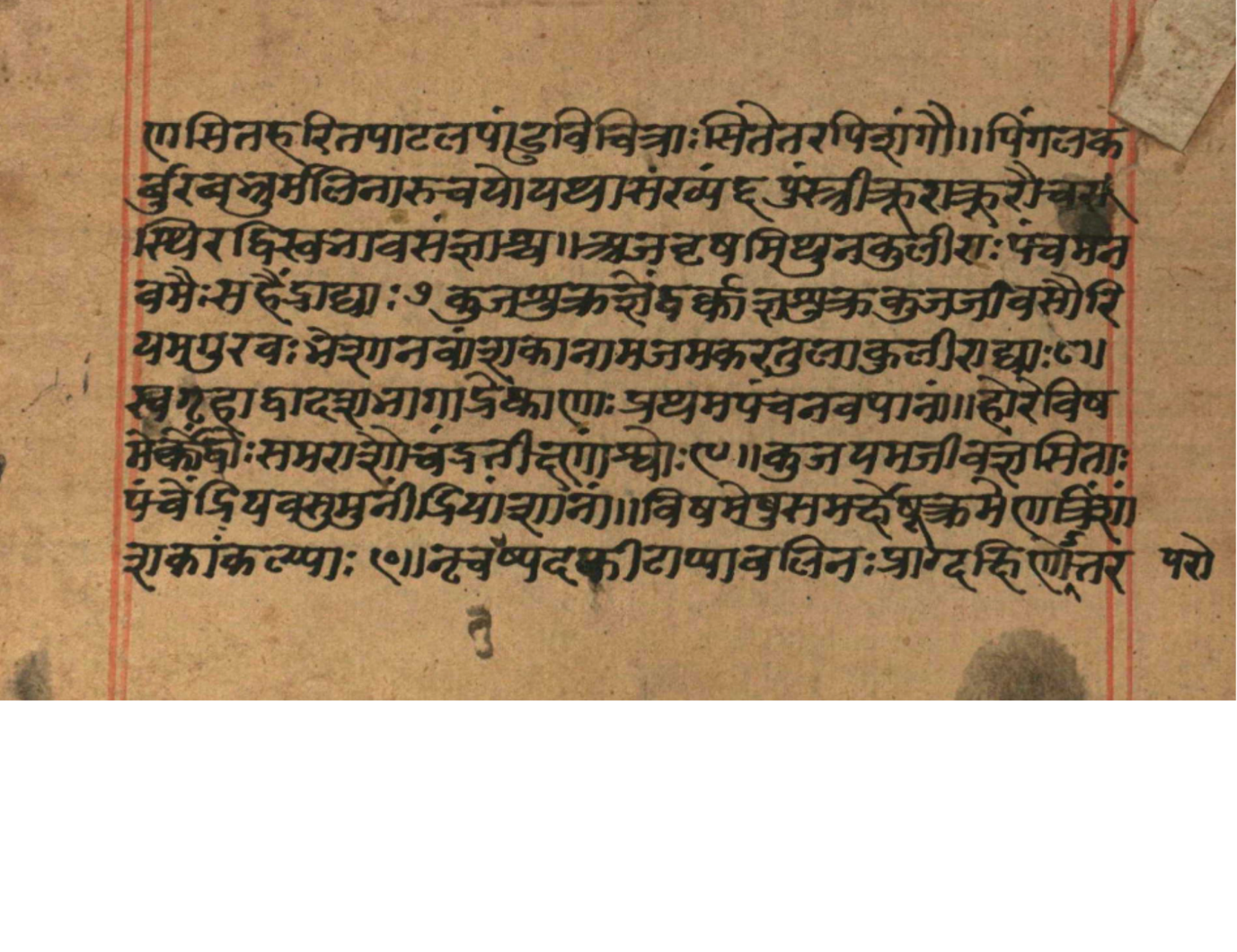
The Laghujātaka of Varāhamihira opens with a striking image: the zodiac is a body, and the signs are its limbs. Aries is the head, Taurus the face, and the list runs down through arms, heart, belly, hips, and knees until Pisces stands for the feet. The sixth-century astrologer-astronomer is not being poetic for its own sake — he is giving students a memory map for the entire chart, and a diagnostic tool for reading character.
The Body of the Zodiac
From the opening chapter of this manuscript of the Laghujātaka (the 'Short Jātaka'), the correspondence is stated directly, and immediately put to work.
The head, face, arms, heart, belly, hips, bladder, secret part, thighs, knees, shanks, and feet — these are the signs beginning with the zodiacal signs. One should consider the limbs of the Time-Person and of men at the time of birth; they are nourished or afflicted according to the conjunction of good or evil planets.
Because each sign rules a part of the body, a planet's placement tells you which limb is nourished and which is afflicted. Mars in the head (Aries) brings courage and cuts, but also headaches and rashness. Venus in the heart (Leo) brings love and artistic talent, but also attachment and excess. Jupiter in the feet (Pisces) brings stability and pilgrimage, but also weight and sluggishness. The chart becomes a diagnostic diagram of the person it describes — not just their fortune, but their physical temperament and the likely sites of illness or strength.
The Twelve Signs and Their Temperaments
Varāhamihira then classifies the signs the way a naturalist would, recognizing that temperament shapes behavior.
Aries, Taurus, Leo, and the first half of Capricorn are quadrupeds; the second half of Capricorn is an insect; Cancer is a reptile; Scorpio is declared [as such].
This is not arbitrary symbolism — the temperament of the sign shapes how its planets behave. A malefic (harmful planet) in a fixed, quadruped sign works differently from one in a watery, mutable sign, and the text's whole system of strengths and friendships depends on getting these classifications right. A planet in Aries (a fixed quadruped) is stubborn, direct, aggressive. The same planet in Pisces (a water-dweller, dual nature) is moody, evasive, fluid. The classification is practical astrology — not ornament, but grammar.
The Planets and Their Friendships
To read a chart, the astrologer must know which planets support each other and which oppose. Varāhamihira's system of planetary friendships is precise and verifiable.
Friends: from the Sun — Jupiter; from the Moon — Mercury and Jupiter; from Mars — the Sun; from Mercury — the Moon, Mars, Jupiter and Venus; from Jupiter — the Moon, Mars, Mercury and Venus; for some, others are enemies.
The Sun and Mars are mutual friends, both fiery and direct. Mercury, the most adaptable planet, is friends with nearly everyone except Jupiter. Venus and Saturn are typically enemies, representing pleasure and restriction. These relationships are not mystical — they describe how the planets' natures interact. A chart heavy in friendly conjunctions tends toward harmony; one filled with enemies tends toward struggle and learning through conflict.
The Houses: Geography of the Chart
The twelve houses radiating from the ascendant are not abstract categories. They are locations, each with a specific domain of life.
From the ascendant, the houses are called: body, wealth, siblings, friends, children, enemies, health, death, dharma, karma; the fourth from the ascendant is called the square, the desired [house].
The first house (the ascendant) is the body and self; the second is wealth and resources; the third is siblings and short journeys; the fourth is home, property, and the mother. The seventh is marriage and open enemies; the tenth is career and public standing; the ninth is dharma and the father; the twelfth is loss and foreign lands. Within this geography, a planet's position tells a complete story. Jupiter in the second house brings financial ease; Saturn in the second brings debt or delay. Mercury in the third brings quick intelligence and communication; Mars in the sixth brings the ability to overcome enemies. The chart is not fatalism — it is a map of influences and tendencies that a conscious person can work with.
Calculating Strength and Duration
Varāhamihira develops a sophisticated method for calculating the strength of planets and the duration of their periods (dashas) in a person's life.
In the house of a friend, when aspected by benefics, and in the house of the Moon and Venus; in the house of a woman, in the house of a man — the remaining are upaga (approaching). In their own days and others, malefic and benefic; in the bright and dark fortnights, the latter are strong.
A planet gains strength through exaltation, placement in its own sign, conjunctions with benefics, and placement in the houses of friends. It loses strength in debilitation, enemy houses, and proximity to malefics. But strength is also temporal — a planet is stronger by day in the day-hours, stronger at night in the night-hours, stronger in its own weekday, stronger in the bright fortnight when aspected by benefics. The astrologer calculates these overlapping strengths to determine periods of opportunity and challenge in a person's life.
An Essence in Āryā Verses
Varāhamihira says he examined the śāstras and condensed their essence into Āryā meter, calling the result 'a lamp in darkness' that reveals the accumulated karma of previous births. This manuscript is a window into how that famous condensation was copied and preserved — a compact, memorizable guide to reading a life from the sky. The Laghujātaka became one of the most influential Sanskrit astrological texts, studied across centuries and regions, because Varāhamihira solved a hard problem: how to teach complex relational knowledge in verse form, memorable enough for students to learn by heart and carry without manuscripts.