
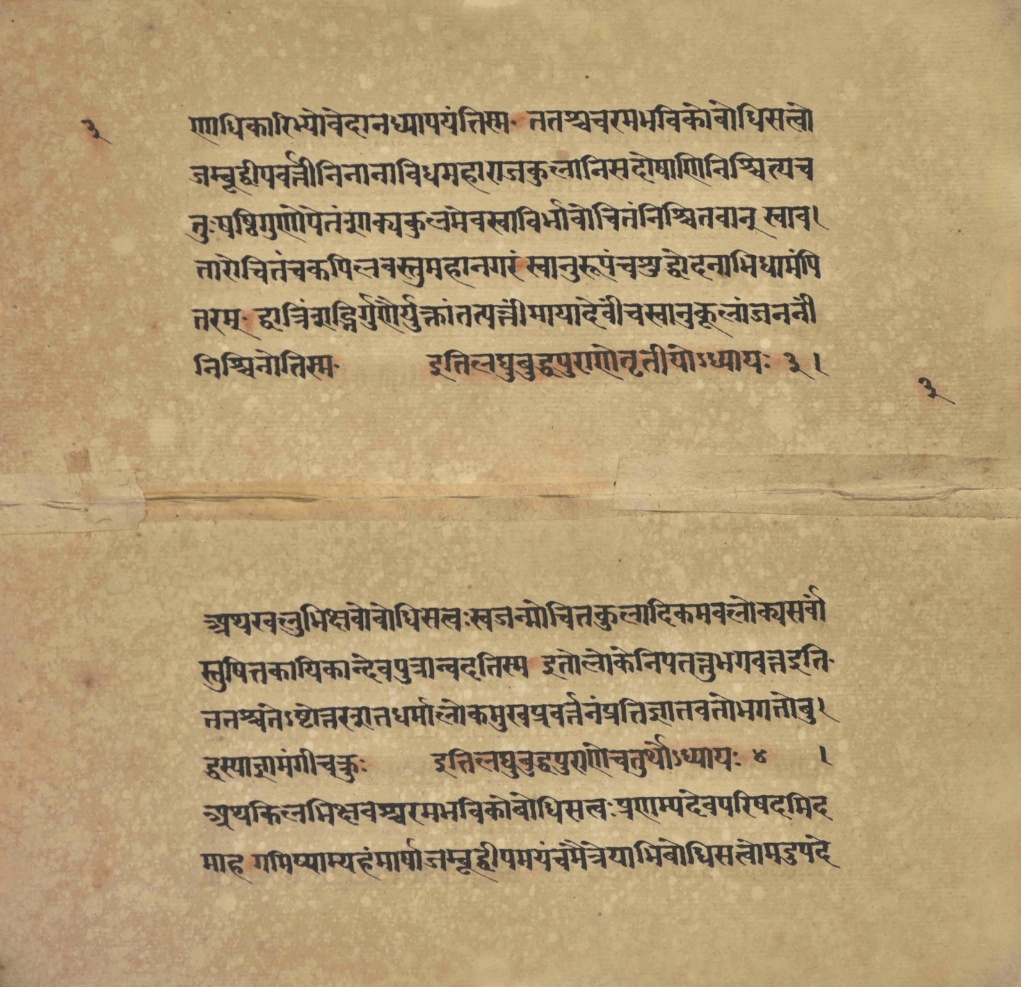
The life of the Buddha begins before birth—with a choice. The Laghubuddhapurāṇa, a Sanskrit retelling of the Buddha's life, opens not in a palace but in the Tuṣita heaven, where the Bodhisattva of the final existence surveys every great family of Jambudvīpa before deciding where to be born. The Buddha's birth is presented as an act of deliberate descent, not fate or accident.
A family chosen with care
The text describes the Bodhisattva's survey as methodical—the same care a discerning buyer gives to a purchase. Many royal families had defects. Only the Śākya family, endowed with sixty-four qualities, was suitable for his manifestation. King Śuddhodana was chosen for his thirty-two qualities. Kapilavastu was selected as the great city most fitting for his descent. And Queen Māyādevī was deemed suitable as his mother.
The Bodhisattva of the final existence, having examined the various great royal families of Jambudvīpa and found them defective, determined that the Śākya family alone, endowed with sixty-four qualities, was suitable for his manifestation. He determined that Kapilavastu, the great city, was suitable for his descent, and King Śuddhodana, endowed with thirty-two qualities, as his father, and Queen Māyādevī as his mother.
Nothing is accidental: the family, the city, the father, and the mother are all assessed and chosen. The narrative insists the Buddha's arrival was deliberate—a teaching in itself about intentionality and care.
The descent and the prophecy
Before descending, the Bodhisattva establishes the future Buddha Maitreya in Tuṣita to carry on the teaching. Then he descends to Jambudvīpa surrounded by gods. The manuscript narrates the descent with precision: "On the full moon day of the month of Vaiśākha, under the Puṣya constellation, the Bodhisattva, by his own yogic power, descended from the excellent Tuṣita heaven and entered the womb of his mother Queen Māyā from her right side."
At birth, the Bodhisattva takes seven steps in each of the ten directions. Seven days later, Queen Māyā passes away and is reborn among the thirty-three gods—a narrative motif that underscores the extraordinary nature of his birth: even his mother cannot remain in the world that bore him.
The sage Asita's prophecy
When the great sage Asita comes to examine the infant, he sees the eighty minor marks of the one destined for perfect enlightenment. But his prophecy is double-edged: "Before long, having departed from the palace, he will go forth into homelessness." King Suddhodana, upon hearing this, falls at the sage's feet and worships him as "the physician of the entire world." The text is placing medical and spiritual knowledge in the same frame: healing the body and healing the soul are not separate arts.
Training and marriage: the prince's preparation
The prince is brought to the writing school where he masters various scripts and writing systems under the teacher Viśvamitra. This is not idle education; it is preparation—the development of wisdom and skillful means. Later, the prince marries Gopā, daughter of the Śākya Dandapani, who becomes his chief queen among eighty-four thousand women. The marriage is arranged, but the text notes that Gopā has her own dream on the night the prince decides to renounce the world—she is witness to his turning point, not merely a background figure.
The great renunciation: six years of austerity
The prince's departure from home is orchestrated in secrecy. With divine assistance, the doorkeepers fall into sleep. The charioteer Chandaka, weeping, follows the prince's orders. They travel six yojanas on the horse Kantaka. At dawn, at the river bank, the prince dismisses the divine assembly and the charioteer. He cuts off his topknot and casts it into the sky, where divine youths catch it, offer him ochre robes, and carry both to the divine world for worship.
Then comes the asceticism: six years of extreme meditation beneath the Jambu tree, without food. The manuscript describes children throwing grass and cotton through his ears and nostrils while he sits immovable. "Yet, like Mount Meru the immovable, I never once fell from my meditative absorption." The text is explicit: this is not peaceful contemplation. It is endurance of suffering as a method of understanding suffering's nature.
Temptation by Māra and the path to enlightenment
After six years, the Bodhisattva accepts food from village daughters and regains his strength. He bathes in the Nairañjanā river and proceeds to the Bodhi tree. There he makes his vow: "Let my body dry up on this seat, let skin, flesh, and blood decay; without attaining enlightenment, difficult to obtain for many aeons, I shall not move this body from here."
Then Māra the Evil One, named Namuci, desiring to break that concentration, spoke this: 'Son of the Śākyas, arise! What is the use to you of this life with bodily exhaustion? Living, you will practice the Dharma; for while living one does those things by doing which one does not grieve afterwards. You are emaciated, discolored, miserable; death is near to you.'
Māra tempts him with the logic of karma and merit: give charity, offer fire-sacrifices, accumulate merit while alive. But the Bodhisattva's reply is striking: "I have no need of even the slightest merit, Māra. Those who have need of merit—those you should speak to. I do not consider death at all; for life ends in death." He rejects the entire framework of merit-making, identifying the armies of Māra as desire, displeasure, hunger and thirst, gain, praise, honor, and false fame.
The turning of the wheel
At dawn, the Bodhisattva attains perfect enlightenment. The manuscript then moves quickly through his decision to teach: the turn of the wheel of Dharma at Ṛṣipatana, the deer park near Vārāṇasī, where he addresses the five Bhadravargīya ascetics. The four noble truths, the eightfold path—the text presents the teachings not as abstract doctrine but as the culmination of a life shaped by deliberate choice, systematic preparation, and unflinching confrontation with suffering itself.
What makes the Laghubuddhapurāṇa remarkable is not its length (it is brief) but its framing: a birth presented as an intentional act, a renunciation framed as the refusal of comfort, an asceticism portrayed not as weakness or flight but as a method of understanding. Every element—the choice of family, the training, the marriage, the great renunciation, the temptation, the enlightenment—is woven into a narrative that treats the Buddha's life as a coherent teaching about how to live deliberately in the face of suffering.