
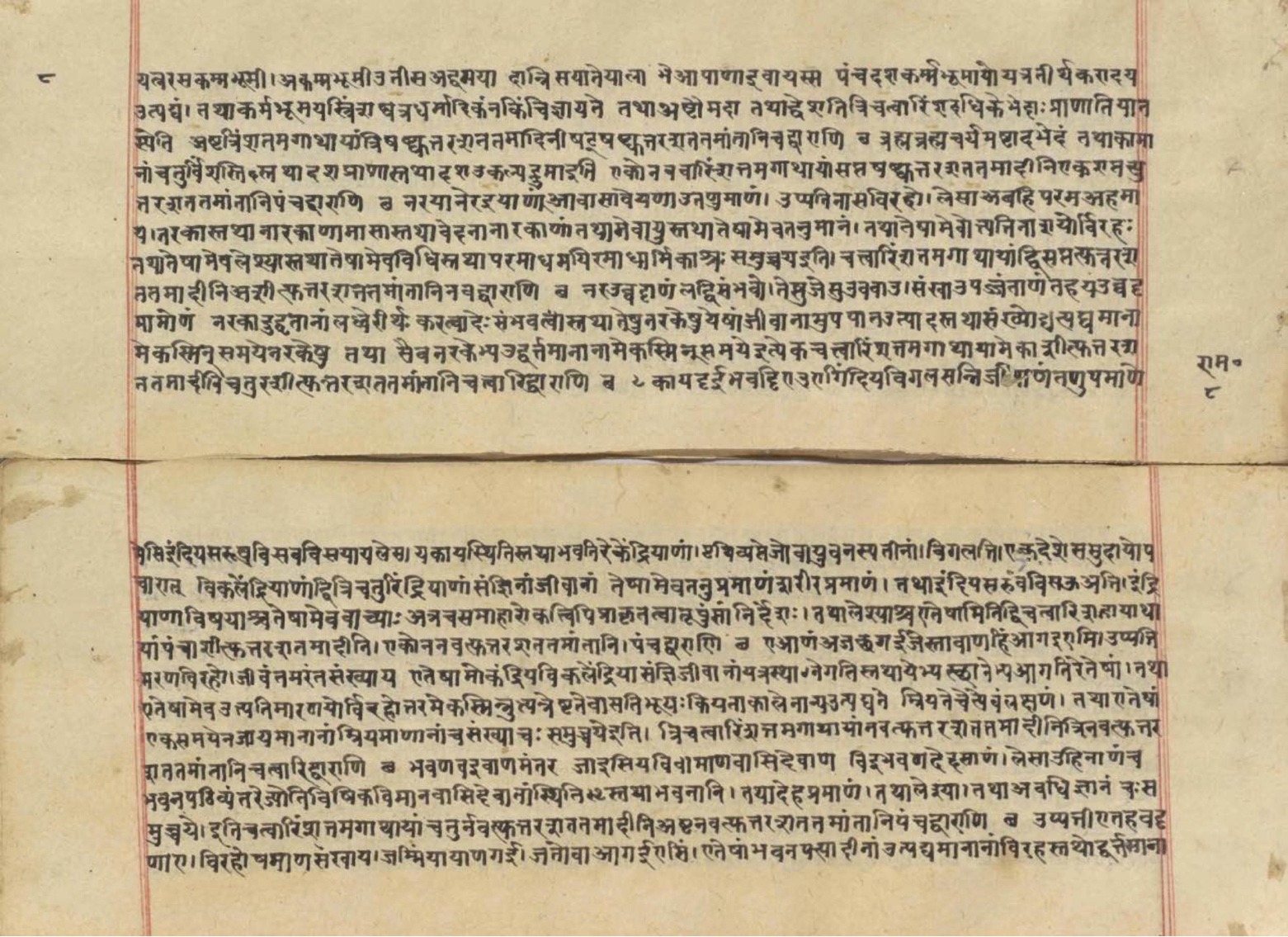
The Pravacanasāroddhāra — 'the essence extracted from the doctrine' — is a Jain text that organizes the entire teaching into numbered categories, and this manuscript preserves a great commentary on it. Its centerpiece is the sermon itself: the Blessed Lord Mahāvīra, seated on a jeweled lion-throne, delivering the essence of the teaching to the faithful.
The sermon in the assembly
The commentary sets the scene with the care of a chronicler. Imagine a city free from sin, adorned with rows of palaces shining with the brilliance of the rising sun, surpassing even the city of the gods in its abundant prosperity. In an assembly hall resplendent with three unparalleled walls—in that place, seated on a magnificent lion-throne inlaid with various jewel fragments, the Blessed Lord Mahāvīra, whose supreme greatness was honored by the chief of gods, demons, kinnaras, and human kings, delivered to all those present, who were worthy of the highest teaching, the essence of the sermon.
In the assembly hall resplendent with three unparalleled walls — in that place, seated on a magnificent lion-throne inlaid with various jewel fragments, the Blessed Lord Mahāvīra, whose supreme greatness was honored by the chief of gods, demons, kinnaras, and human kings, delivered to all those present, who were worthy of the highest teaching, the essence of the sermon.
Then, by the master Sudharma, who was the chief of those who followed that teaching, the meaning was preserved and explained. The transmission is the whole tradition in miniature — the word given by the Jina, then carried and transmitted by the foremost disciple, then committed to the scriptures. What is remarkable about this manuscript is that it does not stop at the sermon itself. It goes on to explain every door of knowledge, every category through which Mahāvīra's teaching unfolds.
The doctrine as numbered categories
What follows is a teaching organized the way a Jain catechesis always is — by enumeration. The commentary moves through 264 doors of knowledge, organized across 64 verses. Each door opens onto a field of inquiry: the regions where Tīrthaṅkaras are born, the karma-lands and karma-less lands, the destinations of rebirth, the qualities of the perfected ones, the lifespan of the Jinas, the names of the Gaṇadharas who preserved the teaching, the nature of right faith, and the methods by which all beings can attain liberation.
In the karma-less lands, in the Udisa and other continents, in the Videha and other regions, in the fifteen karma-lands where Tirthankaras and others are born. Thus in thirty-three dharma-lands something is born, thus in eight Maha-lands, thus in forty-eight additional Bhogabhumis.
Categories as a way of knowing
The Jain cosmological imagination loved number — how many lands, how many gates, how many modes of rebirth — because enumeration was a way of holding the vast together. Where Western philosophy might ask "what is the nature of reality?", the Jain text asks "in how many ways does reality present itself?" The answer is always a number. Thirty-three dharma-lands. Eight Maha-lands. Forty-eight additional Bhogabhumis. Fourteen perfected states. Twenty-seven monastic virtues. These numbers are not abstractions; they are a map of the cosmos as the Jains understood it.
The commentary as transmission
This manuscript is remarkable because the commentator does not claim to innovate. "Nothing new has been added here by me," the author states. "Whatever is worthy of acceptance by the wise, whose intellects are devoted to the scriptures, has been taken from the scriptures." Yet in taking the teaching and organizing it into 264 doors, the commentator creates a structure that allows a practitioner to navigate the whole of Jain philosophy. Each door is a question; answering it in sequence, one moves through the entire landscape of the teaching.
A monument to transmission
The great commentary, running to nearly four hundred pages, is a monument to a habit of mind: the doctrine organized, numbered, and memorized, so that nothing of Mahāvīra's sermon would be lost. In a tradition that values exact knowledge—jnana practiced with precision—this manuscript is both a record of what was taught and a tool for teaching it again. Every reader who works through these 264 doors becomes, in turn, a carrier of the teaching.