
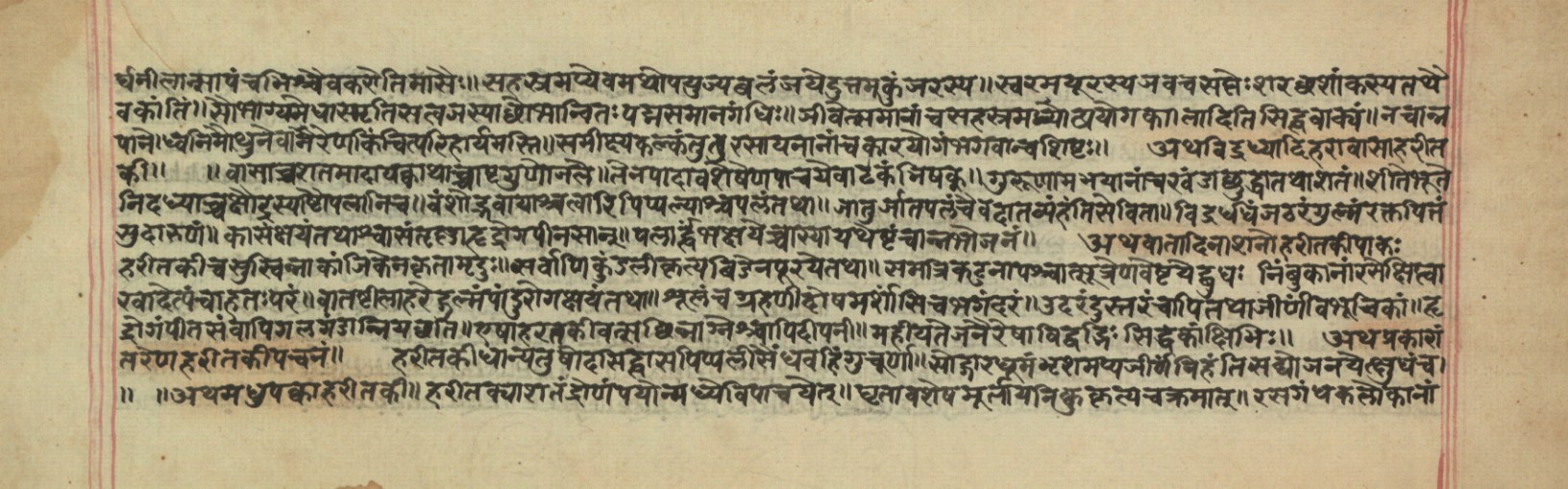
Terminalia chebula—harītakī, pathyā, jaya—appears in the Ayurvedic pharmacopeia as close to a universal remedy, and the Harītakī-prayoga, a five-folio manuscript from the Poona University Collection, is devoted entirely to documenting its preparations. This text opens not with philosophy but with recipes: precise formulations drawn from the Dhanvantari Saṃhitā, each attributed to legendary figures, each targeting specific illnesses.
The First Preparation: A Digestive Tonic
The manuscript's opening formula is elaborate. Harītakī is soaked in ocean water, then boiled with daśamūla, triśigru, granthika, mūlaka, and a battery of salts—sauvarcala, saiṃdhava, svarjikā, among others. The fruit is then removed and hollowed, its cavity packed with pippalī, yavāgraja, parpaṭa, and more salts, before the whole is cooked in lemon juice. The text states it was "made by Dhanvantari, spoken of as eaten by Garuḍa, and similarly by Bhīmasena and Kumbhakarṇa in ancient times." The claim is extravagant but purposeful: this preparation is for strength, for destroying duodenal diseases, and for removing indigestion. It is supremely wholesome.
This was made by Dhanvantari, spoken of as eaten by Garuḍa, and similarly by Bhīmasena and Kumbhakarṇa in ancient times. It is supreme for increasing strength, destroying duodenal diseases, and removing indigestion. This Harītakī exists on earth—there is nothing higher.
The Honey Forms: A Formulation Against Everything
The text then turns to honey-based preparations, madhupakka harītakī—harītakī processed with honey. The list of conditions it claims to treat is staggering: cough, asthma, consumption, hiccup, vomiting, fainting, intoxication, liver and spleen disorders, abdominal tumors, irregular fever, dysuria, diabetes, blood disorders, grahaṇī, raktapitta, leprosy, epilepsy, anemia, and jaundice. Rather than skepticism, the manuscript offers method: soak harītakī in honey for one month to make kṣaudra harītakī. Alternatively, cook it with bilva, gokṣura, and eranda for colic and āma-atiśāra, a specific application within the broader umbrella.
The text mentions a separate decoction of harītakī with ginger, rock salt, long pepper, ajamoda, cumin, and black pepper for gulma, splenic disorders, constipation, and hemorrhoids. Each variation narrows the weapon to fit the wound.
The Grand Electuary: Sarvārogaghni
The manuscript's most ambitious formula is the Sarvārogaghni Vāsiṣṭha—"destroyer of all diseases," a harītakī electuary meant to be taken over months. Its ingredient list runs from daśamūla and aśvagandhā through bhallātaka, uśīra, haridrā, and pippalī, cooked in iron vessels with ghee and honey. This is not a quick fix; it is a systematic rebuilding, a monthly course in which the pharmacopoeia itself becomes the physician. The text attributes this formula to Śiva himself, whom it calls "Sarvavaidyopānama"—the Supreme Physician.
This harītakī is wholesome and kindles the digestive fire. This is highly valued by people, by the learned, by those desiring perfection.
The Eye Formula and Beyond
For specific organs and conditions, the manuscript tailors further. Dāśāmṛta harītakī—harītakī with ten medicinal roots—addresses eye diseases including cataracts and night blindness. The precision here is notable: this preparation is not for fever in general or digestion broadly, but for the eye specifically, for the progressive dimming of sight in age, for the refractive error no modern pharmaceutical can touch without side effects, yet which the traditional formula seems to claim it can reverse or prevent.
Another preparation combines harītakī, ginger, rock salt, long pepper, ajamoda, cumin, and black pepper as a decoction for conditions ranging from gulma to hemorrhoids. The repetition of harītakī across these formulations is not accident; it is the anchoring herb, the one constant in a pharmacy of variation. Different carriers—honey, oil, decoction—and different companions target different presentations of the same underlying imbalance.
A Closing Reflection
The manuscript closes by attributing itself to Śiva, 'Sarvavaidyopānama,' 'one with the name of the supreme physician.' It is a claim of authority and humility at once: the text is not invention but recovery, not pride but service. In this spirit, one fruit, dozens of processes, and a claim bordering on the universal emerge together—a record of how a single botanical substance could anchor an entire therapeutic tradition, holding within it remedies for digestion, for blood, for the eye, for strength, for time itself.