
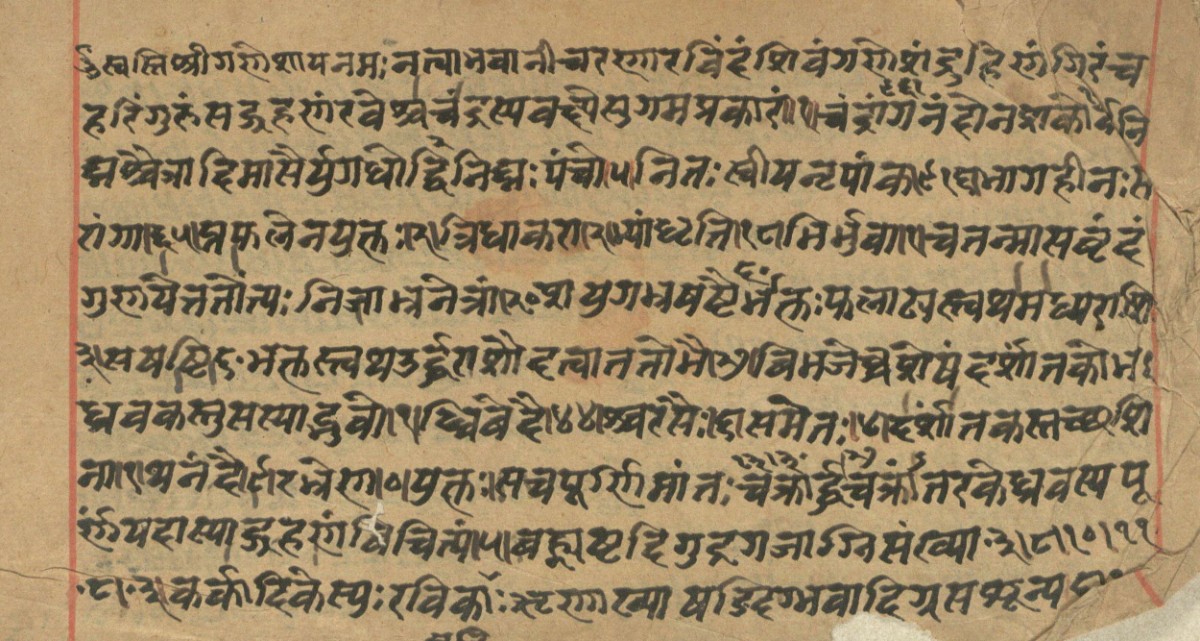
An eclipse is a question with a date. When exactly will the Moon enter the shadow, how long will it stay there, and when will it emerge? Grahaṇagaṇita — literally 'eclipse computation' — is the branch of Indian astronomy that answered those questions with arithmetic, and this small manuscript (just three pages of densely packed verses) is a working copy of that craft.
The algorithm in verse
The text opens with invocations to Gaṇeśa, Bhavānī, Śiva, and the planets, then moves straight into the mathematics of the Moon. The author promises to speak "of the Moon in an easy manner." What follows is deceptive in its simplicity. The text works with intercalary months, mean longitudes, and the time-units of an eclipse — nāḍīs and palas, the subdivisions of time that would later become minutes and seconds.
Having bowed to the lotus feet of Bhavānī, to Śiva, Gaṇeśa, Brahma, and the mountains, to Hari, the Guru, the good planets, I shall speak of the Moon in an easy manner.
What follows is a chain of sexagesimal computation: the text works through a long sequence of multiplications and divisions to arrive at a final answer about when the Moon's shadow will fall. Every intermediate step is recorded in the margins — the 'arrows,' 'wheels,' and 'digits' that are the steps of the computation — so a practitioner could check their own work against the verse and catch any error before trusting the prediction to the public.
Eclipse parameters as technical terms
The manuscript's vocabulary is precise, using technical terms that modern astronomy would recognize. Sparśa means first contact — the moment when the Moon's edge first touches Earth's shadow. Vimarda means the middle of total obscuration — the deepest moment when the Moon sits fully inside the shadow. And the durations that connect them are calculated to the nāḍī — one-sixtieth of an hour, about twenty-four minutes in modern terms. The sophistication lies not just in the mathematics but in the precision of what is being measured.
In Bhāgadika, touch alone [is] the nāḍīs 51, having been refined by the former, excluding the vika, and the Moon 35, the wheel, in the remainder of nāṭkōṣṭha, in the lipādikā, from the middle arrow to the southern half, in the dik 35, the inter-arrow as stated.
What looks cryptic at first is a record of intermediate results — the working shown for a computation, preserved in the margin the way a modern student keeps scratch work beside a formula. The numbers (51 nāḍīs for first contact, 35 for a particular lunar position) are not abstract; they are the result of careful observation and calculation carried forward through centuries of eclipse records.
Why eclipse math mattered
Eclipses were not just spectacle in the Indian calendar; they punctuated the ritual year and carried religious significance. A solar eclipse or lunar eclipse would fall on particular lunar days (tithis) and constellation positions, and getting their timing right was a matter of both practical and religious consequence. A priest needed to know the precise moment the eclipse began, so that the prescribed rituals — bathing, fasting, prayers — could be coordinated. A king needed the prediction to plan public ceremonials. An astrologer needed it to read omens. The mathematics of the sky was a working technology — compact enough to be memorized in verse, precise enough to predict the Moon's vanishing, and copied by hand so the knowledge survived.
A craft preserved in three pages
This fragment is a reminder that Indian astronomical knowledge lived in these compressed forms: a few pages of Sanskrit verse, full of technical terms, working through an algorithm step by step. The beauty of the grahaṇagaṇita is that it shows the thinking — not just the answer, but the path to the answer, laid bare in numbers and procedure. For anyone learning to predict eclipses, this manuscript was a handbook. For us, it is a window into how mathematics and observation were married in the service of both practical need and religious precision.