
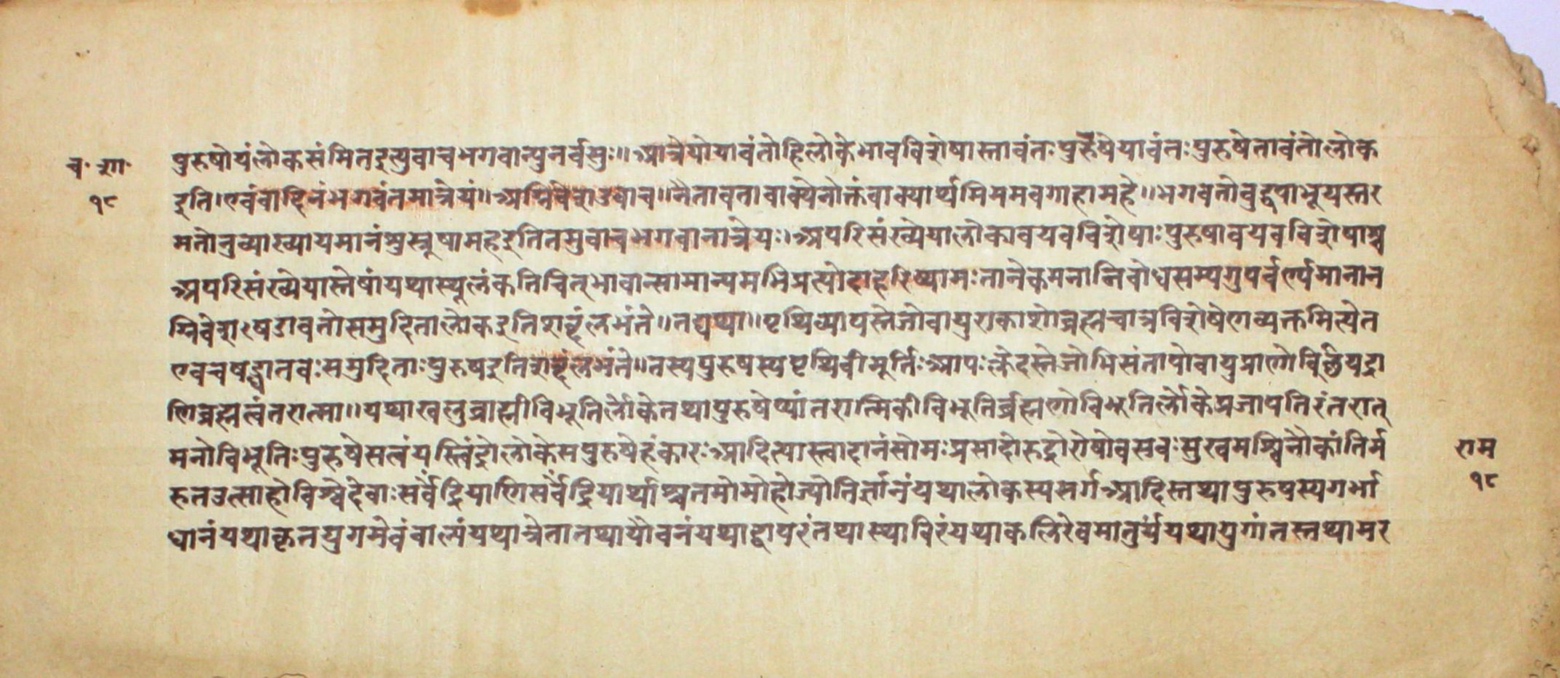
Where does a fetus come from? This manuscript of the Carakasaṃhitā answers with a list that mixes biology and philosophy: the father, the self, adaptability, essence, and inherent nature. The embryo is not just a physical assembly — it is a being with continuity, and it develops through the same elements that make up the cosmos.
Five Sources, One Embryo
The passage sets out the constituents of conception without reducing life to matter alone.
The embryo arises from these conditions: from the father, from the self, from adaptability, from essence, and from the inherent nature. Initially, at the union of semen, blood, and life, the term 'embryo' is applied when it resides in the womb. The embryo, composed of modifications of the five great elements — space, air, fire, water, and earth — serves as the foundation of consciousness.
Notice what is included: the father contributes seed, but the self (ātman), the adaptability of the mother's constitution, nutrition, and temperament all have a share. The text names these as non-negotiable factors. Conception cannot occur without all five. Embryology here is never just biology — it is the meeting of matter and continuity of consciousness.
The Body as the Universe
The most famous idea in this section is the correspondence between the person and the world. The text has a wonderful dialogue in which the sage Atreya spells it out to his student Agnivesha.
Lord Punarvasu said: 'This human being is commensurate with the universe.' Atreya explained: 'Whatever distinct entities exist in the world, the same exist in the human being, and whatever exists in the human being, the same exists in the world.'
The six elements — earth, water, fire, air, space, and Brahman — appear in the body as solid form, moisture, heat, life-breath, cavities, and inner self. The same elements that compose the cosmos compose the person. In the universe, Indra represents the ego; in the human being, the sun represents the act of taking in. In the universe, the moon represents grace; in the person, it does the same. This is not metaphorical — it is a claim about the structure of reality.
Development Month by Month
The manuscript then traces fetal development with remarkable specificity. In the first month, the embryo becomes coagulated and formless. By the second month, it takes on a definite shape — fleshy mass for females, a lump for neuters, and solid for males. In the third month, all senses and all limbs develop simultaneously. But the manuscript goes further than anatomy: it tracks the psychological and spiritual development too. By the fourth month, the embryo gains stability; by the fifth, the mind begins to form. By the seventh month, the fetus becomes suddenly endowed with all faculties.
In the sixth month, the fetus gains strength and complexion more than in other months, so the pregnant woman particularly suffers a loss of strength and complexion. In the seventh month, the fetus is suddenly endowed with all faculties, thus the pregnant woman becomes utterly exhausted in every way.
The text notes something profound: the fetus and mother exchange vitality through their connecting vessels. As the fetus grows, the mother grows weaker. This is not presented as a problem but as a natural rhythm — the mother nourishes the child at cost to herself. The manuscript is observant about the physical toll of pregnancy and recommends that the pregnant woman be protected with affection and beneficial care.
Doshas and Birth Defects
The manuscript also addresses why some children are born with defects. Aggravated doshas in the parents — particularly when they affect the reproductive tissues — can corrupt the seed or ovum. These corrupted portions manifest in the child as various imbalances or deformities. The text distinguishes carefully between defects from maternal contribution and paternal contribution, recognizing that the sources matter.
An Ancient Framework, Still Coherent
This manuscript is a window into a medical tradition that refused to separate the physical from the philosophical. Conception is a biological event and a cosmic one; the fetus is a body and a self. The Carakasaṃhitā remained the backbone of Ayurvedic learning for two thousand years because it asks the big questions — what is life? how is a person made? what connects the individual to the cosmos? — and its answers are built to last. Reading it, you see why these questions still matter.