
Some deities grant wealth. Some grant wisdom. Bagalāmukhī grants silence — to your enemies. This short tantric hymn, the Brahmāstra, is devoted to the yellow goddess who holds a mace in one hand and, in the other, the tongue she has seized from her opponent.
The goddess of the seized tongue
The hymn's iconography is precise and memorable.
I bow to the goddess who is not approached by enemies, who has the color of fresh gold, who is adorned with yellow garments, ornaments, and garlands, who holds a mace, and who has a tongue that is the enemy of the enemy. Taking the tip of her tongue in her left hand, the goddess torments the enemies; with her right hand, by the blow of her mace, I bow to her arm adorned with yellow garments.
She is stambhana personified — the power that arrests. And what she arrests, above all, is speech.
What the mantra does
The effects are catalogued with a confidence that is almost comic — and entirely serious in intent.
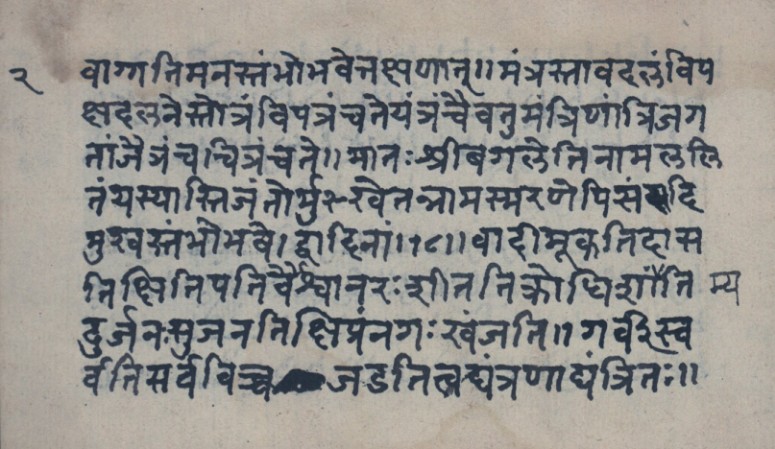
May the stambhana (paralysis) of speech and mind be for chatterers. The mantra alone is sufficient to destroy enemies. The speaker becomes mute, the servant of the earth becomes fire, the angry one becomes cool, the wicked one becomes good, the lame one quickly becomes a mountain (able to walk). Pride becomes humble, the all-knowing one becomes dull — by your mantra-empowered yantra.
Protection for a fragile world
Dated to Śaka 1755 and completed by the scribe Ananta Bhaṭṭa Bhāve, the manuscript places the hymn in its practical context: recited among enemies, in debates, when a king is enraged, during eclipses and at night. It is a text for the moments when words fail and something stronger is needed — a reminder that the tantric world took its protection seriously, and equipped its devotees with a goddess who could hold an enemy's tongue.
nī || 6 || pī yū ṣo da dhi ra tna cā ru vi la sa dra kto jjv a la nmaṃ ḍa pe śrī siṃ hā sa na mū la pā ti ta ri pu pre tā sa nā dhyā si nīṃ || sva rnā bhāṃ ka ra pī ḍi tā ri ra sa nāṃ bhrā mya dg daṃ bi bhratīṃ ya stvā pra dhyā ya ti ta sya yā ni vi pha la sa dyo ba sa rvā pa daḥ || 7 || de vi tva cca ra ṇāṃ bu je vi ta nu te yaḥ pī ta pu ṣpāṃ ja liṃ mu drāṃ vā ma ka re ni dhā ya ca pu na rmaṃ trī ma no jñā kṣa raṃ || pī ta dhyā na pa ro bi jaṃ bha ga va tyā [?] hlīṃ ja pe t prā rthi taṃ ta syā mi tra mu kha sya
I have taken refuge in you; O Vishveshvari, be gracious and protect me.||92|| You are the supreme knowledge, the mother of the three worlds, the destroyer of hosts of obstacles; the attractor of women, the great one, the severer of the single [obstacle?]; the expeller of the wicked, the deluder of animals, the one who paralyzes the tongues of enemies—victorious, O supreme knower of the Brahma-astra.||93|| In the danger of thieves, at the time of striking, in bondage...
In the midst of enemies, in debates of knowledge, in disputes, when the king is enraged, at the time of an eclipse, at night, when under another's control, in the company of women, at the time of killing an enemy, when life is in danger, or in battle—whether going or standing, a wise person should quickly have this hymn recited three times
|| 9 || Restraint of the wicked, pacification of fierce obstacles, dispelling of poverty, cause of the stability of kings, attraction of the minds of deer-eyed women, sole abode of good fortune, full of compassionate glances for my eyes—may your face, O Mother, appear before me for the destruction of enemies
This page contains verses invoking Vishveshvari as a protective deity, describing her as the supreme knowledge (vidya), mother of the three worlds (triloka janani), destroyer of obstacles (vighna), attractor of women (yosha akarshana), expeller of the wicked (dushta uchchatana), deluder of animals (pashu moha), and paralyzer of enemy tongues
||5|| With trembling golden earrings illuminating her beautiful cheeks, with a face bearing the radiance of shining golden champaka flowers and the moon, with a mace struck against the enemies, with a tongue that seizes the enemies, I remember you, Bagalamukhi, who paralyzes the various speeches of enemies.