
What is a negative number? For the Bījagaṇita — the algebra section of the mathematical tradition — the answer is money. Positive quantities are dhana, wealth; negative quantities are ṛṇa, debt. And with that single metaphor, the whole algebra of signs becomes as familiar as a ledger.
Wealth and debt, added and subtracted
The rules of signed arithmetic are stated in financial terms, and the examples follow. The text does not ask the student to imagine abstract numbers — it asks them to picture themselves as a merchant or a money-changer, standing at the balance with weights of gold and IOUs to settle.
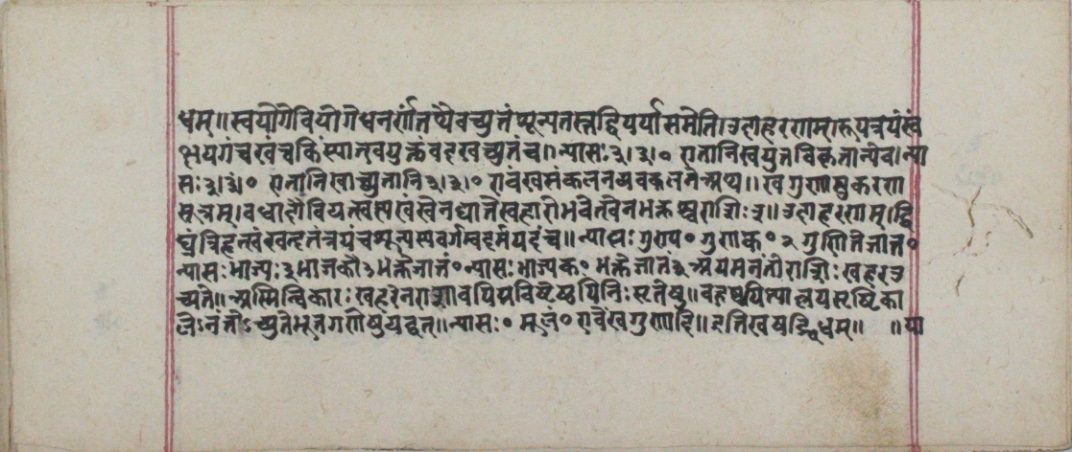
Having quickly purified one's own debt and debt as well as the reverse, the remainder remains. The debt being purified should be one's own, thus in combination, produced 1. Wealth multiplied by wealth, debt by debt — one's own product, in multiplication of same colors, in division also thus explained.
Two wealths multiplied make wealth; two debts multiplied make wealth; a wealth and a debt multiplied make a debt. The algebra of signs falls out of the logic of money. When a debtor owes to another debtor, the transfer of debt cancels out into positive wealth — this is the rule that two negatives make a positive, seen through the eyes of a merchant settling accounts.
Zero, and what lies beyond
The manuscript then takes up zero — the operations of zero-addition, zero-subtraction, zero-multiplication, and the strange case of division by zero. Here is where the metaphor stretches to breaking, where money becomes abstract again.
In addition, in subtraction, in multiplication, and also in division, zero added or subtracted — its opposite is obtained. Example: Three rupees, zero, subtracted from zero added to zero — what would be the result? Tell me, added to zero or subtracted from zero. In multiplication by zero, zero-divisor would be, and a quantity divided by zero.
The text recognizes that a quantity divided by zero does not vanish — it becomes a different kind of quantity, one that the tradition would go on to name ananta, the infinite. The Bījagaṇita does not shy from paradox. It acknowledges that some operations land outside the normal world of numbers, in a realm the tradition calls the "zero-divisor" — a quantity born of division by nothing.
Algebra in the language of the market
The Bījagaṇita is a reminder that the most abstract mathematics in the Sanskrit tradition was anchored in the most concrete experience — money. Debt and credit gave negative numbers a meaning anyone could grasp; zero was the empty till; and the infinite was what you got when you divided by nothing. Algebra, in this telling, is not a language of symbols floating free but bookkeeping raised to a science, a technology of the mind that lets a merchant track dozens of transactions at once, resolve conflicting claims, and know at the end of the day whether the accounts have settled or what is owed.