
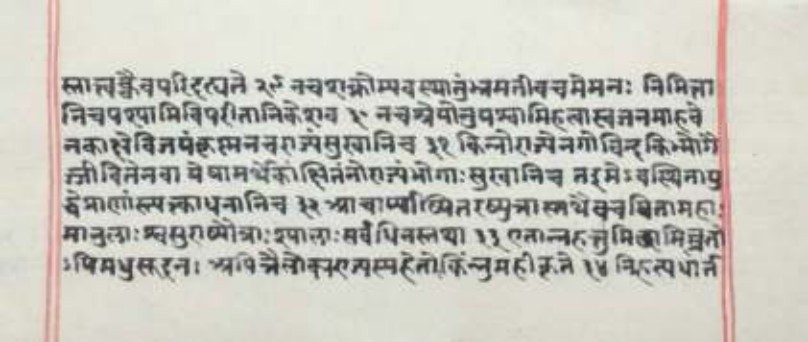
The Bhagavadgītā begins not with philosophy but with a collapse. Before Krishna teaches anything, Arjuna falls apart — his limbs fail, his mouth dries, his skin burns — and the entire teaching is an answer to that moment. This manuscript opens at the very beginning, at the moment the crisis is set in motion.
The field and the question
The text opens with the famous frame: the blind king asking what happened on the battlefield.
On the field of righteousness, the field of the Kurus, gathered together desiring to fight, what did my sons and the sons of Pandu do, Sanjaya? Seeing the army of the Pandavas drawn up in battle formation, Duryodhana then approached the teacher and spoke these words: Behold this great army of the sons of Pandu, O teacher, drawn up in battle formation by the son of Drupada, your wise disciple.
The stage is set with deliberate slowness — the armies named, the heroes listed — so that the collapse, when it comes, lands with full weight.
Arjuna's body speaks
Arjuna's crisis is described physically, in the body, before it becomes an argument.
My skin burns, and I cannot stand still. My mind seems to whirl, O Keshava. I see omens that are contrary. I do not see any good in killing my own people in battle. I do not desire victory, Krishna, nor kingdom, nor pleasures. What use is kingdom to us, O Govinda? What use are enjoyments or even life?
The weight of kinship
Arjuna's despair is not theoretical—it is rooted in the people before him, the cousins and teachers he must kill.
From the sons of Dhritarashtra, what joy would be ours, O Janardana? By killing these aggressors, sin would only take hold of us. Therefore, we ought not to kill the sons of Dhritarashtra and our own relatives. For what joy are we, O Madhava, if we kill our own people in battle? Even though they may be without virtue, overcome by greed, still we should not kill those who are our own.
Arjuna's objection is not abstract: his kinsmen are aggressors, yet they are also family. Virtue points in both directions. Kill to protect dharma, or spare to honor kinship—he cannot do both, and so he cannot act at all. The armies are arrayed, the conches have sounded, the moment of battle has come, and Arjuna sits frozen in his chariot, grieving.
The teaching that follows
Krishna must answer him not with doctrine but with presence, speaking first of the immortal self and only later of duty, understanding that philosophy without compassion is meaningless.
You grieve for those who should not be grieved for, yet you speak words of wisdom. The wise do not grieve for the living or the dead. This imperishable one is eternal, immeasurable, and beyond destruction. These bodies of the embodied, eternal, indestructible, immeasurable—therefore fight, O son of Bharata!
Krishna begins where Arjuna is — in grief, in doubt — and from there moves toward the teaching. The Bhagavadgītā that emerges is not a textbook of Indian metaphysics; it is a text born from crisis, shaped by doubt, and addressed to the moment when a good man cannot see how to act justly.
The attainment of tranquility
Later in the text, Krishna returns again and again to the theme of equanimity — the state of mind that comes not from success but from seeing beyond the fruits of action.
With the attainment of tranquility, there is the cessation of all sorrows. For the mind of the tranquil person soon becomes steady. There is no intellect for the unsteady, nor is there meditation for the unsteady. For the unmeditative, there is no peace. Where is happiness without peace? The mind that is controlled by the wandering senses is as wayward as a ship tossed by the wind on the ocean.
The Gītā teaches that Arjuna's despair comes from attachment—to the fruits of action, to the lives of his kinsmen, to the idea of a righteous war. Only by acting without attachment to outcome can he be free. This is not cruelty; it is the only way to act with integrity when no action is purely good. He must fight, but not for victory. He must kill, but without hatred. He must accept his duty while remaining unmoved by whether his duty succeeds or fails.
The path of action
At the manuscript's center lies Krishna's resolution: that Arjuna must act according to his duty as a warrior, not abandon action out of fear of sin. This is not permission to be callous; it is a teaching that demands the most rigorous attention to moral law even in the most ambiguous situations.
Abandoning all desires, a person moves about without longing, without possessiveness, without egoism—he attains peace. This is the Brahman state, O Partha. Abiding in this state, one is not deluded. Remaining in this state even at the end of life, one attains the bliss of oneness with Brahman.
That is why it begins here, on this field, with Arjuna's limbs failing and his bow dropping from his hand. The teaching is not abstract; it is emergency medicine for a warrior in moral freefall, and it teaches that the path to wisdom runs through action, not away from it.