
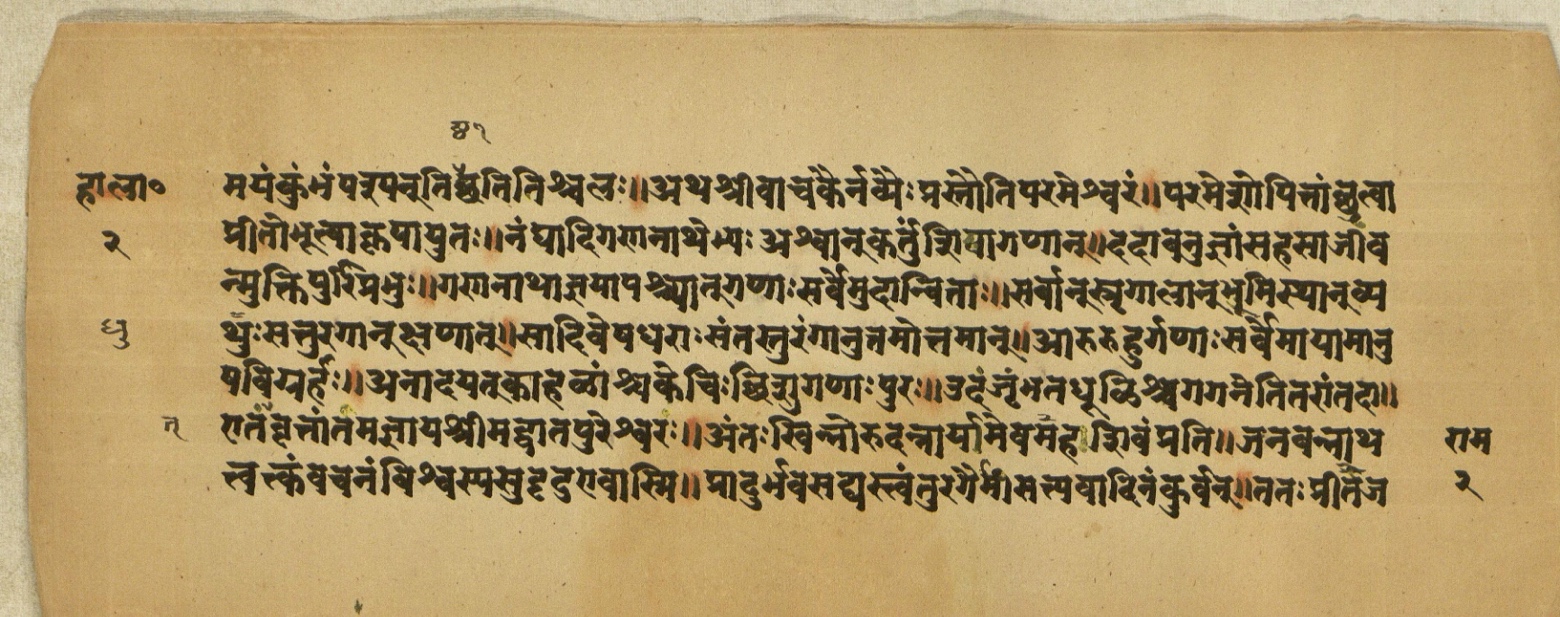
The Aśvaratnaparīkṣā — the examination of the jewel among horses — starts as a story, not a manual. It opens inside the Hālāsya Māhātmya, with Śiva himself "engaged in the sale of illusory horses" to the court of King Mahāpāṇḍya. Only after the divine drama does the text turn to the actual business of judging a horse's qualities. It is a textbook with a mythology attached.
The king who waited for phantom horses
The opening is a small comic masterpiece. "Śambhu, the lord of the earth's treasury, engaged in the sale of illusory horses. Through his playful skill, he astonished the people. 'Today, tomorrow, or the day after, these horses will surely arrive.' Hearing these words, the great king Mahāpāṇḍya, filled with joy, created ponds brimming with water and waited for three days." The king builds ponds for horses that never come — and the text, delighting in the trick, never loses its affection for him.
Śambhu, the lord of the earth's treasury, engaged in the sale of illusory horses. Through his playful skill, he astonished the people. 'Today, tomorrow, or the day after, these horses will surely arrive.'
Devotion tested by fire
The drama deepens into hagiography. A devotee of Śiva endures the court's torments — "with staves of solid wood, they struck his hands and feet, yet repeatedly he cried out loudly, 'Śiva! Śiva!'" — and is hoisted onto a scorching stone slab, untouched by it, while the king watches. The scene belongs to the Śaiva purāṇa world: the god tests his devotee, the devotee's faith converts the court, and the celestial machinery is revealed.
The god grants horses to the ganas
Then comes the theophany that gives the manuscript its title. "Having heard the Supreme Lord's command, overjoyed and filled with compassion, the Lord, capable of bestowing liberation, granted horses to the leaders of the hosts, such as Nandi, and permitted the Shiva ganas to live for a thousand years." Jackals are transformed into fine steeds, the gaṇas ride in triumph, and the horse — the animal of the warrior and the king — receives divine sanction as the vehicle of the gods' own attendants.
Having heard the Supreme Lord's command, overjoyed and filled with compassion, the Lord, capable of bestowing liberation, granted horses to the leaders of the hosts, such as Nandi.
What follows: the parīkṣā itself
The manuscript's title promises examination, and the framing makes the point: because even illusory horses can fool a king, the science of aśvalakṣaṇa — reading a horse's true qualities — is a royal necessity. The pages that follow describe traits, marks, and methods for assessing horses, the practical companion to the myth that opened it. The frame story is not decoration; it is the justification for the manual.
Then, in thirteen places, they become dispersed: in conch, in the head of a fish, in the region of a frog, on the earth; in bamboo, in the tusk of a boar, in the hood of wind-devouring serpents; in the tusk of an elephant, in the ears of a woman, in the throat, in the forehead, in the joints of sugarcane; in rice stalks, in conch shells, in oysters, in the arm of a crab-bearer; pearls born in conch are white, resembling a pigeon’s egg
Then, the ruler of the Pandya kingdom, filled with supreme joy, addressed his minister, saying, 'Tell me who this foremost being is.' The minister replied, 'I do not know either.' Meanwhile, holding a snake as a noose and grasping it with the tip of his hand that had severed the bonds, he who eternally embodies the unshaken universe stood before them as the lord of beasts, manifesting himself in the form of a horse’s gait
He then spoke freely: 'What kind of jewels do you seek that you have not obtained?' 'I shall give you all those great jewels.' ||19|| Hearing this, their hearts filled with joy, they said to the lord of gods, 'Let jewels worthy of your crown be given to us at once.' ||20|| When this was said, they displayed the priceless, magnificent divine jewels and began to describe their qualities
By those through which kinsmen are discerned by their conduct, observation, and judgment; ||72|| The lotus, the jasmine flower, the red water-lily, || The śilīdhra, the garland flower, the hundred-petaled lotus; ||73|| Iron, the blue water-lily, the white mandāra as well, || The devotee, ever devoted to me, should wear these on his head
|| First, resembling the leaf of likucha, corrupted like oleander, || 37 || third, like the color of a bear’s fur with the sheen of a peacock’s feather, || fourth, clear as the leaf of hima-siketa or jini, || 38 || and fifth, resembling a peacock’s feather—these are the five kinds considered.
Reading it, I was struck by how naturally the tradition mixes genres: a purāṇic tale of divine horses, a king's comedy of errors, and a technical guide to equine examination all bound together in one manuscript, held together by the belief that the horse is a jewel worth knowing how to read.