
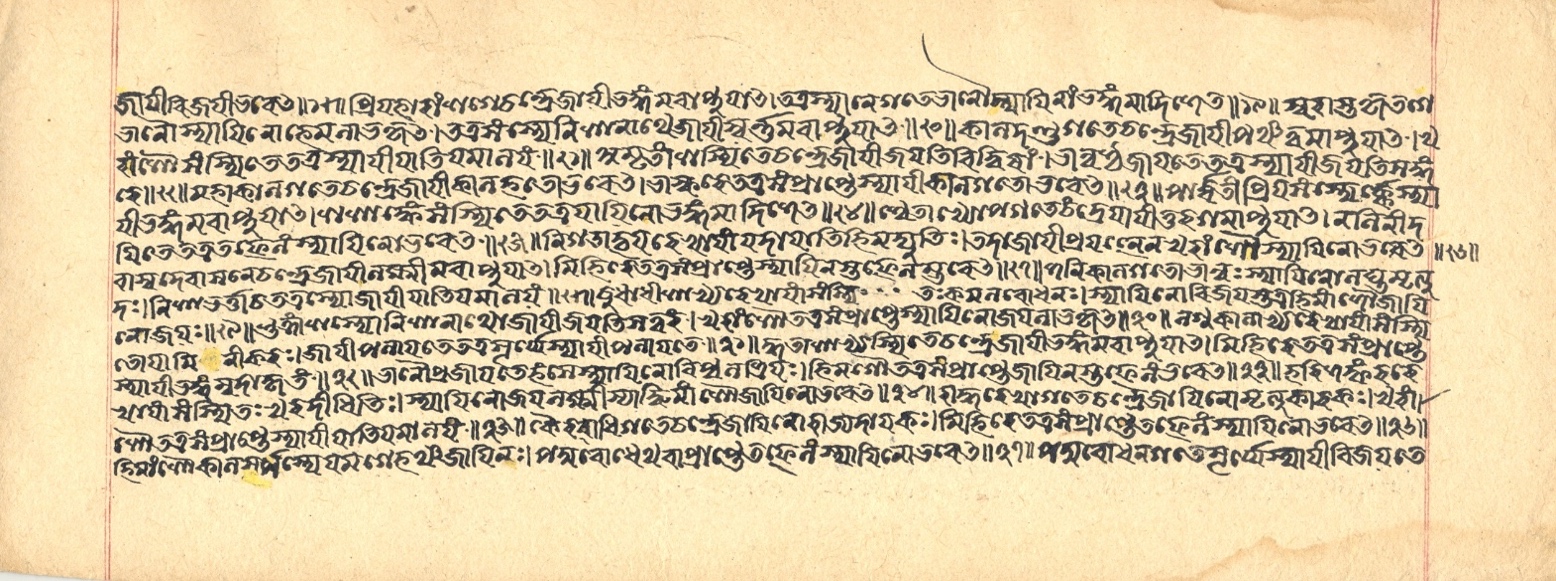
A treatise titled 'Skill in Warfare' — Yuddhakauśalya — survives as an unpublished manuscript in Mithila script, and its contents are not what a modern reader might expect. It is not a manual of tactics. It is a manual of everything around battle: the gods to invoke, the omens to read, and the moment to strike.
Protection first
The text opens in dialogue — Pārvatī asking Mahādeva to protect the world and its armies.
Śrī Pārvatī spoke: O God of gods, Mahādeva, the form of the Lord of worlds, the three-eyed one who creates, maintains, and destroys, who protects, who is the form of the released, the created, and the given, of elephants and horses. Protect me, O destroyer of obstacles, giver of bliss. Among mortals in the mortal world, you are the punisher of the wicked.
Before any strategy, there is the request for protection — for the army, for the horses and elephants, for the enterprise itself. The deity invoked is not abstract; he is the three-eyed Shiva, the one who destroys obstacles and punishes wickedness. The army goes into battle not as isolated warriors but as practitioners calling on forces larger than themselves.
Reading the sky before the march
The manuscript then turns to the omens that decide whether to march at all — planetary positions read for the traveler and the resident, the invader and the defender.
When the Moon is in Priyahāśī, the traveler obtains destruction. When the Sun is in Asyāna, the resident is indicated to have destruction. When Jupiter is in Svahā, the traveler should go to Hemanā. When the Moon is in Saṃsthatīka-saṃsthita, the traveler conquers enemies. When it is situated there, the resident always conquers the horā.
Each position carries a meaning: Jupiter in Svahā means favorable conditions for travel, while the Moon in Priyahāśī forecasts destruction. The text distinguishes carefully between the person at home (sthāyin) and the person on campaign (yāyī). When the Moon is in Saṃsthatīka-saṃsthita, the traveler — the one who marches — conquers his enemies; but the resident at home, the one who stays, conquers the hora, the hour or the temporal cycles. Each gains according to his position.
The moment of decision
These verses make clear that the Yuddhakauśalya is not a military treatise in the modern sense. It contains no formations, no supply-line calculations, no discussion of weaponry. What it contains instead is a systematic way of reading time itself — of knowing whether now is the moment to march or to wait, whether this hour favors the aggressor or the defender, whether the stars speak war or counsel patience.
The text reflects a military wisdom that modern strategists have mostly forgotten: that timing is not just a matter of opportunity but of compatibility. A general who moves when the planets forbid it might win a battle but lose a campaign. One who waits for the right constellation might delay, but when he moves, he moves with the grain of events rather than against it.
War as a whole environment
What Yuddhakauśalya preserves is the sense that war in this tradition was never only a matter of arms — it was a practice embedded in ritual and astrology, in the mood of the stars and the favor of the gods. The manuscript, written in the distinctive Mithila script, is a rare survival of that larger science of war.