
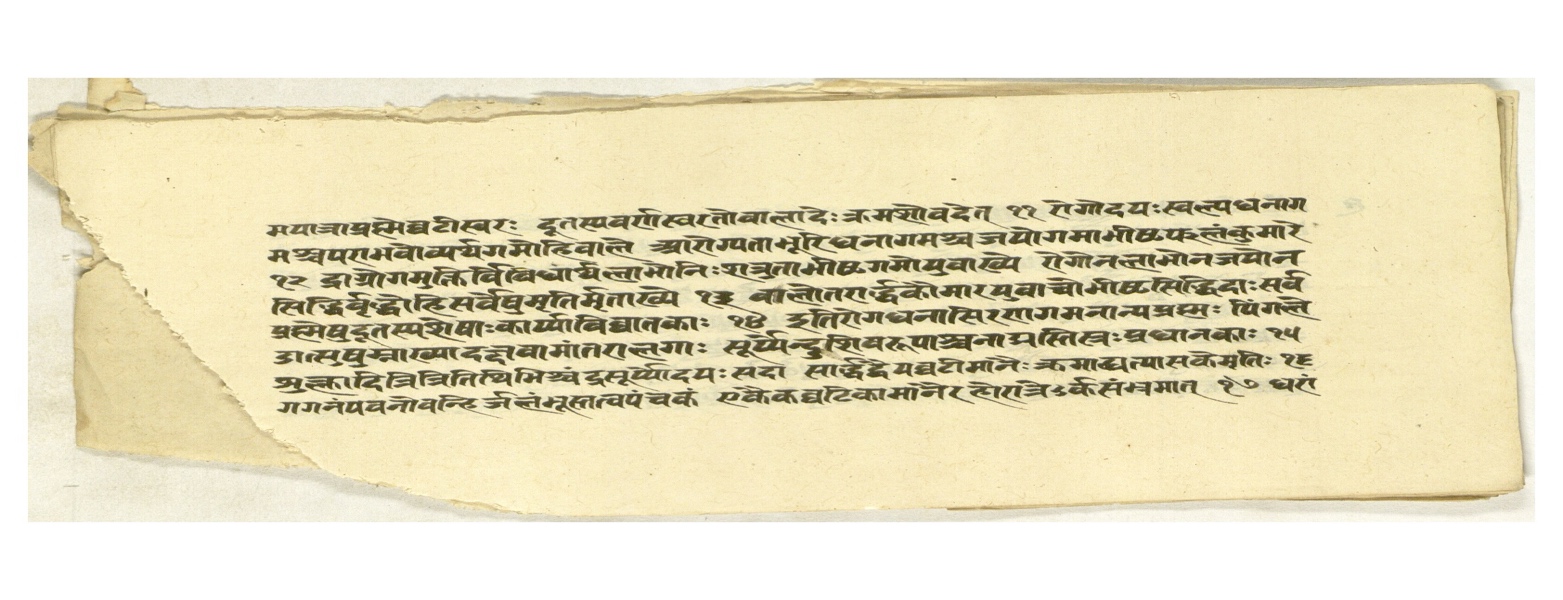
Yuddhādarśa — 'the mirror of war' — is a compact manual of the divination that surrounded ancient battle. Its instrument is not the sword but the syllable: the five vowels A, I, U, E, O, and the intricate chain of correspondences that run from a name to a lunar day to an outcome. Read a fighter's name, and the text shows you a battle unfolding in its sounds.
Vowels as the foundation
The text opens by establishing its system — the five vowels as the foundation of all calculation and knowledge.
Salutation to Śrī Gaṇeśa. Having bowed down to Gaṇeśa, the son of Savitrī, and to the guru, I shall speak for the understanding of children, that which is seen by the seer. The first vowels are sixteen; among them five — A, I, U, E, O — are known as short, called mātrās (measures), indeed the life-breath, the sun, the moon, the body, the union, the earth, the waters. From their distinct rising, the first letter of the name is the mātrā; from the mātrā, the tithi (lunar day); from the tithi, the nakṣatra (lunar mansion), the rising, and the ascendant.
This is the entire system in compressed form: name → vowel → lunar day → star → moment of battle. Each transformation is mechanical, precise. You need only the person's name and the calendar.
The messenger as oracle
The manuscript then applies this vowel science to a specific, practical question: how to read the messenger. In ancient warfare, a messenger arrives with demands or news. The Yuddhādarśa teaches that this messenger himself is an oracle — his voice, his color, his age, all carry information about the battle to come.
The messenger's color and vowel — according to the stages of child, youth, young adult, and old, one should speak in order: in the child, the arising of disease and small gain; in the youth, health and abundant gain; in the young adult, release from disease and victory; in the old, neither gain nor victory, and in the dead, death.
This is more than superstition — it is a system of reading. A messenger who is young and speaks in the vowel associated with victory predicts a very different outcome than an old one speaking in the vowel of loss. The text treats divination as an applied science: gather data, apply rules, predict outcomes.
The timing of victory
Beyond the messenger, the manuscript offers methods for determining which direction brings victory, which tithi (lunar day) is auspicious for departure, and which celestial configurations predict defeat.
If the wind blows from behind, on the right side, it grants victory in battle; if it blows from the left or the front, it causes defeat — there is no doubt. If the sun's orb is behind on the right, and the moon's orb is on the left or in front, then in the solar course there is disease, and in the lunar course there is victory.
These are not metaphors but practical omens. Wind direction, the position of sun and moon at the moment of departure, the alignment of planets — all feed into a calculation of success or failure. The commander who knows this system has an edge not in arms but in timing.
The armor of knowledge
The Yuddhādarśa also describes a complex system of directional astrology for fortress warfare. It teaches that malefic planets placed at certain positions around a fort predict its fall, while benefic planets in specific configurations guarantee its defense.
If malefic in the fortress and maraka, auspicious at the outer gates, then there is destruction of the fortress and annihilation of the besieger's army. When gentle planets are in the fortress and cruel ones are situated at the outer gates and within, then even a small citizen force conquers from outside.
This layering of analysis — messenger reading, vowel calculation, lunar timing, planetary position, directional astronomy — suggests a culture that treated war as something to be read and predicted, not merely fought. The Yuddhādarśa is a manual for that reading. Its 'mirror' is the system itself: hold it up to the battlefield, and what you see reflected is not just what is happening but what will happen next.
This manuscript survives as a reminder that ancient warfare was surrounded by a science of signs — in sounds, in light, in the positions of the visible world. Whether or not a commander believed these calculations changed outcomes, they shaped how battles were understood and planned. The mirror of war, for those who knew how to read it, was already written in the names and tithis of those who fought.