
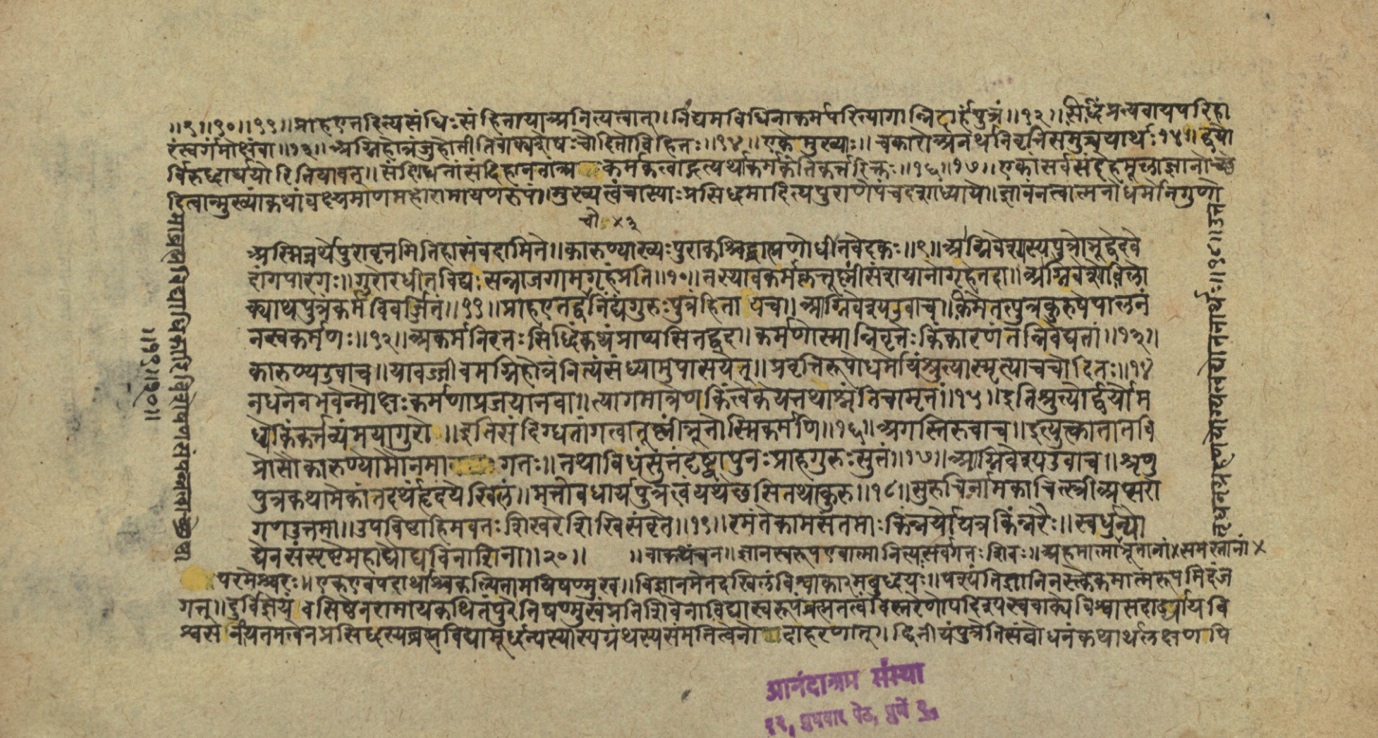
The Yogavāsiṣṭha teaches through stories — long, winding narratives designed to loosen the reader's grip on a fixed self. One of its opening dialogues, preserved in this manuscript copy, captures its method perfectly: a young Brahmin's refusal to act, and the father who challenges him with a tale that turns the question inside out. The story asks what looks like a simple problem — should you work or renounce? — and answers with something stranger: the two are not opposites.
The Self as sovereignty
The text opens with a cosmic claim that runs through the entire work — the Self as the source and resting place of everything.
The nature of that Self-existent Reality is described as undiminished. For from whom all beings and living bodies arise at the time of creation, in whom they remain established, and in whom alone they dissolve at the time of dissolution — unto that true Self belongs the sovereignty over all beings. I salute Śrī Rāma, from whom all beings arise, in whom they remain established, and into whom they attain cessation.
This is not metaphor but the manuscript's foundational claim: the Self is not something inside you that needs liberation — it is that from which everything arises and into which everything returns. Every being, every moment of existence, belongs to it.
The son who stopped acting
Against this cosmic backdrop, the story begins with a domestic argument about the most practical of questions: should you act at all? A Brahmin named Kāruṇya, well-versed in the Vedas, stops performing his duties — he will not work, will not worship. His father, Agniveśya, confronts him.
There was once a Brahmin named Kāruṇya, well-versed in the Vedas, son of Agniveśya, who had gone beyond passion. His teacher, having completed his studies, came to his house. Agniveśya said: 'Son, why do you not perform your own duty of maintenance? How will you attain perfection, being devoted to inaction?' Kāruṇya said: 'As long as one lives, one should perform the Agnihotra and daily worship the twilight prayers. Dharma in the form of activity is enjoined by both Śruti and Smṛti. Liberation does not come through wealth, nor through action, nor through progeny. Only through renunciation, as the scriptural injunction declares.'
Kāruṇya cites scripture to justify his idleness — the Vedas teach renunciation, he argues, so why act? His father sees the trap in this reasoning and decides to teach him through a story.
The king who refused heaven
Agniveśya tells the story of King Ariṣṭanemi, a royal sage who renounced his kingdom and went into the forest to perform austerities on Mount Gandhamādana. Indra, the king of the gods, watches this austere king and decides to reward him. He sends a divine messenger with an aerial chariot, accompanied by celestial musicians, to bring the king to Amarāvatī, the city of heaven.
The messenger said: 'Listen, O blessed one, I shall tell you in detail what occurred. When that best of royal sages was performing difficult austerities, I was then commanded by the king of gods, the king of suras: "Messenger, go there quickly, taking this aerial chariot, accompanied by a host of apsaras, resounding with various musical instruments, adorned with gandharvas, siddhas, yakṣas, kinnaras and others, with cymbals, flutes, drums and such, to Mount Gandhamādana."'
But when the messenger arrives and makes his offer, the king asks a question: what are the defects of heaven? And when he hears that even heaven has its troubles — envy, the inability to bear others' superiority, and the certainty of falling when merit is exhausted — he refuses.
The king said: 'I do not desire, O divine messenger, a heaven with such fruit as this. Therefore, having performed austerity with this body, I shall abandon it. Pure, desiring to know, I have come here to you.'
The answer that is not an answer
The king's refusal of heaven is the story's turning point. He wants neither worldly wealth nor heavenly reward — he wants only liberation from the cycle itself. This is why the manuscript then brings in the sage Vālmīki, who offers to teach the king the complete Rāmāyaṇa, specifically the dialogue between Vasiṣṭha and Rāma.
Vālmīki said: 'Hear, O king, I will tell the uninterrupted Rāmāyaṇa. Having heard and ascertained with effort, you will become liberated while living. The dialogue of Vasiṣṭha and Rāma, the story of the means of liberation has been heard. The nature of knowledge, O king of kings, I will tell — hear, O wise one.'
The answer to Kāruṇya's question is not an abstract principle but another story — the Yogavāsiṣṭha itself. The text teaches that the question of action versus inaction is the wrong frame. Knowledge does not come from refusing to act; it comes from understanding, deeply and continuously, the nature of the Self that acts through all beings. To know this while acting, while living fully in the world, is to be liberated while living — a state the text calls jivanmukti.
The manuscript's brilliance is that it does not settle the debate between Kāruṇya and his father. Instead, it dissolves the debate by revealing its premise to be false. Action and renunciation, dharma and moksha, are not choices that exclude each other. They are two sides of the same understanding. The Yogavāsiṣṭha, one of the rare copies with a ṭīkā or commentary, preserves this teaching in its original form — not as doctrine but as dialogue, as one person trying to awaken another to what was always true.