
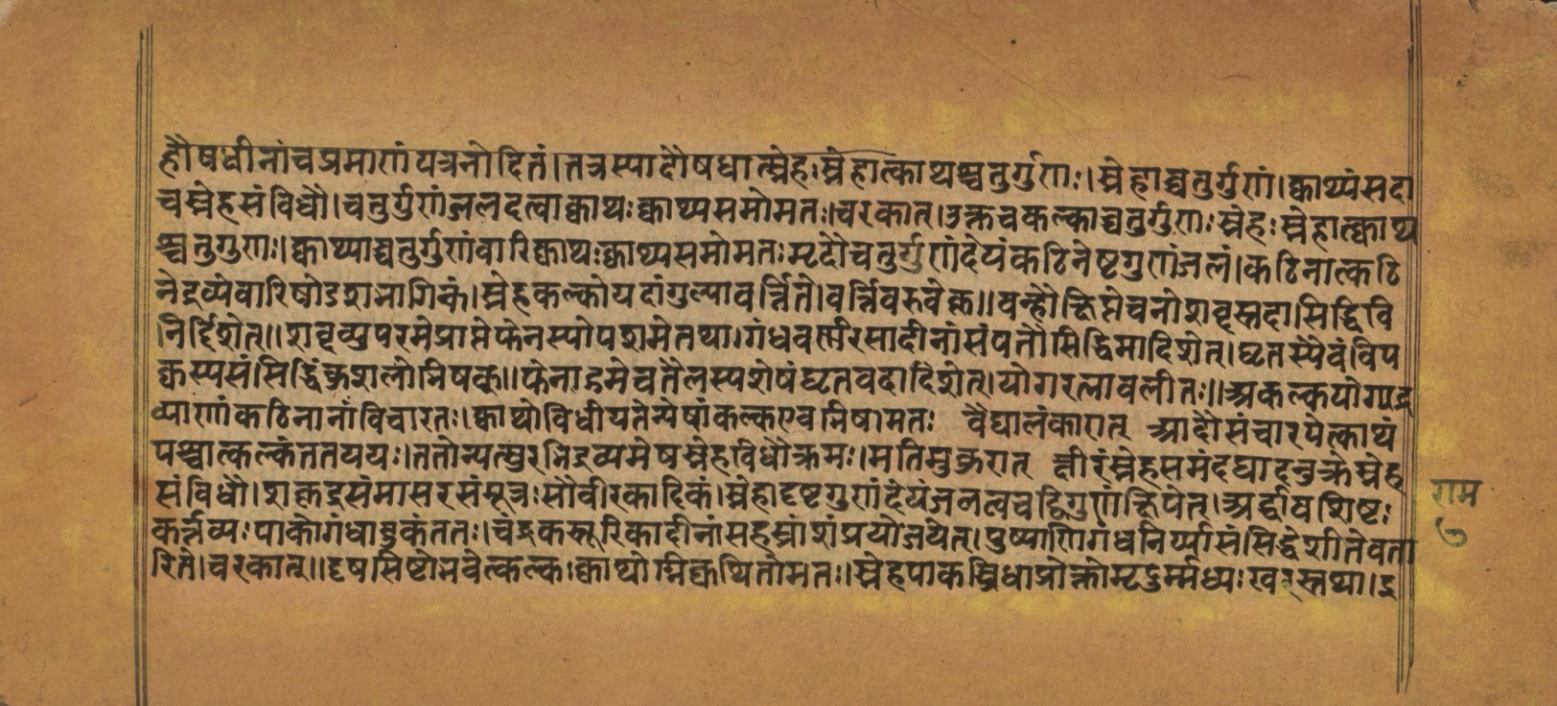
Every recipe needs measuring cups. The Yogataraṅgiṇī, an Ayurvedic compendium composed by Trimallabhaṭṭa in Samvat 1703, contains some of the most careful metrology in the tradition — a complete ladder of weights running from a single seed up to the pala, with synonyms for every step, and then the exact ratios that make a medicated oil come out right.
The ladder of weights
The text lays out the system in a single unbroken chain, each unit defined by the ones below it.
Six of those (rājikās) make one rājikā. Three rājikās are called a sarṣapa by the learned. Eight sarṣapas are called a yava; four of those make a guñjā. Six raktikās make a māṣaka, also called a hemadhānaka. Four māṣas make a śāṇa, also called a dharaṇa. Two kolas make a karṣa... Two karṣas make an ardha-pala; two śuktis make a pala.
The same verse piles on synonyms — akṣa, picu, pāṇitala for one unit; karṣa, karamadhya, haṃsapada for another — because a practitioner meeting the same measure under a different name in a different text had to recognize it. This is a working reference, designed to be consulted at the dispensary.
The ratios that make the medicine
Measurement was not just about knowing the units; it was about the proportions that determined whether a preparation worked. The Yogataraṅgiṇī gives the classical ratios for cooking medicated fats, citing Caraka by name.
Where the measure of medicinal substances is not specified, the fat (sneha) should be four times the paste (kalka), and the decoction (kvatha) should be four times the fat. In the preparation of fat, water should always be given four times the substance to be decocted. For soft substances, water should be given fourfold; for hard substances, eightfold water is prescribed. For a hard substance within a hard substance, water should be sixteen parts.
The ratios escalate with hardness — four, eight, sixteen — and the text even tells you when the oil is done: when a drop of the paste rolled between the fingers forms a wick and makes no sound in the fire.
The medicine, the patient, the physician, and the attendant
What distinguishes the Yogataraṅgiṇī is how it frames medicine not as isolated recipes but as a whole system. Trimallabhaṭṭa, who composed the work in the early seventeenth century, opens with the four pillars of medical treatment — the physician learned in the scriptures, the patient obedient to the physician's advice, the medicine itself, and the attendant faithful in its administration.
The physician, the patient afflicted by disease, the medicine, and the attendant — these are the four pillars of medical treatment, the means and causes of its accomplishment.
A physician must be "learned in the scriptures, pure, courageous, light-handed, and diligent"; a patient must be "wealthy, obedient to the physician, able to describe his disease, of good character and disposition, and following a proper diet." Even the attendant has a role: one who has "conquered sleep, is beneficial, versed in dharma and artha, has traveled to many lands, and is skilled in action." Medicine works, the text implies, only when four elements move together.
Preparing the medicine: the stages of cooking
The text describes three stages of cooking a medicated fat. The soft stage (mṛdu), where the paste becomes juiceless and soft, is for nasal administration. The medium stage (madhya), where the paste becomes slightly hard, is for all procedures — internal medicines, enemas, and ointments. The hard stage (khara) is for massage and external application. Each stage requires different care.
When the paste becomes juiceless and soft, the cooking of the fat is soft. When the paste becomes slightly hard, the cooking of the fat is considered medium. Beyond that, the cooking becomes burnt, causing burning and being useless. When the crackling sound ceases and the foam subsides, and when the proper fragrance, color, and taste are attained, the skilled physician should declare it perfectly prepared.
A physician who understands these stages — who can listen for the sound, watch for the foam, test the fragrance — is distinguishing medicine from mere cooking. The difference is in the attention.
A practical science
The Yogataraṅgiṇī is the kind of text that shows Ayurveda at its most engineering-minded: standardization, verification, and a refusal to leave quantities vague. It is a pharmacist's manual, copied and used, that made the medicine reproducible — one seed at a time.