
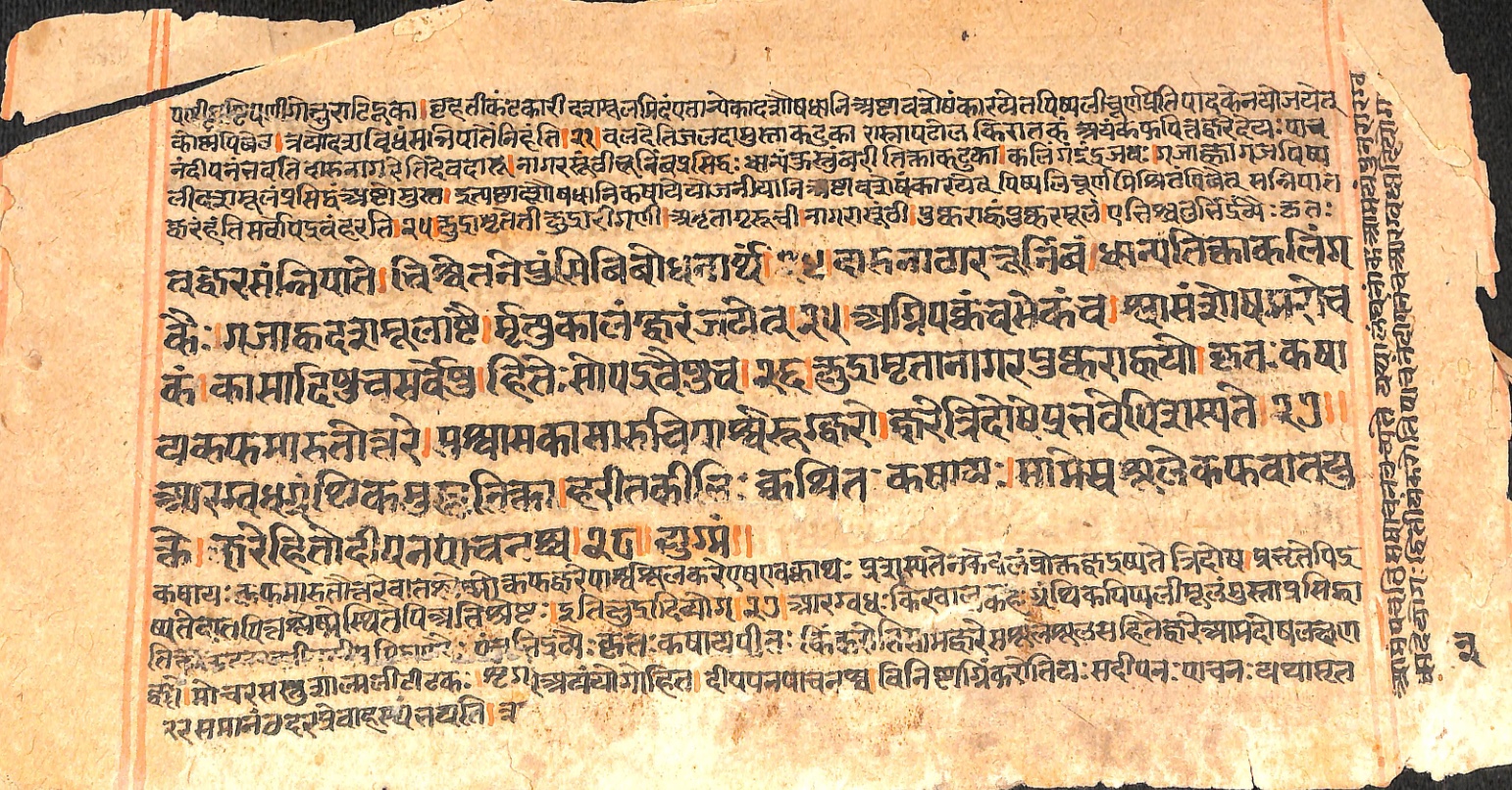
A hundred yogas — not postures, but medicinal preparations. The Yogaśataka is a classical collection of a hundred formulas, and this manuscript is its commentary, written for the 'easy understanding of this Ocean of Medical Knowledge.' It is a doctor's working handbook, page after page of decoctions, pastes, and pills, organized by disease from fever down to skin conditions and digestive complaints.
The ocean made navigable
The commentary opens by explaining its own purpose and ambition — and by laying out how a physician is expected to work before ever reaching for a formula.
This commentary on the Yogas, beginning with the words 'yo gānāṃ ṭīkā', is undertaken for the easy understanding of this Ocean of Medical Knowledge (Vaidyajñānārṇava). Now, the causes of diseases of living beings, the causes of the manner of diet of living beings, and [conditions] arising from the drinking of poison.
The image is deliberate: the source text is an ocean, and the commentary is a boat. It goes on to insist that only a physician who has properly examined the doṣas, the disease, and its symptoms — and who understands the patient's digestive strength — deserves the name vidagdha-vaidya, 'learned physician.'
Reading fever by its symptoms
Before any formula, the text teaches diagnosis — the distinct symptom-clusters of vāta, pitta, and kapha fever, so that treatment can be matched to cause rather than applied blind.
Roughness of the limbs, piercing pain, confusion, trembling, and pain of the limbs; numbness, coldness, and constriction of the hands — these are said to be the actions of vata... Fatigue, exhaustion, burning, diseases, trembling, sweating, heat of digestion, delusion, intoxication, thirst — these are said to be the actions of pitta... Whiteness, coldness, heaviness, stickiness, oiliness, coating, stiffness, and horripilation, sweetness in the mouth, and delayed action — these are said to be the actions of kapha.
The great decoction of ten roots
At the heart of the fever formulas is daśamūla — the 'ten roots' — the famous combination that still anchors Ayurvedic respiratory and fever medicine today.
Elā, Pṛśniparṇī, Gokṣura, Aṭikā, Vṛhatī, Kaṇṭakārī — these are the eleven drugs of Daśamūla. Boiling them in eight parts of water and reducing to one-eighth part, one should make a decoction. To this, one should add Pippalī powder in one-fourth quantity and drink it lukewarm. It destroys the thirteen types of Sannipāta (complex fevers).
The precision is pharmaceutical throughout — eight parts of water reduced to one, a fourth part of long pepper added, drunk warm — and the claim is total: thirteen kinds of sannipāta fever, one decoction. The commentary immediately cites its source directly: 'thus spoke Suśruta,' anchoring the formula in the older surgical classic rather than presenting it as original.
Beyond fever: worms, jaundice, and digestive fire
What the earlier draft of this article missed entirely is how far the commentary ranges past fever. A separate run of formulas targets krimi — intestinal worms — using musta, akhuparni, and trivṛt in decoction; another treats sarvāṅga-śotha (whole-body swelling) and pāṇḍu-roga (jaundice or anemia) with punarnava, nimba, and guḍucī.
Musta, Akhuparni, Phaladaru, Trivrit — a decoction immediately destroys worms; by the previously mentioned method, it gradually destroys developed worms and worm-induced disorders.
A separate section builds toward Yogarāja guggulu, an elaborate compound of some twenty ingredients — pippalī, citraka, triphalā, guggulu itself, processed with milk, ghee, and cow's urine — prescribed for vāta disorders ranging from kidney stones to epilepsy to fistula, with the explicit warning that alcohol and sex should be avoided during its use.
Skin, itching, and the physician's everyday complaints
The commentary also works through less dramatic but more common ailments — ringworm, vitiligo, itching, and blistering skin conditions — with topical pastes and medicated oils rather than internal decoctions.
Ḍiṇḍīrikā, citraka, mārkava, arka — with uṣṭra (camel), dumāla, kalavala with roots, equal parts, oil is cooked. This removes maṇḍala, dadru, kuṣṭha, śvitra (vitiligo), vraṇa (wounds), tāpa (burning sensation).
Formulas for hoarseness, chronic rhinitis, hiccup, and loss of appetite round out the collection — small, everyday complaints treated with the same exacting measurement as the grand fever decoctions, a reminder that a working medical handbook has to cover the common cold as thoroughly as the crisis.
The formulas keep coming
The Yogaśatakaṭīkā is a reminder that the Ayurvedic tradition's genius was not only in grand theory but in the patient accumulation of working recipes — tested, measured to the fraction, cited back to their sources, and handed on from physician to physician across centuries, a hundred yogas at a time.