
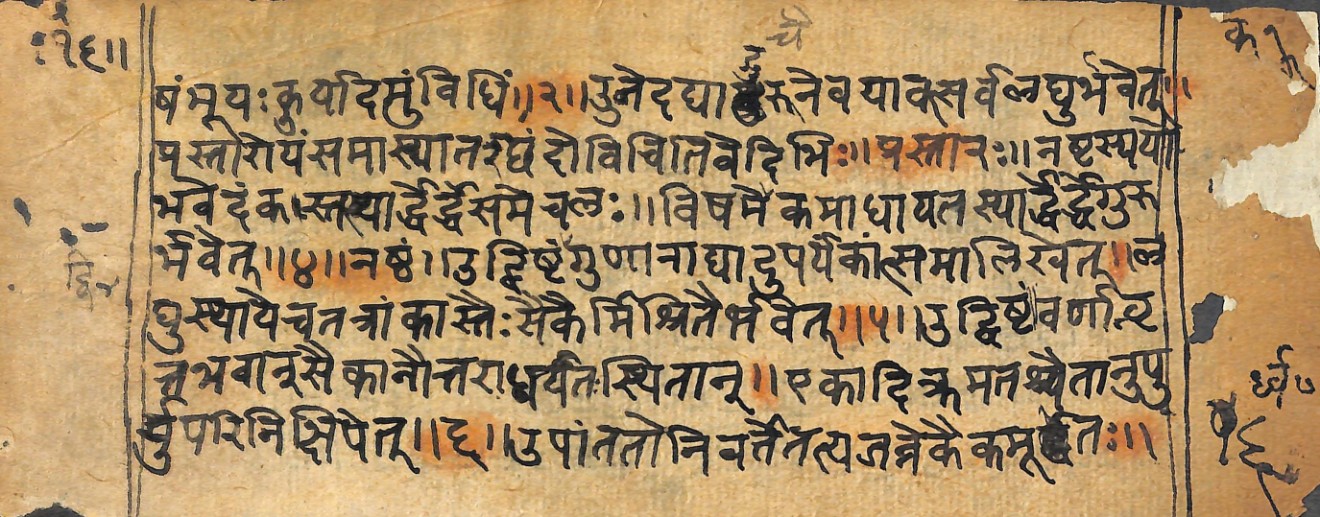
Sanskrit poetry is machine-checkable: every verse has a meter, every meter a pattern of long and short syllables, and the Vṛttaratnākara — the 'Jewel-Mine of Meters,' composed by Kedārabhaṭṭa of the Bharadvāja lineage — teaches how to build those patterns, name them, and even recover them when lost. This manuscript preserves all six chapters, working from ten founding syllables through named meters to a method of reconstruction that runs on pure binary logic.
Ten letters that build all speech
The manual begins with a startling claim: the entire universe of Sanskrit verse is composed from just ten building-block syllables — the gaṇas.
These ten letters ending with 'la' — 'ma', 'ya', 'ra', 'sa', 'ta', 'ja', 'bha', 'na', 'ga', 'la' — create the entire universe of speech, as Vishnu [does] the three worlds.
From these ten come the three-syllable cells that, combined, generate every classical meter, from gāyatrī's small stanzas up through bṛhatī, paṅkti, triṣṭubh, and jagatī, all the way to the sprawling daṇḍaka meters that Kedāra says lie beyond the twenty-six-syllable line entirely.
Even and uneven meters
The taxonomy turns on symmetry: when a verse's four feet match, the meter is sama; when they differ, viṣama.
That in which the marks in the four feet are different from one another — the experts in the science of meter call that 'visama' [uneven] meter.
Between these two poles sits ardhasama, the 'half-equal' meter, where odd and even feet each keep their own internal pattern but differ from each other — the manuscript's fourth chapter works through named examples like Vaitālīya, Puṣpitāgrā, and Pramitākṣarā built on exactly this asymmetry.
A named meter for nearly every occasion
The bulk of the text — chapters two and three — is a catalogue of named meters, each defined by its exact gaṇa sequence and often attributed to a specific authority: Kāśyapa, Śaunaka, Piṅgala, Gobhila. Vasantatilakā, Śārdūlavikrīḍitam, Sragdharā, Mandākrāntā, and dozens more each get a precise formula.
With bha-u joined with sa-ga, she has gold, whom... With na-ra and ja-gai, she becomes delightful... Campakamālā if bha-ma-sa-guḥ... Dīpakamālā if bha-u [?] ta-gau.
The manuscript's marginal corrections and interlinear insertions throughout this section show generations of students actually working the formulas — checking a gaṇa sequence against the rule, catching a scribe's slip, penciling in the meter's name where it had been abbreviated.
Recovering a lost meter by halving
The most algorithmic part of the text is its sixth chapter, on the six pratyayas — prastāra, and its inverse, naṣṭa: given a syllable pattern, find its numbered place in the master list of all possible meters of that length, or, given the number, reconstruct the pattern by halving it, again and again.
The mark of the lost (syllable) is obtained by halving and halving again. In the odd (result), having placed one, its half and half becomes guru. The lost.
This is binary arithmetic worked out in a medieval prosody manual centuries before anyone called it that — the same halving-and-marking logic that, applied to switches instead of syllables, would later become the machinery of computing. Kedāra even includes an aṅguli-kriyā, a finger-counting method, for readers who wanted to do the calculation by hand rather than on the page.
The jewel-mine's author
The colophon of the sixth chapter names the author directly, and closes on an unusually warm note for a technical manual.
With a mind focused solely on worshipping the pair of feet, with a smiling face, this pure [work] named Vṛttaratnākara has been composed, delightful [to all].
An earlier passage in the same closing section credits Kedāra's own teacher, 'Bhūtkāśyapa,' a scholar of Śaiva Siddhānta — a small act of filial acknowledgment tucked into a chapter otherwise devoted to pure calculation. Between the ten founding syllables and that final smile, the Vṛttaratnākara maps the entire architecture of Sanskrit verse — and this manuscript, corrected and annotated across generations, shows exactly how it was taught.