
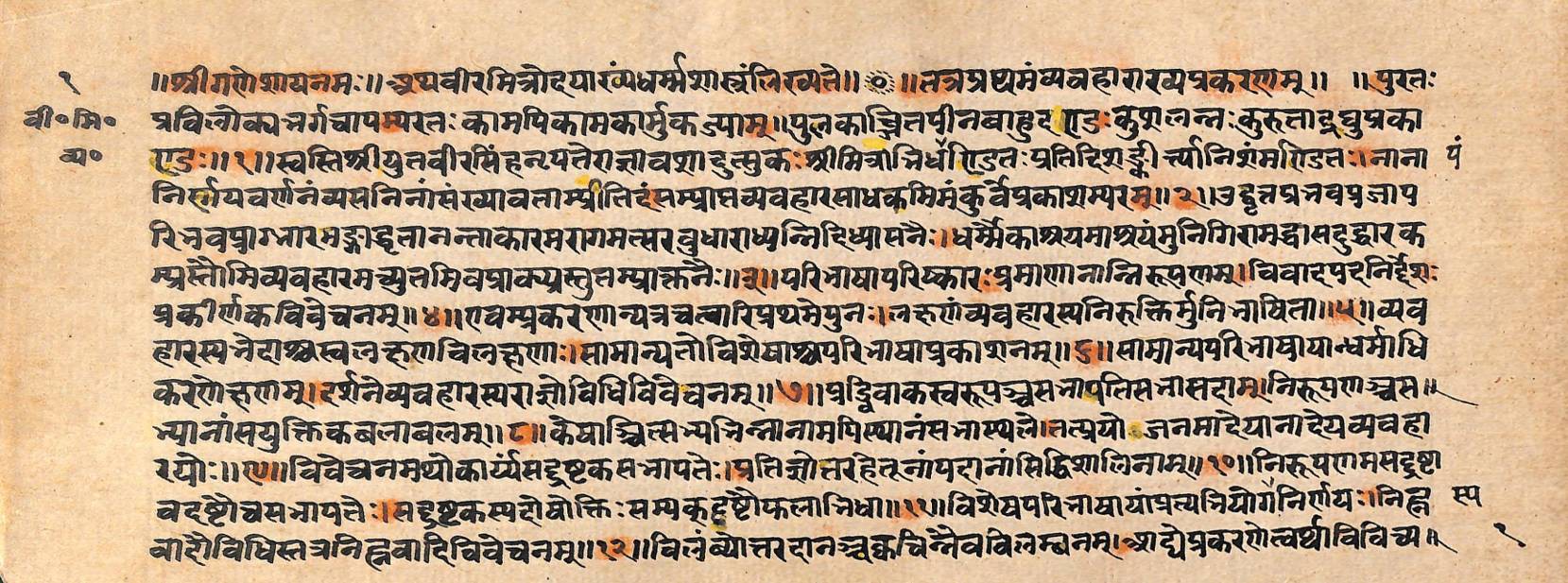
What do you do when the law is unclear? The Vīramitrodaya, a comprehensive legal digest composed by Mitramiśra under King Vīrasimha in the seventeenth century, answers with a scheme that goes back to Bṛhaspati: doubtful matters are decided four ways — by dharma, by vyavahāra, by caritra, and by the king's command.
The fourfold means of decision
The Vyavahārakāṇḍa — the section on legal procedure — opens by establishing the hierarchy of methods.
By dharma, by vyavahāra, by caritra, and by the king's command — the fourfold means has been declared for deciding doubtful matters.
Each has its sphere: dharma is the moral law, the eternal principle; vyavahāra is written procedure and the rules of evidence; caritra is the established custom of the region, the practice that proves itself; and the king's command is the royal decree that settles what cannot be settled otherwise. The digest spends its pages working out how these four interact, which prevails when, and what happens when they conflict.
The machinery of the court
The text is equally careful about the parts of a legal proceeding — defining the roles that make a court work.
From the plundering of the four castes, he is called 'four-benefiting' (caturhita). The actor, the nayaka, the witness, the assembly member, and the king — these five. Whatever kind one obtains from which, therefore it is called 'four-taking.'
It reads like a definition of jurisdiction: who can bring a suit, who hears it, who testifies, who judges. The actor (kārin) is the plaintiff, the one bringing the claim; the nayaka is the magistrate or judge; the witness testifies to fact; the assembly member advises on law; the king, at the top, commands. The technical vocabulary — caturhita, caturhara — shows a legal culture that had thought carefully about the anatomy of a trial.
Testimony and the weight of evidence
The Vīramitrodaya distinguishes carefully between kinds of evidence: direct testimony from a witness who saw the act, circumstantial evidence from signs and inference, documentary evidence from written records and seals, and inference from the character and behavior of the parties. A witness must be of good reputation, free from enmity toward both sides, and capable of clear speech. The text specifies that a single witness cannot decide a case involving significant value or property; multiple witnesses are required, and their testimony must agree in essential details even if they differ on minor points.
When witnesses conflict, the judge must examine their character, their access to knowledge, and whether they have any interest in the outcome. A servant has less credibility than a householder; a woman of bad repute has less than a woman of good character; a man with much to gain from his testimony has less than one who speaks against his own interest. For property disputes, documents are valued — but only if they bear the seals of credible persons and are not contradicted by more numerous or more reliable witnesses.
The law, in other words, is not a system of rules but a system of judgment: it requires a magistrate attentive to all sources of knowledge, capable of weighing credibility, and wise enough to know when custom must yield to written law and when law must yield to the particular case.
A working legal library
At 602 pages, the Vīramitrodaya manuscript is a major legal reference — the kind of digest a court would consult, combining the authority of the smṛtis with the reasoning of the commentators. Its preservation is a reminder that the Indian legal tradition was not a set of scattered rules but a literature, built to be argued with — and that a seventeenth-century jurist could still reach back to Bṛhaspati for the first principles of deciding a case.