
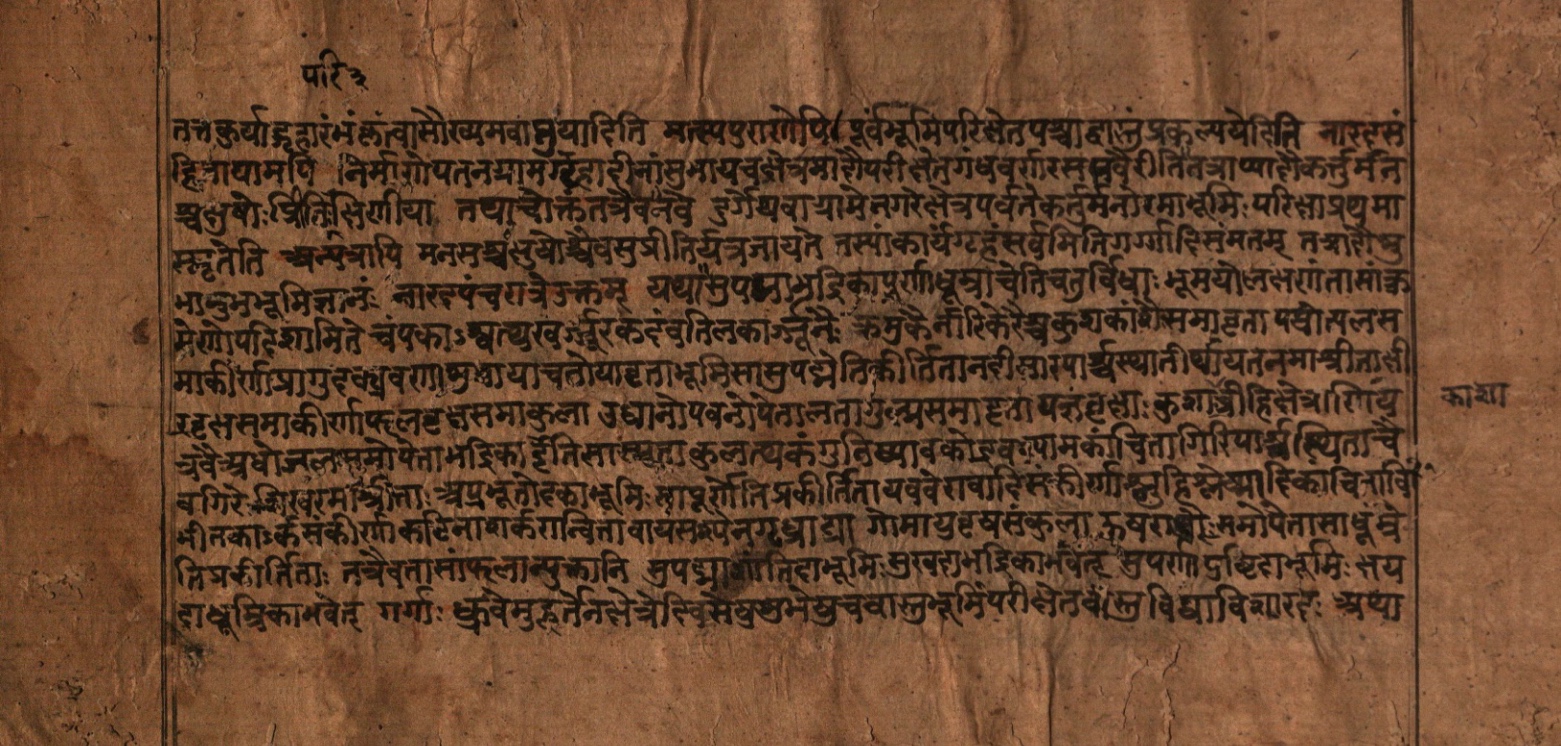
Every building begins with a decision about the ground. The Vāstuśiromaṇi — the 'crest-jewel of architecture' — is a treatise on that decision, and its third chapter is a lesson in how to read a piece of land before a single stone is laid. But the reading does not stop at the surface: this compendium, attributed to a scholar named Śaṅkara and produced under royal patronage, tests the land with smell, color, taste, water, lamps, and even buried splinters.
Examine the land first
The text opens its practical teaching by citing the authorities on the order of operations.
One should not begin house construction until one obtains the Maurya (auspicious time), as stated in the Matsya Purāṇa: 'First one should examine the land, then plan the vāstu.' For the construction of cities, villages, houses, etc., by those desiring auspiciousness: first one should examine the land with tests of smell, color, taste, and water.
Four tests — smell, color, taste, and water — a full sensory examination of the site. The ground is read like a patient, with diagnosis before treatment.
The earth's smell and its class
The text associates the scent of the soil with the four varṇas — a scheme that turns the earth itself into a social body.
Dadhigandhā would be Brāhmaṇī, Kṣatriyā would be Ājyagandhikā, Vaiśyā would be Dugdhagandhā, and Śūdrā would be Annagandhikā — each caste having its own respective [characteristic].
Earth that smells of curd is brāhmaṇa-land, of ghee kṣatriya-land, of milk vaiśya-land, of cooked rice śūdra-land. The same page even records a scholarly dispute — Keśava and Śaunaka disagree over whether the kṣatriya's earth smells of ghee, and the commentary works to reconcile them, showing that the text was studied, not merely copied.
Testing the soil by its sprout
The botanical test is precise about time, turning the land's fertility into a question of days.
A sprout that arises within three nights from the earth — know that as excellent; in five nights, medium; in seven nights, inferior. On the remaining days, the sprout is to be avoided; that earth is inferior. In the Matsya Purāṇa also: in the bright fortnight of Phālguna, one should sow all seeds. Those that grow in three, five, or seven nights should also be known.
Three nights and the earth is excellent; seven and it is inferior — the land is graded by its own response to seed, a test any farmer would recognize.
Lamps on the bare ground
The builder's satisfaction is one measure; the behavior of fire is another. The text prescribes a divination with ghee lamps set directly on the earth.
One should place four lamps filled with ghee on the ground at equal distances, with wicks facing east and the other directions, and light them; if they burn with steady flames in all directions, they bring desired wealth and grain; small flames and small light are not auspicious. Having thus examined the ground, one should then consider the Vāstu — this is the examination of the ground.
The steady flame is the omen of prosperity; the guttering one, of loss. The land is not only smelled and tasted — it is asked, and it answers with fire.
The builder's satisfaction
What makes the passage distinctive is what it adds to the technical tests.
There too, first the builder's mental satisfaction should be considered. In a new fort, as in a village, city, field, or town, land pleasing to the builder's mind — this examination is declared to be foremost. Where self-satisfaction arises through conformity with the land, that is the auspicious ground.
The technical tests are not enough; the builder's own sense of rightness is part of the method. Vāstu is a discipline in which feeling and measurement cooperate.
The eighty-one squares of the Vāstu Puruṣa
Beyond site selection, the compendium lays out the sacred geometry that organizes the building itself — the eighty-one-square grid on which the house is imagined as the body of a divine being.
Therefore I shall now describe the world — within the house, a space of one hand's breadth all around, upon rice grains, eighty-one divisions should be made. In that division, one, two, three — forty-five divisions are worshipped by the gods; thirty-two I shall describe as external. Those gods beginning with Īśāna — their places and names I shall describe from the divine compartments.
The Vāstu Puruṣa mandala — the cosmic being whose body is the building — turns architecture into worship: every room a deity's compartment, every line a boundary of the divine.
Hunting the hidden splinter
The most curious of the tests is for śalya — the buried impurity, a bone, thorn, or splinter, that the tradition believed must be found and removed before building. The method is divination by the sound of a question.
When a question is asked with the sound 'ca', one should indicate in the Agneya (southeast) direction a bone splinter or thorn of a cat, of the measure of a hand-span. When a question is asked with the sound 'ca' of the 'ca-varga' (palatal class), one should indicate in the south a splinter of a jackal or deer, of the measure of a hand-span.
The first syllable of the question determines the direction, the animal, and the size of the impurity to be dug out — an odd but internally consistent system, and one more sign of how seriously the tradition took the purity of the ground.
Architecture begins with attention
The Vāstuśiromaṇi is a reminder that the Indian building tradition understood something modern construction often forgets: the relationship with a site begins before design. Smell the earth, taste the water, watch the lamp, read the sprout, listen to your own satisfaction, and search the ground for what should not be there — then build. That is the crest-jewel's first lesson, and this manuscript preserves it in all its strange, systematic fullness.