
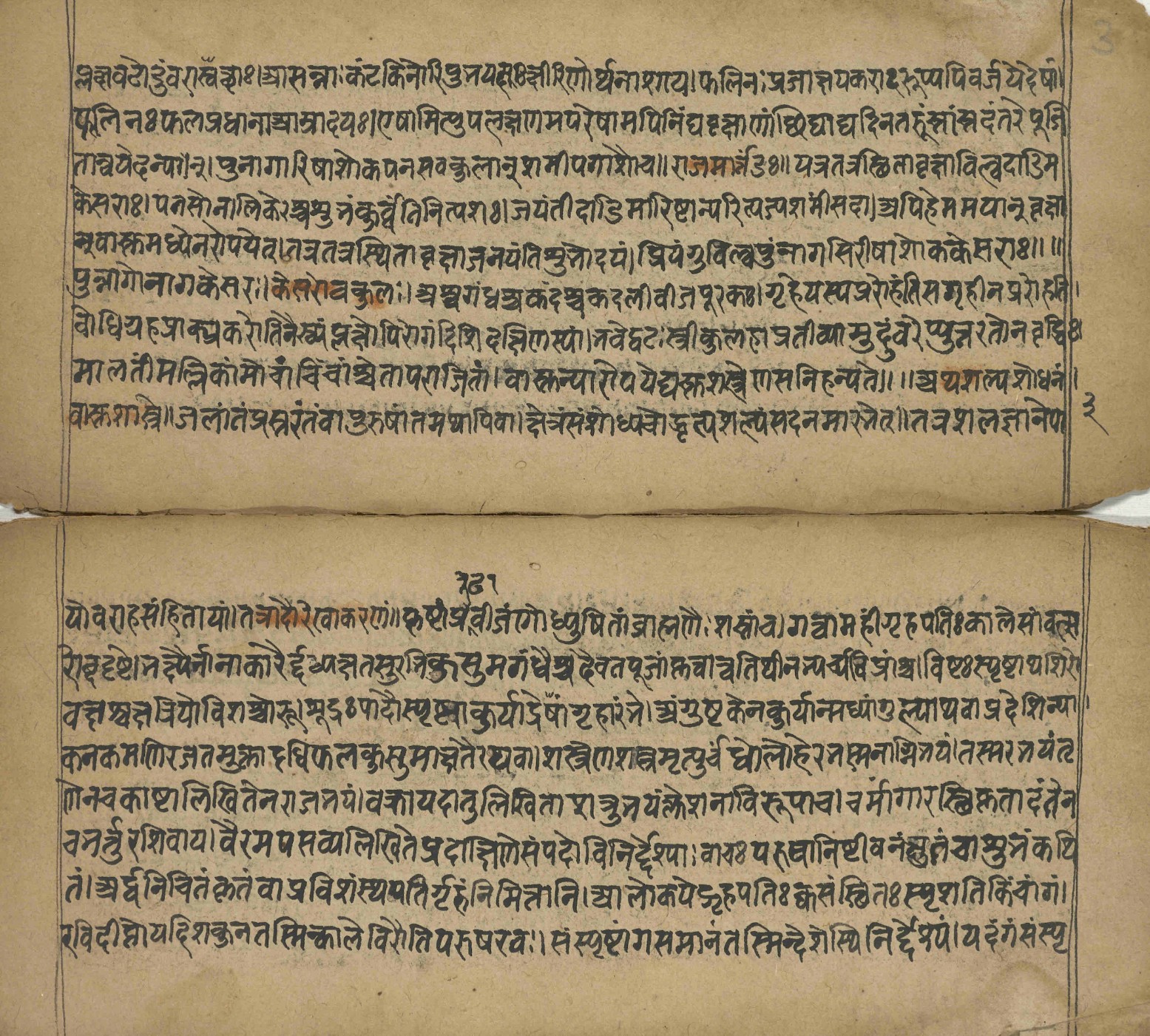
A house is more than shelter — in the Vāstu tradition, it is a statement about the life you intend to live. The Vāstusaukhya, the section on 'household happiness' from the Tōḍarānanda, is a manual for getting that statement right: where to build, how to orient, and which trees to plant.
A science assembled from the masters
The text opens by naming its sources — a whole shelf of Vāstu authorities. It is a digest — the accumulated wisdom of the tradition, organized under the authority of the legendary architect Viśvakarman.
He whose mind is devoted to the two lotus feet of Govinda, that King Tōḍaramala indeed creates household happiness. Examined by the words of Varāha and Lalla, and by the treatises of Vasiṣṭha, Garga, Bṛhatpārāśara, etc., and fashioned by Viśvakarman.
The names invoke an entire lineage: Vasishtha, author of foundational sutras; Garga, the astronomical sage; Varaha, whose Samhita gathers the older wisdom; Lalla, mathematician and astronomer. This is not the work of one author but of a tradition passing knowledge hand to hand, each generation refining what the previous discovered.
Which trees to keep
The text's tree-lore shows how practical the science was — the planting around a house was a matter of prosperity and health.
Nearby thorny trees, milk-yielding trees for wealth destruction, fruit-bearing trees for population decline — one should avoid these even if made of silver. One should cut them down, and in the interval of days, having worshipped, one should take shelter of the praised. Bilva, Dadima, Kesara. Panasa and Narikela always. Jayanti, Dadima, Arista, and other trees, Shamipaga always.
The bael, the pomegranate, the jackfruit, the coconut — the auspicious trees are named, and the thorny ones are to be felled, with a small ritual to accompany the cutting. A tree is not removed thoughtlessly; it is acknowledged, worshipped, and only then taken. And in its place — or nearby — the good trees are planted, each one bringing its own benediction.
Testing the earth and finding water
Before a house is built, the Vāstusaukhya prescribes that the land itself must be examined. There are two methods for this: the test of water and the test of fire. A pit is dug in the middle of the proposed site, filled with water, and observed the next morning. If the water has increased, the land promises prosperity; if it remains equal, the results will be equal; if it has decreased, there is loss. The fire test uses a lamp with four wicks placed in the pit, and the direction in which it burns tells which way the blessing flows.
Having made the field pure, one should fill with water. Seeing in the morning: increase in water, equality in mud, loss in dryness. Thus endowed with characteristics, in land endowed with all, one should draw an equal circle in the middle with attention to directions.
The land speaks through these tests — not mystically, but through observation. Water that pools reveals the earth's shape; the lamp reveals the wind's path. The water test is performed at night and the result examined at dawn — and it works not through magic but through the earth's actual capacity to hold water, which is a sign of fertility and stability. A builder who reads these signs reads the house before it is built.
The four directions and proper orientation
Orientation is not arbitrary. The Vāstusaukhya specifies that the four directions have four qualities: the east is for wisdom, the south for courage, the west for prosperity, the north for comfort. A garden in the south or southeast brings "quarrel, anxiety, and trouble"; but a garden in the west, north, or east "increases sons, grandsons, and wealth." The position of the house itself matters as much: in the Īśānya (northeast) direction, prosperity; in the Nairṛta (southwest), death and loss of children. For the Vāyavya (northwest), mental anguish; for the Āgneya (southeast), fire and burning.
The text does not merely prohibit; it prescribes alternatives, so that building becomes not a matter of avoiding evil but of actively inviting good. The east brings learning; place there the study. The north brings wealth; place there the treasury or guest chambers. Every direction has its proper use, and a house built in ignorance of these correspondences is a house working against itself.
Dwelling as a practice
Vāstusaukhya treats the house not as an object but as an environment — built, planted, and oriented so that its residents thrive. It is a reminder that architecture in the Indian tradition was never just engineering: it was a discipline for arranging the world so that happiness had a place to stand.