
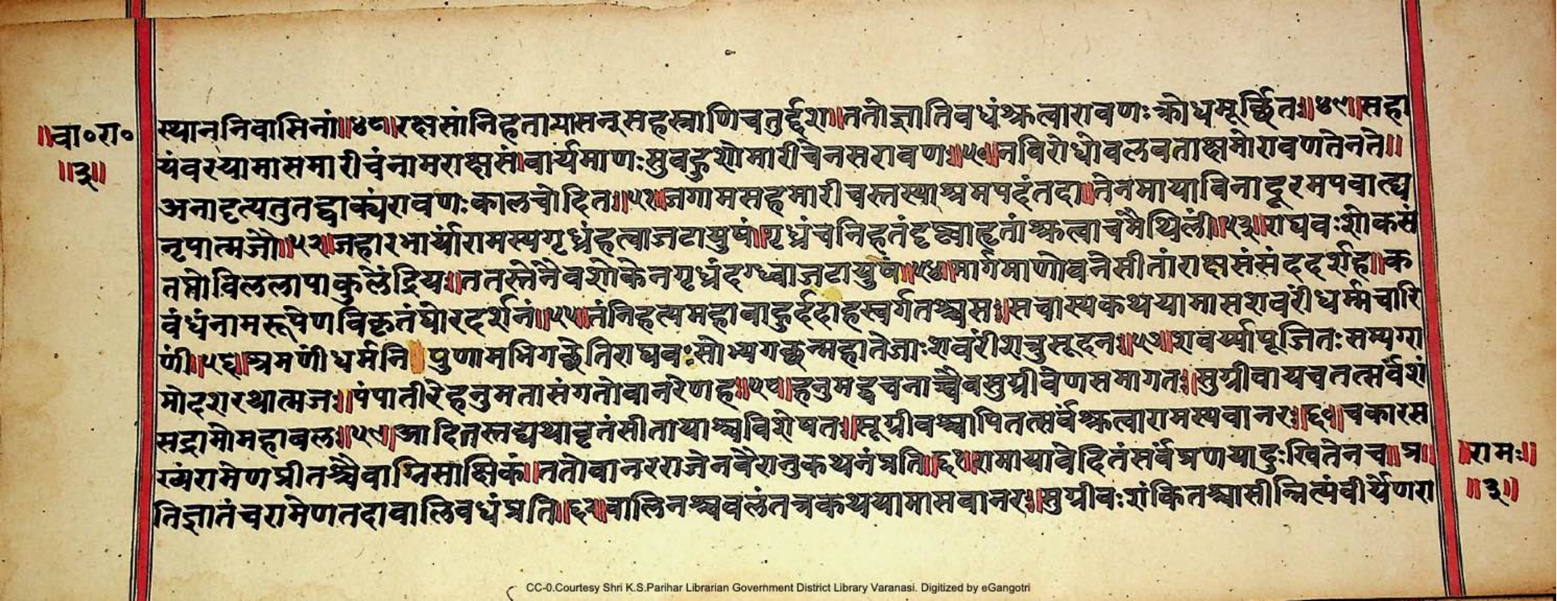
Before the Rāmāyaṇa tells its story, it praises its own teller. This manuscript opens with the famous invocatory verses — salutations to Rāma and his companions, and a chain of images for Vālmīki himself, culminating in the loveliest: the sage as a cuckoo perched on the branch of poetry.
Salutations before the story
The opening verses set the devotional frame for the whole epic. They invoke the Supreme Person known through the Vedas, born as the son of Daśaratha — the very Veda became the sage's mind, embodied as the Rāmāyaṇa itself.
Oṃ, to the Supreme Person, known through the Vedas, born as the son of Daśaratha — the Veda became the sage of the mind, embodied as the Rāmāyaṇa. I bow again and again to Rāma, to his brother, to Sītā, to Bharata and his brother, to Sugrīva and the son of the wind (Hanumān).
The homage covers the whole cast in two verses — the hero, the family, the allies — before the narrative begins. It is not a plot summary but an act of reverence, a bow to every figure who will move through the epic.
The cuckoo of poetry
Then comes the image of Vālmīki himself — the poet as a bird singing on the tree of the epic. The Sanskrit plays on the sounds of the name, on the bird's call, on the sweetness of syllables.
The cuckoo singing sweetly 'Rāma, Rāma' in its sweet syllables — having climbed the branch of poetry, I bow to that Vālmīki-cuckoo. Hearing the sound of the Rāma-story from the lion of sages roaming the forest of poetry, who does not go to the highest goal?
The epic is a tree; the poet is a cuckoo; the story is a song — and the verse invites every listener to follow that sound to liberation. In classical Indian thought, to hear the Rāmāyaṇa was already a form of spiritual practice.
The hero announced
The narrative proper opens with Nārada's account of Rāma's virtues — the famous catalogue that makes the hero known before he acts. Through Nārada's words, we meet a figure of impossible completeness: self-controlled yet radiant, forgiving yet powerful, learned yet wise.
Pleasing to behold at first sight, self-controlled, having conquered anger, radiant, free from envy. Like the fire at the end of time in anger, like the earth in forgiveness, like Kubera in generosity, like Dharma itself in truth — that Rāma, endowed with such qualities, of true valor.
The path to exile: Rāma's descent into the forest
The opening verses establish the hero; the narrative then traces the turn that sends him from the palace to the wilderness. Though Daśaratha wishes to crown Rāma as heir, the second queen Kaikeyī demands her own son's coronation instead — and Rāma, bound by his father's word, accepts exile with unshakeable devotion.
Though being urged to accept the kingdom, the mighty one did not desire kingship. That hero, seeking to please Rāma's feet, went to the forest. Having given his sandals to him as deposit for the kingdom, again and again he made Bharata turn back, the elder brother of Bharata.
Rāma departs with his brother Lakṣmana and wife Sītā, who follows him like Rohiṇī follows the moon. The poet's attention to their fidelity is striking: not the plot's machinery, but the devotion that moves through it.
Allies in the search: from monkeys to Hanumān
Once Sītā is abducted by the demon king Rāvaṇa, Rāma's search carries him deep into the forest, where he meets the monkey Sugrīva and forges an alliance that will change everything. Through this friendship and the loyalty of the mighty Hanumān, the isolated prince becomes a commander.
Then, together with Sugriva, having gone to the shore of the great ocean, he agitated the ocean with arrows resembling the sun. Then, at the words of the vulture Sampati, the mighty Hanuman leaped across the salt ocean extending a hundred yojanas. There, having reached Lanka, the city ruled by Ravana, he saw Sita meditating, come to the Ashoka grove.
This manuscript, 158 pages of the epic, opens that long story with the poet's prayer — a reminder that the Rāmāyaṇa has always been read as both literature and devotion, beginning with a bow.