
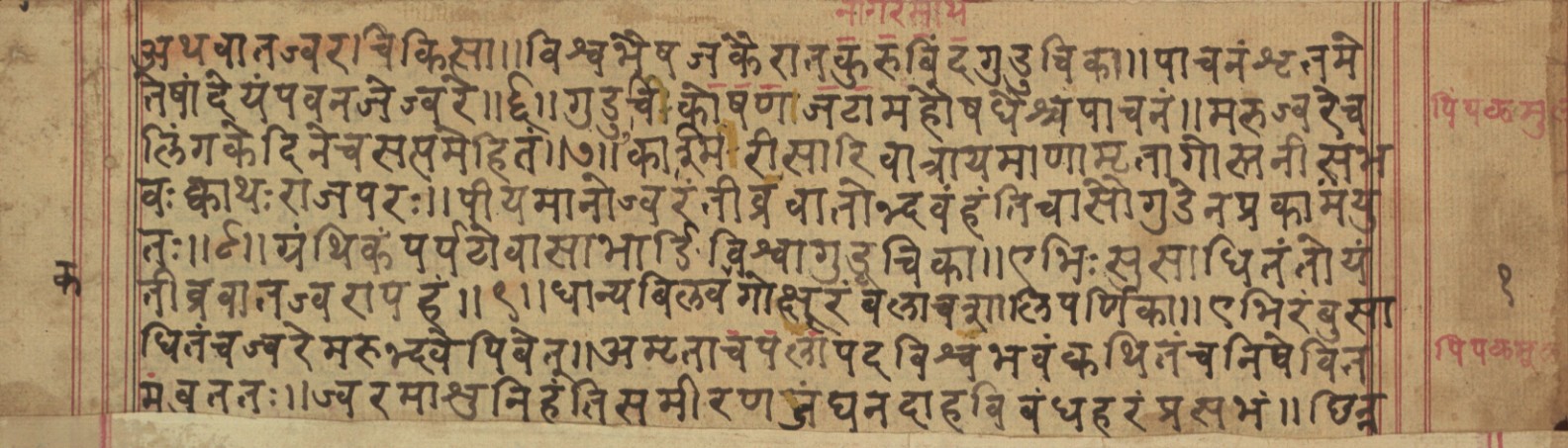
The Vaidyavilāsa — 'The Physician's Delight' — is a 50-folio fever manual by Raghunāthakavīśvara, preserved in the Poona University Collection. Its opening pages are a vāta-pitta-kapha fever formulary; its closing pages are something rarer — a diagnostic clinic, where the pulse moves like animals and a single drop of oil in urine tells you which doṣa is angry.
Fever, classified before it is treated
The formulary is organized by cause, and the decoctions are built accordingly. For vāta-born fever, the pācana (digestive) decoction is of viśvabheṣaja (ginger), kairāta, kuruvinda, and guḍūcī. For pitta fever, an astringent decoction from priyaṅgu pollen and dust, licked with sugar, "destroys thirst, burning, confusion, bleeding, and fever." Kapha fever gets water cooked with nīrada, viśva, dūrvā, ālambu, and vāsā. A sannipāta-fever decoction is assembled from daśamūla — bilva, agnimantha, śyonāka, pāṭalā, kāśmarī and the rest — "the ten roots... destroyers of sannipāta fever and fear."
Bilva, agnimantha, urubilva, kāśmarī, pāṭalā — thus the ten roots are to be known as destroyers of sannipāta fever and fear.
The pulse that moves like a snake
The diagnostic section is unforgettable. "The pulse assumes the movement of a snake and a leech in wind disorder; of a sparrow, frog, and crow in bile disorder; likewise of a pigeon, peacock, and swan, and also of a partridge. In phlegm disorder and in weakness, the pulse assumes the movement of a swan, quail, and partridge." The pulse in fever "is hot and swift." A whole animal menagerie, used to read three doṣas at the wrist.
One drop of oil reads the urine
Then comes the taila-bindu test. "Having risen in the morning, collecting urine in a vessel... taking a drop of oil with a straw, one should drop it there. In vāta [disorder], it spreads quickly; in pitta, it immediately appears golden in color; in kapha, it should be known as blue and bubble-like." If the drop forms a wheel-fragment, a hand-fragment, a circle, or a tortoise, the omens are read from the shapes. A human-shaped drop, a chariot, or two flies means a bhūta-doṣa — and the text prescribes the appropriate rite.
Taking a drop of oil with a straw, one should drop it there. In vāta, it spreads quickly; in pitta, it immediately appears golden in color; in kapha, it should be known as blue and bubble-like.
The weighing system behind every dose
The text closes with its metrology — the small weights that govern every prescription: four māṣas make a śāṇa, a dharaṇa and a śāṇa-niṣka are two ṭaṅkas, a kola is a small māṣa, six māṣakas make a gadyāṇa, ten a karṣa. The colophon even dates the work: composed by Raghunātha, "an ocean of charming works," in the month of Kārtika in the year of the bull-calf. A signed, dated, practical physician's manual — the delight of the title is earned.
Salutations to Śrī Gaṇeśa. Now begins the Vaidyavilāsa. I bow to the beautiful trunk, the fierce destroyer of demons, the elephant-faced one, whose cheeks are crowded with bees, who is the fragment of the dense mass of the moon, and the staff of the moving and unmoving worlds. Having seen this essence of yoga, which gives joy to the learned and quickly destroys the poison of bad speech, this Vaidyavilāsa is composed by the poet Rāghava for the virtuous. Whatever remedies have been experienced by hundreds of physicians, and which I too have obtained through their grace—those very treatments, previously employed by sages with great effort, I shall declare here.
Now begins the Vaidyavilāsa. I bow to the beautiful trunk, the fierce destroyer of demons, the elephant-faced one, whose cheeks are crowded with bees, who is the fragment of the dense mass of the moon, and the staff of the moving and unmoving worlds. Having seen this essence of yoga, which gives joy to the learned and quickly destroys the poison of bad speech, this Vaidyavilāsa is composed by the poet Rāghava for the virtuous. Whatever remedies have been experienced by hundreds of physicians, and which I too have obtained through their grace—those very treatments, previously employed by sages with great effort, I shall declare here. The physician who constantly ponders in his heart the causes of diseases, and who from the presence of true gurus constantly performs pure treatment of all diseases—he, the wise physician, attains supreme success.
I bow to the beautiful trunk, the fierce destroyer of demons, the elephant-faced one, whose cheeks are crowded with bees, who is the fragment of the dense mass of the moon, and the staff of the moving and unmoving worlds. Having seen this essence of yoga, which gives joy to the learned and quickly destroys the poison of bad speech, this Vaidyavilāsa is composed by the poet Rāghava for the virtuous. Whatever remedies have been experienced by hundreds of physicians, and which I too have obtained through their grace—those very treatments, previously employed by sages with great effort, I shall declare here. The physician who constantly ponders in his heart the causes of diseases, and who from the presence of true gurus constantly performs pure treatment of all diseases—he, the wise physician, attains supreme success. Fasting alone is beneficial for one afflicted with new fever; for that arising in the joints from the three humors, the physician Raghugada, the deer-slayer, here prescribes the Kuṃbhividāraṇa remedy.