
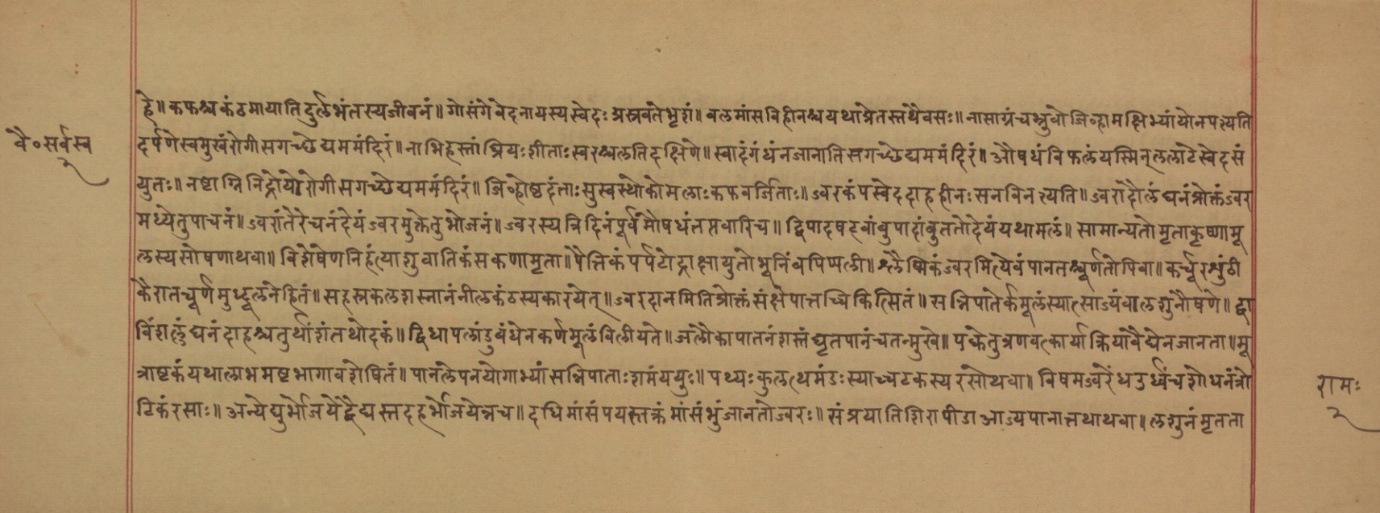
The Vaidyasarvasvagrantha — 'The Complete Compendium of Medicine' — by Manu, son of Lakṣmaṇa and grandson of Cakrapāṇi, is just five folios long. In a few pages it does what longer books take hundreds to do: diagnosis first, then fever, then the signs of death. Directness is its power. The opening is a motto every clinician would recognize: "First examine the disease, then afterward the medicine, then the act."
Diagnosis: pulse, urine, symptoms
The text expects physicians to know three diagnostic tools: nāḍī-parīkṣā (the pulse of Iḍā and Piṅgalā), mūtra-parīkṣā (the oil-drop test on urine), and praśna (questioning). The pulse on the left and right sides tells you which dosha is aggravated. Urine examined at dawn—spread on a white vessel in good light—shows you the state of the three doshas: white for kapha, yellow-black for pitta, black for vata, mixed colors for their combinations.
Kapha, pitta, and vata, which hold the body, move in sequence. The right and left nadis of swans, crows, etc., are full of blood, hot, heavy, and of samagni quality. In those with weak digestion and diminished dhatus, the nadi becomes slower.
But the text also teaches that disease does not fit into neat categories. A wise physician should not feel ashamed of not knowing the names of every modification: "For there is no fixed position of names for all modifications." What matters is understanding place, time, age, digestive fire, suitability, constitution, strength, and the specific nature of the disease itself.
The oil-drop test
The oil-drop test is described tersely because the physician reading this text already knows it. Urine collected in the Brahma muhurta (the auspicious early morning hour), placed in a white vessel, then a drop of oil placed upon it—the pattern that emerges tells the story. Spread out, the oil drops indicate vata. Split, it indicates pitta. Dense and slow-spreading, kapha. These signs are certain for vata, pitta, kapha, and their combinations. The text does not elaborate because elaboration is for students; this is a reference for practitioners.
Fever: three stages, three treatments
For fever, the text prescribes differently depending on the stage of the disease. At the beginning, fasting (langhana) is wholesome—let the digestive fire burn away the disease. In the middle of fever, digestion-promoting measures (pachana) are appropriate. At the end, purgation (virechana) is given. When the patient is freed from fever, food is reintroduced. But never—and the text is emphatic—never give food before the disease has fully passed.
At the beginning of fever, fasting is prescribed; in the middle of fever, digestion-promoting measures; at the end of fever, purgation should be given; when freed from fever, food.
Specific fevers require specific interventions. Vata-type fever is helped by Mritakrishna root or its dried form, combined with Karanja. Pitta-type fever responds to Parpata with grapes, Nimba, and Pippali. Kapha-type fever is treated differently again—with camphor and dried ginger powder. Sannipata fever, where all three doshas are vitiated, requires a more complex approach: Karnamula, Sarshapa, Leech application, and ghee drinking.
Signs of death: a physician must know them
But the Vaidyasarvasvagrantha is unflinching about limits. Not every disease is curable, and the physician must know which signs indicate the approach of death so that false hope is not given to the patient or family.
Phlegm rises to the throat, his life becomes difficult to sustain. Sweat flows profusely from the body due to pain. Devoid of strength and flesh, he is just like a corpse. He cannot see the tip of the nose, the eyebrows, or the tongue with his eyes. The sick person who sees his own face in a mirror goes to the abode of Yama.
A patient with cold extremities and navel, trembling voice, loss of taste and smell, and inability to feel pain—these are signs the physician must learn to recognize. A patient whose digestive fire is destroyed and who cannot sleep will also not recover. "Medicine becomes ineffective for one in whom sweat appears on the forehead."
Treatments: from basic principles to specifics
The text covers diseases throughout the body: diarrhea and grahani, piles and fistula, asthma and hiccup, skin diseases and eye troubles, ear and nasal conditions, headaches and hemiplegia, even possession by spirits and the effects of poison. For each, it names specific herbs, oils, preparations—but always in a terse style that assumes the reader already knows the basics and needs only to be reminded where to apply them.
In five folios, Manu distilled the essentials: how to diagnose, how to treat the foremost disease (fever), how to know when a patient cannot be saved. The text is a handbook for the working physician who cannot afford lengthy contemplation or elaborate exposition. It is still read that way today.