
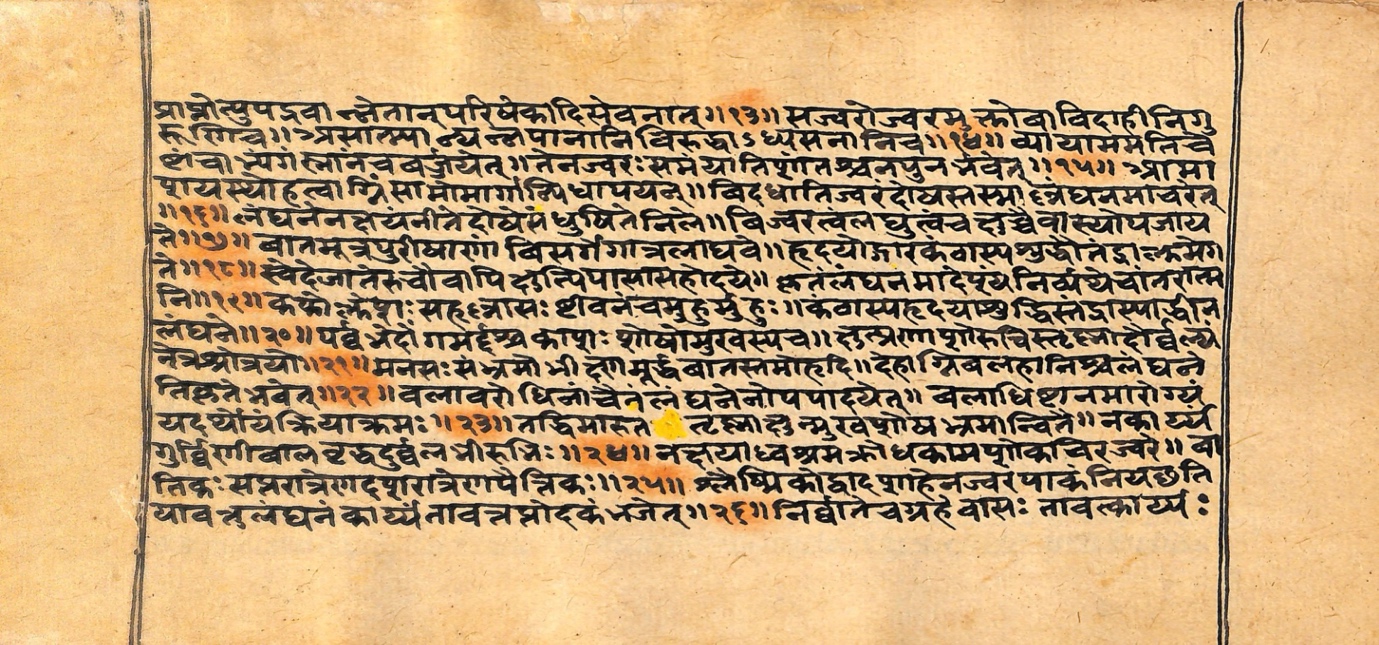
The Vaidyarahasyam — 'The Secret of Physicians' — is an 87-folio compendium by Vidyāpati, composed in 1698 and catalogued as number 23 in the Vishveshvaranand collection. Its table of contents alone is a census of medicine: fever, diarrhea, grahaṇī, hemorrhoids, worms, anemia, raktapitta, consumption, cough, hiccup, dyspnea, and 50 more, up to the modern-sounding phirangaroga, syphilis. But the therapy I keep thinking about is water — boiled down until it becomes medicine.
Water as a graded drug
The manuscript prescribes water in four strengths, each with a different action. Water reduced by a quarter "destroys pitta"; reduced by half "pacifies vāta"; reduced by three-fourths "destroys kapha, is astringent, promotes digestion, and is light." The remaining quarter is the prize: "The remaining one-fourth of water is called 'health-giving water' (arogyambu). Health-giving water is always wholesome, removes cough, dyspnea, and kapha; immediately alleviates fever, is constipating, digestive, and light; it stimulates the appetite and is the best of all waters."
Water deficient by one-fourth destroys pitta; deficient by half pacifies vāta. Deficient by three-fourths destroys kapha, is astringent, promotes digestion, and is light. The remaining one-fourth of water is called 'health-giving water' (arogyambu).
Fasting, timed by doṣa
Fever therapy begins with laṅghana, fasting. The reasoning is the classic one: the doṣa blocks the rasa channels and suppresses digestive fire, so reducing intake lets the fire rekindle. The fasting is timed — seven nights for vāta-type fever, ten for pitta, and the text is emphatic that "fever in a strong man disappears simply by fasting," while heavy food "is the greatest destroyer of fevers."
Fever in a strong man disappears simply by fasting. Whether with fever or fever-free, one should give light food at the end of the day. Heavy food at that time is the greatest destroyer of fevers.
A 64-disease formulary
From that austere beginning, the book expands into a full clinical manual. The fever section alone runs from pitta-jvara (kaṭukī paste with drakṣā and sugar) to sannipāta (a mercury pill of pārada, amṛta, gandhaka, nāga, and jātīphala). Diarrhea treatment leans on putapāka — pot-baked preparations — and a pomegranate pill "considered curative of chronic diarrhea." Later chapters take up gulma, plīha, heart disease, dysuria, aśmarī, prameha, swelling, goiter, wounds, fractures, and even the aphrodisiacs of the vājīkaraṇa section.
A century of exchange in one colophon
The manuscript's inclusion of phirangaroga (syphilis) and its date of 1698 place it in a moment of medical exchange, when Indian physicians were absorbing new diseases into the old doṣa framework. The text treats it as another chapter in the same system — with pastes of betel nut, turmeric, and lac, and triphala-ash with honey for its ulcers. That is the quiet radicalism of this book: nothing is outside medicine, and everything is classifiable. A text written in 1698 already knew that a physician's work is not fixed; it grows as the world does.
I came for arogyambu, the water boiled to a quarter; I stayed for the catalog of a 17th-century physician's whole world of disease.