
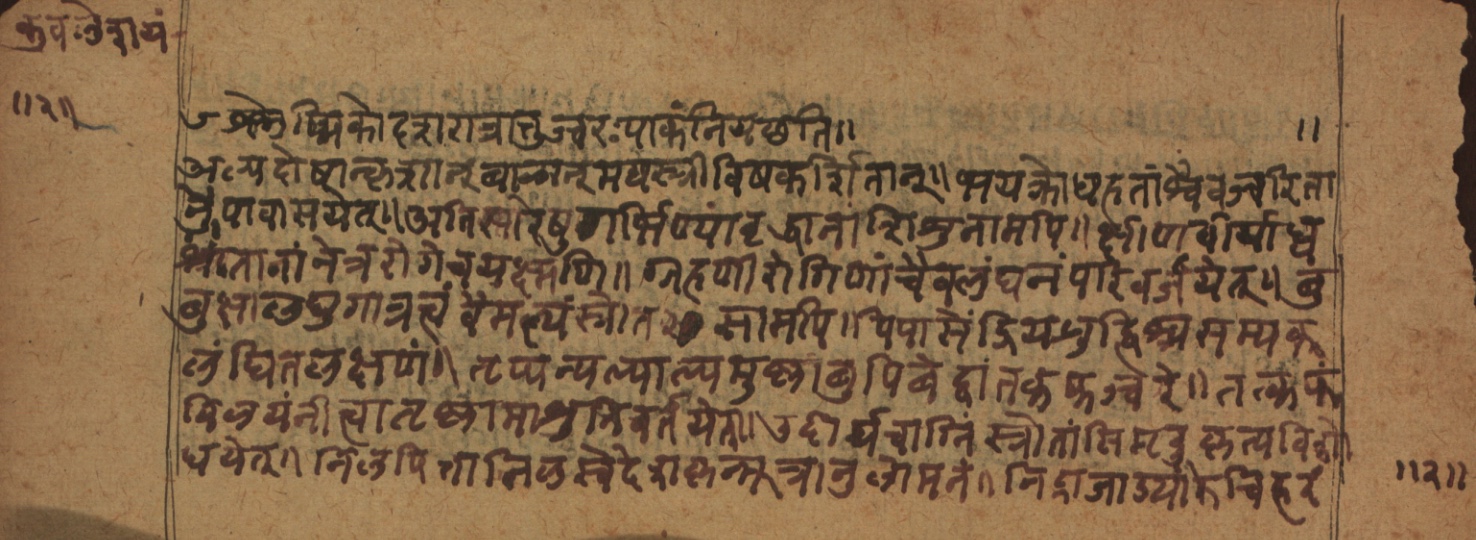
Fever is the one illness where classical Āyurveda says the first medicine is to eat nothing at all. A Vāgbhaṭa Cikitsāsthāna manuscript in the collection lays out the logic in careful steps — when to fast, when to switch to thin gruels, when medicine is finally safe — and the durations vary by doṣa.
Why fasting comes before medicine
The reasoning starts from what fever actually is: unripe doṣas blocking the channels. The text puts it bluntly: "Therefore, at the very onset, one should make the newly-fevered patient fast" — the idea being that undigested matter (āma) sits in the stomach, and feeding it only feeds the disease. Only after the doṣas have been 'cooked' by light therapy does real nourishment return.
Therefore at the very beginning one should make the one with new fever fast.
Seven days, ten days, fifteen — the doṣa clock
Fasting isn't open-ended; it's timed to the doṣa in charge. The manuscript gives a striking set of numbers: a vāta-type fever ripens in seven days, pitta in ten, kapha in fifteen. Matching that, it prescribes shorter fasts for vāta (three nights), less for pitta (one night), and longer for kapha (six or seven nights). Weak patients — children, the elderly, women, the emaciated — are explicitly exempted from heavy fasting. The text is precise: "Fasting should not be done in those with small doṣa, the thin, children, the elderly, women, those weakened by poison, those overcome by fear and disease, in diarrhea, in pregnant women, in those with cough and asthma, in those depleted in virility, in those oppressed by hunger, in eye disease, in consumption and grahaṇī disease."
The gruel ladder: peyā to vilepī
Once the fever softens, food returns by degree. The manuscript grades gruels precisely: a maṇḍa is rice-water without solids, peyā carries a few grains, yavāgū is thicker, and vilepī is nearly a porridge. Each is matched to the condition — a peyā cooked with bilva for fever with vomiting, one with sugar for pitta fever, lajā-peyā (toasted-rice gruel) for fever with thirst or diarrhea. Even the water ratio is specified: one pala of medicine and a prastha of rice simmered in an āḍhaka of water, reduced to a quarter.
At the start of fever, fasting is wholesome; in the middle, gruels; at the end, medicine is best; once freed of fever, purgation.
What to avoid, and when ghee becomes poison
The chapter is equally firm about don'ts: in new fever, no daytime sleep, no bathing, no oil massage, no sex, no grief, no wind, no exertion, and no astringent foods. And one warning stands out — milk in a fresh āma state is "like poison," while in a ripe, depleted fever the same ghee that was forbidden becomes nectar. The entire therapy is a timing problem: the identical substance is medicine or poison depending on the stage.
Reading this chapter, what struck me is how modern the staging sounds. It is not a single remedy but a sequence — depletion, digestion, nourishment, elimination — each step gated on signs like lightness of body and clarity of the senses. For a physician in the 19th century copying Vāgbhaṭa, this was the working protocol for the most common disease in the clinic.