
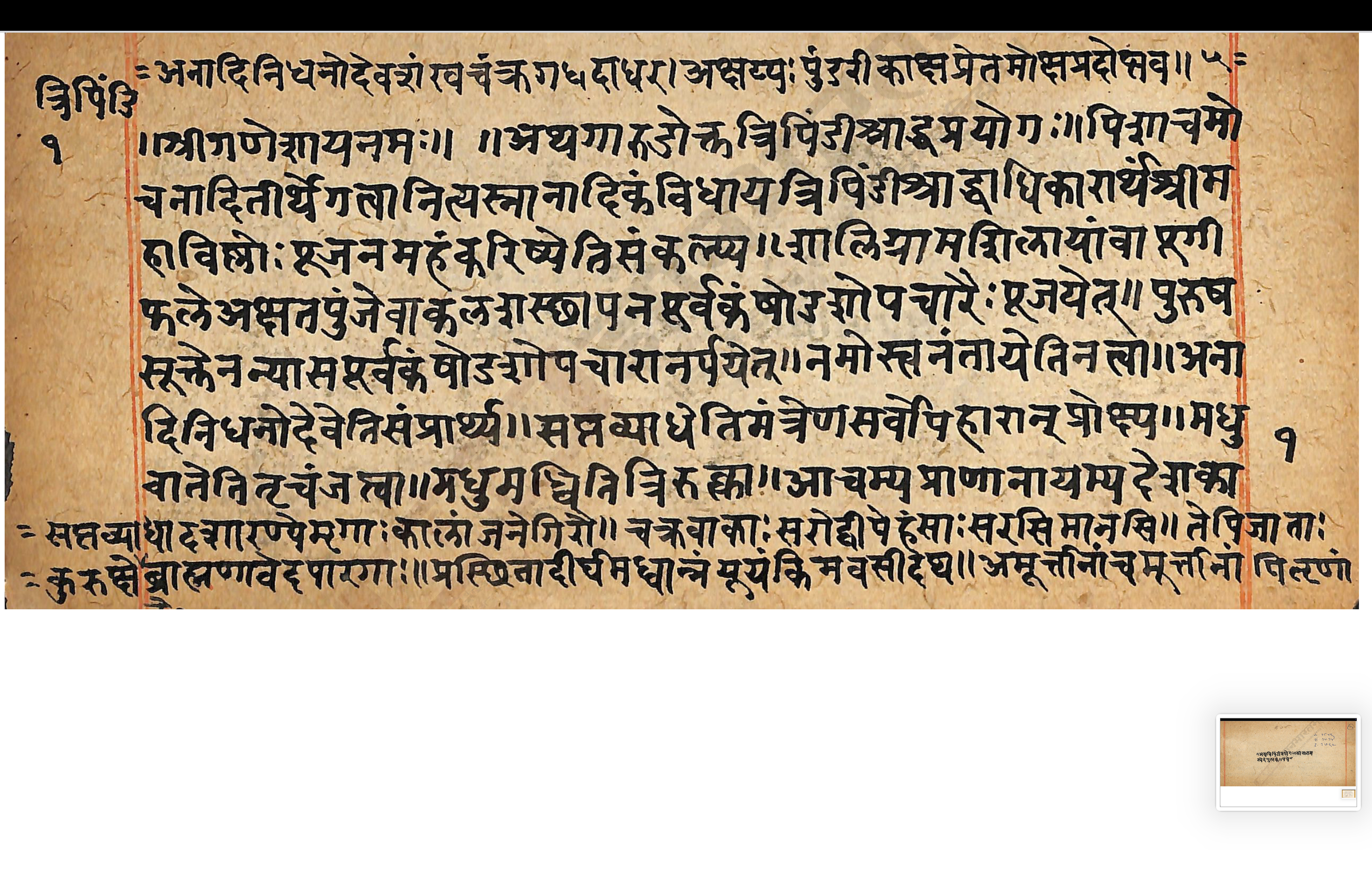
The śrāddha is the ritual that keeps the dead among the living — offerings of water and rice-balls (piṇḍas) that connect a family to its ancestors. The Tripiṇḍīśrāddhaprayoga, a ritual manual preserved at the Oriental Institute, Baroda, is a working text of that rite — from the three piṇḍas that give it its name to the Kṣipiṇḍī that opens it, and down to the very words to be spoken over each ball of rice.
The god without beginning or end
The text opens with its invocations — including the deity who presides over the ancestors — and immediately moves into the first rite.
The god without beginning or end, the destroyer of enemies, the bearer of the mace. Imperishable; lotus-seated, the lord of the departed, the indestructible. Salutations to Akṣigaṇeśa. Having approached, the Kṣipiṇḍī rite is to be performed. Having made the Piśāca, the eternal tīrtha of the throat, the beginning, and having established the Kṣipiṇḍī, the place, the authority to remove obstacles; having resolved 'I shall perform the great rite'.
The lord of the departed is invoked first — the rite cannot begin without him — and then the Kṣipiṇḍī, the preparatory offering, is established. The same page runs through the preparations: 'Having invited the noble and the immortal, or having made the eightfold offering with fruits, the pot, the bell, and the durva grass, one should worship with the proper materials.'
Words over the rice-balls
The heart of the manual is the piṇḍa offering itself, and here the text is wonderfully specific — it preserves the actual formulas to be recited as each ball is offered.
Then, taking the second ball of rice. 'May this be made for the cool, clear, radiant one.' 'For the god Aditi, for this departed one, may this ball of rice be made.' 'Those ancestors of mine who are known by little thought, by whom the ball of rice is offered, by that offering may they attain kingship.' 'Those departed ones who stand one by one, with the form of Śācī, by this ball of rice offered with the udāna breath, may they attain what is desired.'
The formulas move between address and wish: each ball is directed to a specific ancestor, and each carries a hope — kingship for the known, fulfillment for the departed, passage 'from the unoffered to the offered, from the unliberated to the liberated, from the unborn to the born.'
The three piṇḍas and the forgotten dead
The manual's namesake rite, the tripiṇḍī proper, is for a particular and poignant purpose: the appeasement of the dead who remain in the condition of preta — the wandering spirits of those whose rites may not have been completed.
Tripindi. May this oblation be offered to the ancestors named Anadiha, belonging to our family, for the appeasement of the great distress of those who are tormented by thirst, who are in the condition of preta (spirits of the dead), who are our relatives, makers of pinda offerings, who have passed away. Let this first pinda be offered. Thus the second and third pinda are offered.
The text attends to the ancestors whose names and gotras are unknown — the ajñāta-nāma-gotra — and to the various classes of the departed: the uncremated, the unbathed, the one-eyed beings of wind form in the intermediate space. The ritual's reach extends beyond the remembered dead to the forgotten ones, the 'unknown-named, the cow-knowing, the uncremated, the ten-organed' — the dead who have no one else to feed them.
Garments of the sages
Alongside the ritual mechanics, the manual preserves older lore about the orders of the twice-born — a passage that reads like a digest of traditional teaching on the outward marks of the different classes of sages.
The poet's garment is the bark. The royal sage's is the Kambu. The sage's is the skin. The twice-born should know this. The higher and the lower, the royal sages and the deceased, they do not enter darkness, they do not sink into the river.
Bark, conch, skin — the garment marks the vocation, and the assurance that the wise 'do not enter darkness' ties the domestic ritual back to the larger soteriology.
A book with a history
The manuscript is also a document of its own life. Its opening pages are a catalog entry — the accession number, the title variant Tripiṇḍīśākhāprayogaḥ — and its closing pages record a different kind of ownership.
Salutations to the illustrious Sita-Ramachandra. In the year 1889, on the 17th-18th of Rakesha (Ashvina), in the Paridhavi-Mambaka lake. This book belongs to the great Sita-Rama.
The śrāddha is the most family-centered ritual of the tradition — the act by which each generation honors the ones who came before. The Tripiṇḍīśrāddhaprayoga is its manual, and this copy is doubly a family document: a ritual for keeping the dead present, signed by a man who owned it in 1889 and kept it with his own gods. It is a reminder that the dharmashastra tradition was not only law and cosmology; it was also the patient craft of memory — the rite that makes the ancestors present, and the family continuous.