
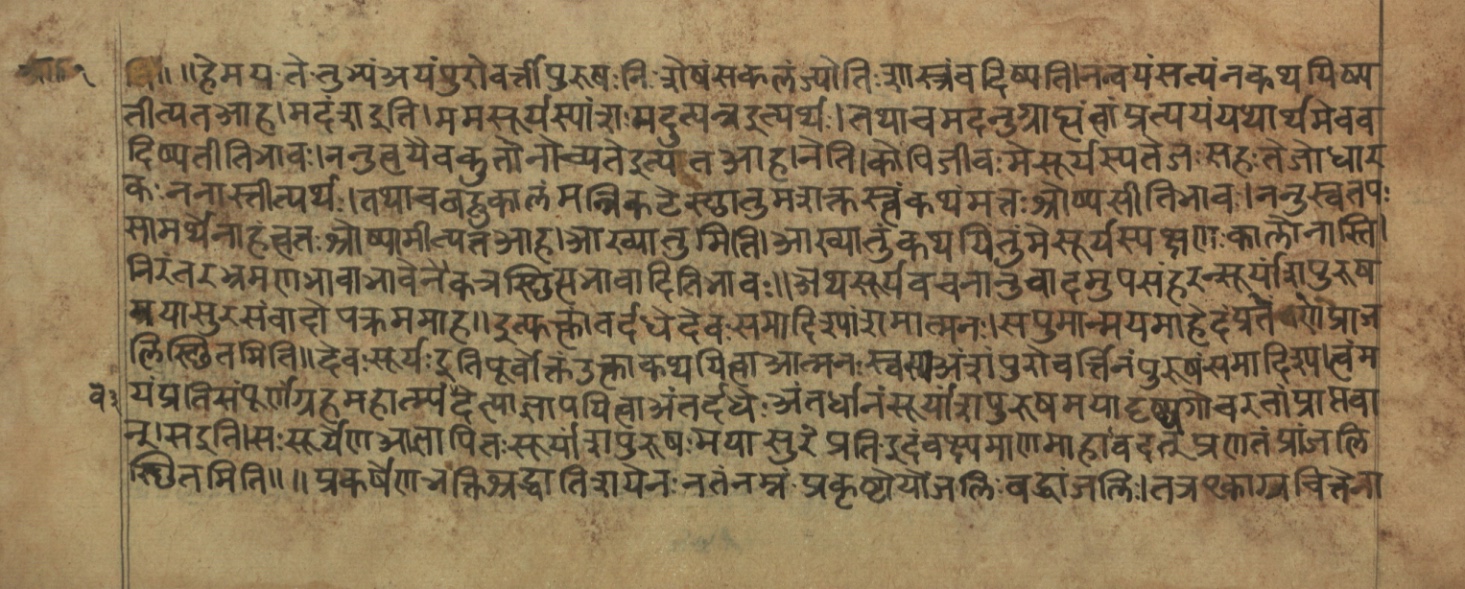
The Sūryasiddhānta is the foundational text of Indian mathematical astronomy — but its knowledge did not come from a sage or a school. It came, the tradition says, from the Sun himself, taught to the demon Maya. This second copy of the Sūryasiddhāntaudāharaṇa preserves the frame story in full, embedding the authority of the mathematics in a story of spiritual transmission.
The demon who wanted the sky
The story opens with an asura — not evil, but powerful, and outside the ordinary order of the world. This asura, the demon Maya, desires knowledge of astronomy, the supreme secret that governs the heavens. He performs impossible penance, standing on one foot with gaze turned inward, mind turned inward, devoted to the Sun god Vivasvat. For how long? The text hints: a demon's lifetime of devotion, a span of time immense by human measure.
One-fourth of the earth, measured from Lanka, is the Sālmala continent, upon which, with one foot placed northward, whose gaze is fixed within, whose mind is turned inward, whose deity is Vishnu, performing a vow, worshipping Vivasvat, the Sun — how did that great asura obtain knowledge? What kind of Jyotiṣa-astronomy? A supreme secret, most excellent, hidden, because it produces knowledge of planetary motions, eclipses, etc.
Astronomy is here a supreme secret — hidden, most excellent — and its secret is worth a demon's lifetime of austerity. The knowledge Maya seeks is not forbidden to him; it is only made difficult to attain, reserved for one who will pay the price in years of devotion. The story establishes from its opening that astronomical knowledge is not casual information but sacred science, requiring initiation, sacrifice, and the favor of the divine.
The Sun's solution
When the Sun appears to Maya, he cannot teach in person — his radiance would destroy any student, burn away the mortal form before the first theorem could be understood. His solution is an act of infinite compassion and infinite distance: delegation.
'O Maya, this man standing before you will speak to you the entire science of astronomy completely without remainder. But will he not speak the truth?' Therefore he says: 'My portion.' The meaning is: 'He is born of my portion, of the sun.' And thus, through my grace, he will speak everything with conviction exactly as it is. 'But why does He not speak Himself?' Therefore he says: 'No.' Some living being is capable of bearing my, the sun's, radiance; there is none — this is the meaning.
The Sun sends his own portion — a portion of himself that can stand before a mortal. It is a lovely image of transmission: the teacher too bright to be approached, sending a fragment of himself instead. The knowledge flows through an intermediary, a portion-of-the-sun, who bears the teaching with the authority of the whole. The teacher cannot be perceived directly; but the teacher's portion speaks the truth exactly, because it carries the Sun's grace.
Why the frame matters
The frame story is not decoration or mythology added after the fact. It establishes the authority of every number in the text — the Sūryasiddhānta claims divine origin, spoken by the Sun and carried to the world through a delegate. Every equation in the treatise inherits that authority. A student working through a lunar eclipse calculation is not solving a puzzle; he is following the Sun's own words, transmitted through Maya, to understand the cosmos as the Sun understands it.
This manuscript, a working copy of the examples with commentary, keeps the frame attached to the math: the sky's science, with its own origin story. Every commentary in the margins, every calculation worked out by a previous student, is part of a chain of transmission stretching back to the asura Maya and forward to each new student who picks up the text. The mathematics is sacred because its source is the light itself.