
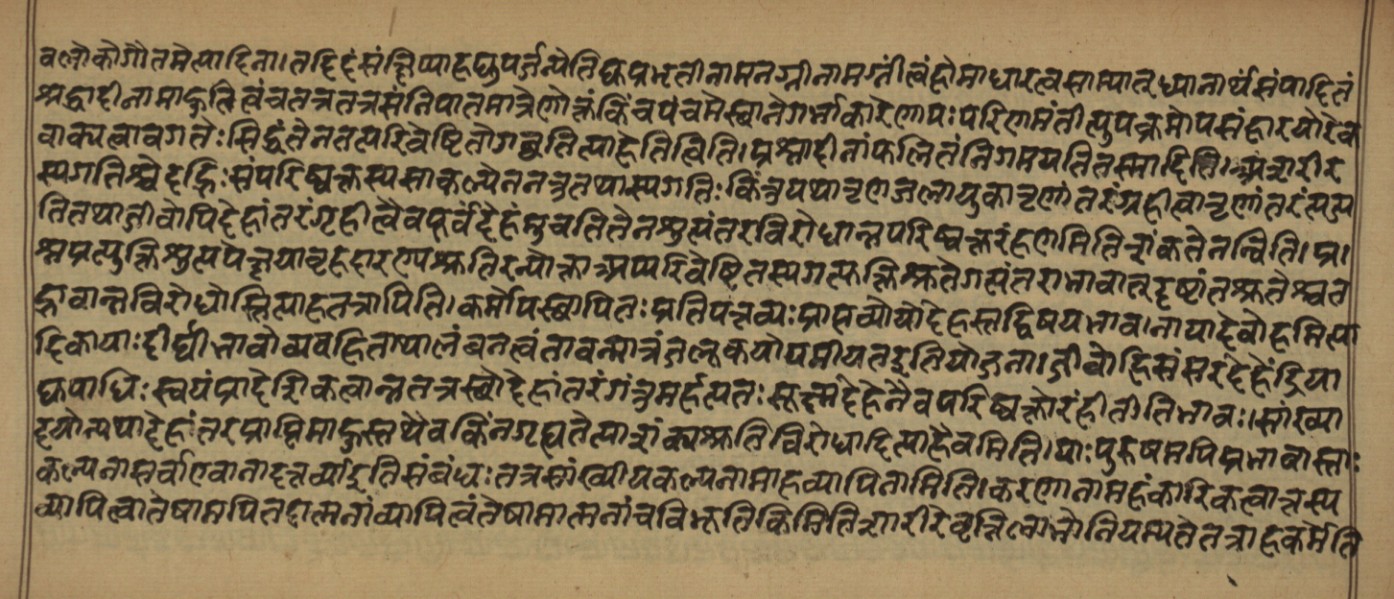
What happens between one body and the next? The Śārīrabhāṣyaṭīkā — a commentary in the Vedānta tradition on the science of the body — takes up exactly that question: the journey of the jīva, the soul, as it leaves one body and enters another.
The jīva in the interval
The text opens with the soul's equipment and its movement between births.
After determining the birth, etc., of the jīva, which is equipped with the subtle and gross elements as its instruments, in order to describe the manner of the jīva's transmigration, it goes together with that which embraces it at the beginning of another body — this is the purport; therefore, 'in the interval.'
The soul does not travel naked — it carries its subtle and gross elements as instruments, and it is joined by what embraces it at the threshold of the next body. The 'interval' between lives is itself a state to be described.
The sheaths of the body
The commentary works through the traditional anatomy of the person — the sheaths (kośas) that wrap the self.
The sheath of the vital airs and the rest are to be served. For that is indicated by the Sruti passages 'clinging together' and 'at the extremities of the Sruti.' Because the bodies are two, here and there, by mere association, the world alone is the agent of going around — not that the soul is enveloped by that.
A philosophy that follows the soul
At 307 pages, the Śārīrabhāṣyaṭīkā is a major commentary — the kind of text that worked through every question about the body and the soul with the tools of śruti and reasoning. Its subject is the deepest mystery of the tradition: what travels, what remains, and what happens in the interval between one body and the next.
When Brahman is approached, since there is no opportunity for chapter discussion by one who removes contradiction of śruti and reasoning, who is for the knowledge of truth, and in whom there is absence of invalidity of form—therefore the connection with that which possesses cause. To show the connection with the immediately following, he repeats what is employed there: 'in that.' And thus the investigation of the manner of transmigration of the jīva equipped with that descends—this is the remainder.
To show the connection with the immediately following, he repeats what is employed there: 'in that.' And thus the investigation of the manner of transmigration of the jīva equipped with that descends—this is the remainder. Now, dividing the verse into two pādas for convenience, he shows the third meaning: 'if.' For the sake of dispassion, having summarized 'beyond objects, beyond the void of objects,' the nature of transmigration, etc., as characteristic, the jīva as the object of the word 'thou,' and its different states, and the nature of Brahman as the object of the word 'that,' are to be determined—this is the meaning.
Now, dividing the verse into two pādas for convenience, he shows the third meaning: 'if.' For the sake of dispassion, having summarized 'beyond objects, beyond the void of objects,' the nature of transmigration, etc., as characteristic, the jīva as the object of the word 'thou,' and its different states, and the nature of Brahman as the object of the word 'that,' are to be determined—this is the meaning. He states the meaning of the third pāda: 'knowledge.' The knowledge of attributeless Brahman, which is to be summarized as repeated in all branches, where there is non-difference of knowledge in qualified meditation for qualified aspirants, and where there is no sublation of qualities—this is to be investigated.
The meaning is that this is certain because it is also the cause of the immediately preceding saṃskāra. Here too, 'āye' leads to 'saṃśṛti'—this is the meaning. Thinking that the refutation of the Lokāyatika view also belongs to the same context, he says 'prasaṅga'. Here too, in the meaning of the term 'āye-saṃjñā', 'saṃśṛti' is resorted to there—thus the fifth case. In the sacrifice, 'earth is the puruṣa'—seeing this, meditation is established, relying on the Pañcāgni-vidyā, the manner of experiencing the fruits of merit and demerit in saṃsāra is here determined.
Here too, 'āye' leads to 'saṃśṛti'—this is the meaning. Thinking that the refutation of the Lokāyatika view also belongs to the same context, he says 'prasaṅga'. Here too, in the meaning of the term 'āye-saṃjñā', 'saṃśṛti' is resorted to there—thus the fifth case. In the sacrifice, 'earth is the puruṣa'—seeing this, meditation is established, relying on the Pañcāgni-vidyā, the manner of experiencing the fruits of merit and demerit in saṃsāra is here determined. The scriptural introduction also merely shows that; its procedure is indicated by mention in connection.
Thinking that the refutation of the Lokāyatika view also belongs to the same context, he says 'prasaṅga'. Here too, in the meaning of the term 'āye-saṃjñā', 'saṃśṛti' is resorted to there—thus the fifth case. In the sacrifice, 'earth is the puruṣa'—seeing this, meditation is established, relying on the Pañcāgni-vidyā, the manner of experiencing the fruits of merit and demerit in saṃsāra is here determined. The scriptural introduction also merely shows that; its procedure is indicated by mention in connection. Here only the means to human ends should be determined—why then is the course of saṃsāra shown?